Industry
Humanoid Robots Beat Bolt, Then Hit the Wall
Robots at Beijing’s World Humanoid Robot Games are now faster than human track records, but the useful story is what the benchmark reveals about control, autonomy, and deployment limits.

Performance
Records are the headline; the test conditions are the story
Humanoid robots at Beijing's 2026 World Humanoid Robot Games crossed a public benchmark that recently sounded implausible: a 9.39-second 100-meter sprint, faster than Usain Bolt's 9.58-second human world record.
The more useful signal is the comparable data on speed, thermal limits, autonomy, resets, stopping behavior, and failure modes—not a simple human-versus-machine score.
Key Stats
9.39s
Robot 100m Time
38.15s
Robot 400m Time
2,056
Robots Entered
51
Events
Benchmark readout
The Headline Is Speed. The Story Is Measurement.
At the National Speed Skating Oval in Beijing, the 2026 World Humanoid Robot Games moved from spectacle into a more interesting category: public measurement. Reports from the first competition days say Tiangong Ultra, developed by the Beijing Humanoid Robot Innovation Center, ran the 100 meters in 9.39 seconds. Honor's Lightning robot reportedly finished the same heat in 9.47 seconds, and clocked 9.32 seconds in a pre-competition test.
Those numbers are why the clips went global. They also risk making the wrong point. A flat, prepared sprint lane is not a warehouse, a hospital, a home, or a disaster zone. It is a controlled locomotion benchmark. That is exactly why it is useful. It isolates speed, balance, gait control, actuator performance, battery output, and thermal management under repeatable conditions.
The viral detail after the 100-meter race was not only the time. It was the stopping problem. Several reports and clips described robots hitting padded barriers after the finish because they could not decelerate gracefully at race speed. That is not a punchline. It is engineering data. Fast bipedal motion is improving. Safe, elegant recovery after high-speed motion remains a separate control problem.
The 400-meter results sharpen the signal. Tech Times reported that Tiangong Ultra won the large-group 400 meters in 38.15 seconds, faster than Wayde van Niekerk's 43.03-second human world record. A different X-Humanoid machine, Tien Kung Omni, won a small-group 400-meter final in 45.66 seconds with an unusual running posture discovered during reinforcement-learning training.
Technical context
Beijing's robot records matter less as human-versus-machine theater than as a public stress test for control policies, thermal limits, autonomy rules, and how quickly teams can move from simulation to physical hardware.
Why the 400-Meter Posture Matters
The most important technical detail from the first half of the Games may be Tien Kung Omni's strange 400-meter running form. Engineers reportedly designed the robot around a human-like arm swing. In training, the robot settled on a different posture: arms held high near the face, torso pitched forward, hip and waist motion doing more of the work.
That behavior came from reinforcement learning, a training method where the robot is rewarded for completing a goal and allowed to discover a movement policy through many simulated trials. The reward did not need to say, "raise your arms." It only needed to reward a fast 400-meter result. The policy found that human-style arm swing was not the best match for the robot's body.
The reported reason is practical: shoulder joints heat up and consume energy during a sustained sprint. If the robot can reduce shoulder load and drive the stride through other joints, it may run faster over distance. That is physical AI doing what physical AI is supposed to do, finding a control strategy shaped by the machine's actual body instead of copying human motion because it looks familiar.
This is not magic, and it is not consciousness. It is optimization against a goal inside a model of physics. The step that matters is sim-to-real transfer. A posture found in simulation only counts if it survives contact with the real track, real actuator heat, real batteries, real latency, and real balance errors. According to the reports, the posture did survive on hardware.
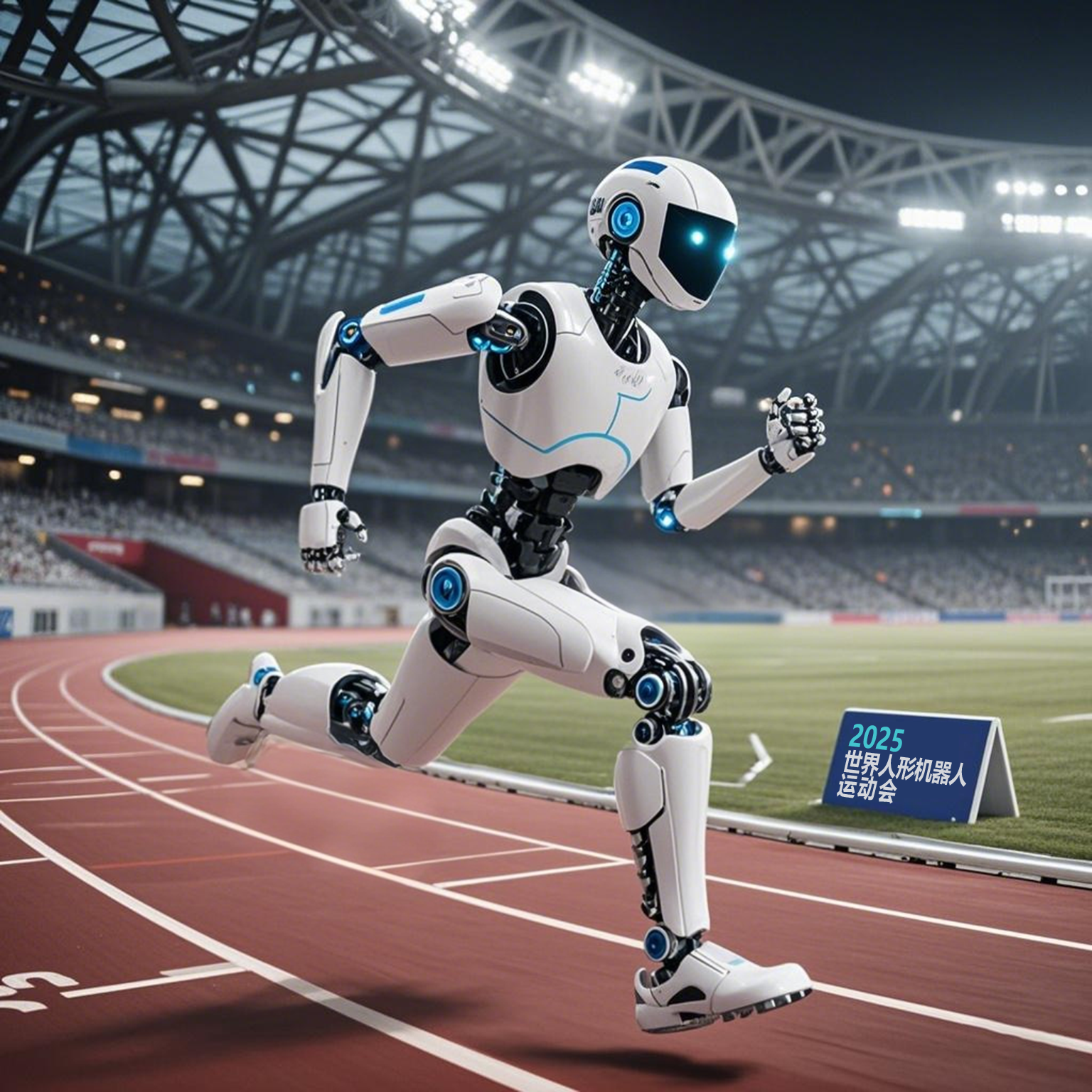
 AI-generated image
The strongest benchmark events expose the physics that demos can hide: heat, energy use, falls, resets, and control limits. Source: AI-generated editorial image.
| Benchmark | Reported Robot Result | What It Actually Tests |
|---|---|---|
| 100-meter sprint | Tiangong Ultra at 9.39 seconds | Explosive gait control, traction, balance, power output, braking limits |
| 400-meter large group | Tiangong Ultra at 38.15 seconds | Sustained locomotion, battery draw, thermal management, repeatable stride control |
| 400-meter small group | Tien Kung Omni at 45.66 seconds | Whether RL-trained gaits can survive on physical hardware |
| Standing high jump | Reported 2.88-meter robot jump | Peak actuator force, structure, balance recovery, landing tolerance |
| Scenario tasks | Factory, hotel, hospital, home, retail, emergency tracks | Closest proxy for practical work, if autonomy levels are disclosed |
Autonomy Rules Are the Real Scoreboard
The Games are large enough to be noisy. They include athletics, table tennis, fighting, dancesport, scenario tasks, and public ceremony. The most valuable feature is the rule structure. Some events require full autonomy. Others permit teleoperation. Scenario events appear to reward autonomous completion more heavily than operator-assisted completion.
That matters because humanoid robotics has a measurement problem. A robot doing a task in a video may be autonomous, scripted, remotely operated, supervised, or rescued off camera. Buyers rarely know which. Public rules that separate autonomous execution from teleoperated completion help expose the difference.
Flat-ground sprinting is now much less mysterious than full workplace autonomy. A robot can run fast on a track and still struggle with a cable on the floor, an object placed at the wrong angle, a slippery surface, a missed grasp, a human stepping into its path, or a task sequence it has never seen. That is why the scenario tracks matter more than medal clips.
The reported scenario environments include factory assembly, hotel service, emergency response, hospital care, home tasks, and retail. These are not proof of deployment, but they are closer to the world customers care about. The useful questions are direct: how much teleoperation was allowed, how many attempts were needed, what counted as failure, how many objects varied, and how many human interventions occurred?
Locomotion
Track races show speed and balance, but prepared surfaces hide many deployment hazards.
Manipulation
Factory and service tasks reveal whether hands, perception, and force control can produce useful work.
Autonomy
The clearest signal is whether robots complete tasks without human operators making the hard decisions.
China's Advantage Is Not Just Fast Robots
HumanoidHub summarized the event scale as more than 2,000 robots, 666 teams, 16 countries, 51 events, and 1,301 individual competitions. Those numbers matter because physical AI improves through data, failures, iteration, and cheap access to hardware.
China's robotics ecosystem can put a large field of companies, university teams, suppliers, and research labs into one venue. That creates an iteration surface. Robots break in front of peers. Teams copy useful techniques. Suppliers see which components fail. Local officials see which tasks might translate into standards. Startups get visibility. Students get hardware practice.
The United States still has world-class robotics labs and several of the most closely watched humanoid companies. Europe has industrial automation depth and strong safety culture. Japan and South Korea have decades of robotics expertise. What Beijing is showing is different: the ability to turn humanoid robotics into a mass public benchmark with policy support, manufacturing depth, and a large domestic audience.
That does not automatically convert into exportable commercial leadership. Procurement teams still need to weigh security, maintenance, certification, software support, supply-chain risk, and regulatory fit. The FCC's recent scrutiny of foreign-made advanced robotic devices is part of that context. Performance and trust will both shape who can sell into factories, warehouses, hospitals, and public infrastructure.
 AI-generated image
The robotics race is increasingly about measurement infrastructure as much as individual machines. Source: AI-generated editorial image.
What Buyers Should Take From the Records
The first takeaway is that humanoid locomotion is improving quickly on prepared surfaces. The gap between last year's event and this year's sprint records is large enough to treat as real progress, even if exact comparisons depend on event rules, hardware class, and timing methods. Robots are getting faster, more dynamic, and more tolerant of aggressive control policies.
The second takeaway is that speed does not equal deployability. A factory buyer does not need a humanoid that can outrun a sprinter. It needs a machine that can complete useful tasks, avoid people, recover from small errors, run long enough to matter, and produce predictable economics. The stopping failures after the sprint are a reminder that deployment is full of secondary problems.
The third takeaway is that reinforcement-learning policies will become more important and more controversial. Robots that discover non-human movement strategies may outperform human-designed gaits. They may also be harder to explain, certify, and constrain. The policy that wins a race is not automatically the policy an insurer wants near workers.
The fourth takeaway is that autonomy disclosure should become standard. Every robotics benchmark, demo, and pilot should state whether the robot was autonomous, teleoperated, supervised, scripted, or restarted. Without that information, performance claims are incomplete.
Procurement Checklist After a Benchmark Claim
• Ask for the exact autonomy level used during the task.
• Request reset counts, failed attempts, and intervention logs.
• Separate peak performance from sustained shift performance.
• Check whether the task used fixed props or varied objects.
• Require safety documentation before any human-adjacent pilot.
Frequently Asked Questions
Did a humanoid robot really beat Usain Bolt's 100-meter record?
Reports from the 2026 World Humanoid Robot Games say Tiangong Ultra ran 100 meters in 9.39 seconds, faster than Bolt's 9.58-second human world record. Honor's Lightning robot reportedly ran 9.47 seconds in the same heat.
Does that mean humanoid robots are ready for factories?
No. A sprint proves a specific locomotion capability on a prepared surface. Factory readiness depends on manipulation, safety, uptime, integration, maintenance, and error recovery.
Why is the 400-meter reinforcement-learning story important?
It suggests that robot control policies can discover non-human movement strategies that better match their hardware. In this case, the reported posture reduced shoulder load and helped the robot sustain speed.
What should observers watch next at the Games?
The scenario tasks matter most: factory assembly, hotel service, hospital care, home tasks, retail, and emergency response. They are closer to deployment needs than pure athletics, especially if autonomy levels and failures are disclosed.
The 12-Month Outlook
The next step is not another highlight clip. It is a cleaner public results archive. If organizers publish completion rates, reset counts, failure categories, autonomy levels, task times, and hardware breakdowns, the Games could become one of the field's most useful annual benchmarks.
The same pressure should move into commercial pilots. A customer should not accept a demo video as proof. It should ask for the same basic evidence the Games can expose: what was autonomous, what failed, how often humans intervened, how long the robot ran, and what changed between attempts.
The Beijing records are real progress, but the durable story is more practical. Humanoid robots are getting fast enough that speed is no longer the only question. Now the hard questions are stopping, working, recovering, and proving that performance can survive outside the lane.
The Bottom Line: The 2026 World Humanoid Robot Games show that bipedal locomotion is advancing fast. They also show why robotics needs better public measurement before anyone confuses a record sprint with a reliable worker.