Humanoid Robots
Booster T2 Turns the Developer Humanoid Race Toward Practical Specs
Booster Robotics' T2 gives the developer humanoid market a concrete spec sheet at a moment when labs need robots they can actually train, repair, and instrument.

Booster Robotics has put fresh attention on its Booster T2, a compact developer humanoid listed at about 140 centimeters tall, 42 to 43 kilograms, and 31 degrees of freedom. The company is not pitching T2 as a warehouse labor replacement on day one. It is selling a body for teams that need to train, test, and iterate on embodied AI in the real world.
That makes T2 timely. The humanoid market has spent 2026 arguing about factory deployments, home robots, safety policy, and robot foundation models. Under that debate sits a simpler bottleneck: developers need accessible machines with enough payload, sensing, and compute to run experiments outside polished demo scripts. T2 is a useful marker for that middle layer, below the billion-dollar industrial programs and above the toy-grade desktop robot.
Key Stats
140 cm
Standing height
31
Total degrees of freedom
10 kg
Claimed dual-arm payload
2 m/s
Listed walking speed
Why T2 Matters Now
The news value in T2 is not that another humanoid can walk across a stage. The industry has plenty of that. The more important signal is that Booster is packaging a research-grade humanoid as a developer product, with published specs, optional end effectors, onboard compute, common connectivity, and an open platform message. For robotics labs, that is the difference between watching humanoid progress and participating in it.
Booster's product page describes T2 as a flagship embodied development platform. That phrase is doing work. It says the customer is not only an end user who wants a robot to move boxes. The customer is a university lab, a robotics startup, a corporate research group, a competition team, or a developer building perception and control software. Those buyers care about repeatability, sensor access, policy deployment, documentation, and hardware that can survive many failed experiments.
The timing lines up with a broader shift in physical AI. Google DeepMind, NVIDIA, Figure, Apptronik, Agility, 1X, and Chinese humanoid vendors are all pushing the idea that robot intelligence will improve through more real-world data and better policy learning. That creates demand for platforms that can collect data, run policies locally, recover from errors, and be repaired without a factory reset every time a control experiment goes wrong.
T2 also lands in a category where size matters. At roughly 140 centimeters and about 42 to 43 kilograms, it is smaller than many adult-scale industrial humanoids. That can limit some heavy work, but it can also make the platform easier for labs to store, transport, test, and supervise. A compact robot that can walk, perceive, carry modest loads, and support dexterous options is often more useful for researchers than a taller machine that is too expensive or risky to run every day.
Target Buyer
Developers, universities, research labs, and competitive robotics teams.
Core Bet
Useful humanoid progress needs shared hardware platforms, not only custom in-house robots.
Open Question
Price, uptime, repair flow, and software access will decide whether T2 becomes a lab standard.
The Hardware Story
Booster lists three Professional configurations for T2. The shared baseline is clear: standing height near 1.4 meters, weight near 42 to 43 kilograms, 31 total degrees of freedom, six degrees of freedom per leg, seven per arm, three at the waist, and two at the head. The robot uses industrial-grade crossed roller bearings at the joint output and high-speed internal-rotor permanent magnet synchronous motors. Booster lists maximum peak torque at 140 newton-meters.
Those numbers put T2 in a practical developer bracket. It is not trying to be the strongest general-purpose labor robot in the market. It is trying to be capable enough for whole-body motion, manipulation research, perception work, and scenario exploration. The claimed 10 kilogram maximum dual-arm payload is useful, but Booster notes that actual payload depends heavily on arm posture. That caveat is important because payload claims can mislead buyers when they are not tied to reach, speed, duty cycle, and center of mass.
The end-effector options matter as much as the leg specs. Booster lists optional end effectors across configurations, including a gripper and a 6-DOF dexterous hand. That gives developers a path to choose between simpler grasping and more complex manipulation. For many labs, a sturdy gripper is enough for early manipulation work. Dexterous hands become more important when the research question involves tool use, in-hand adjustment, contact-rich tasks, or imitation learning from human demonstrations.
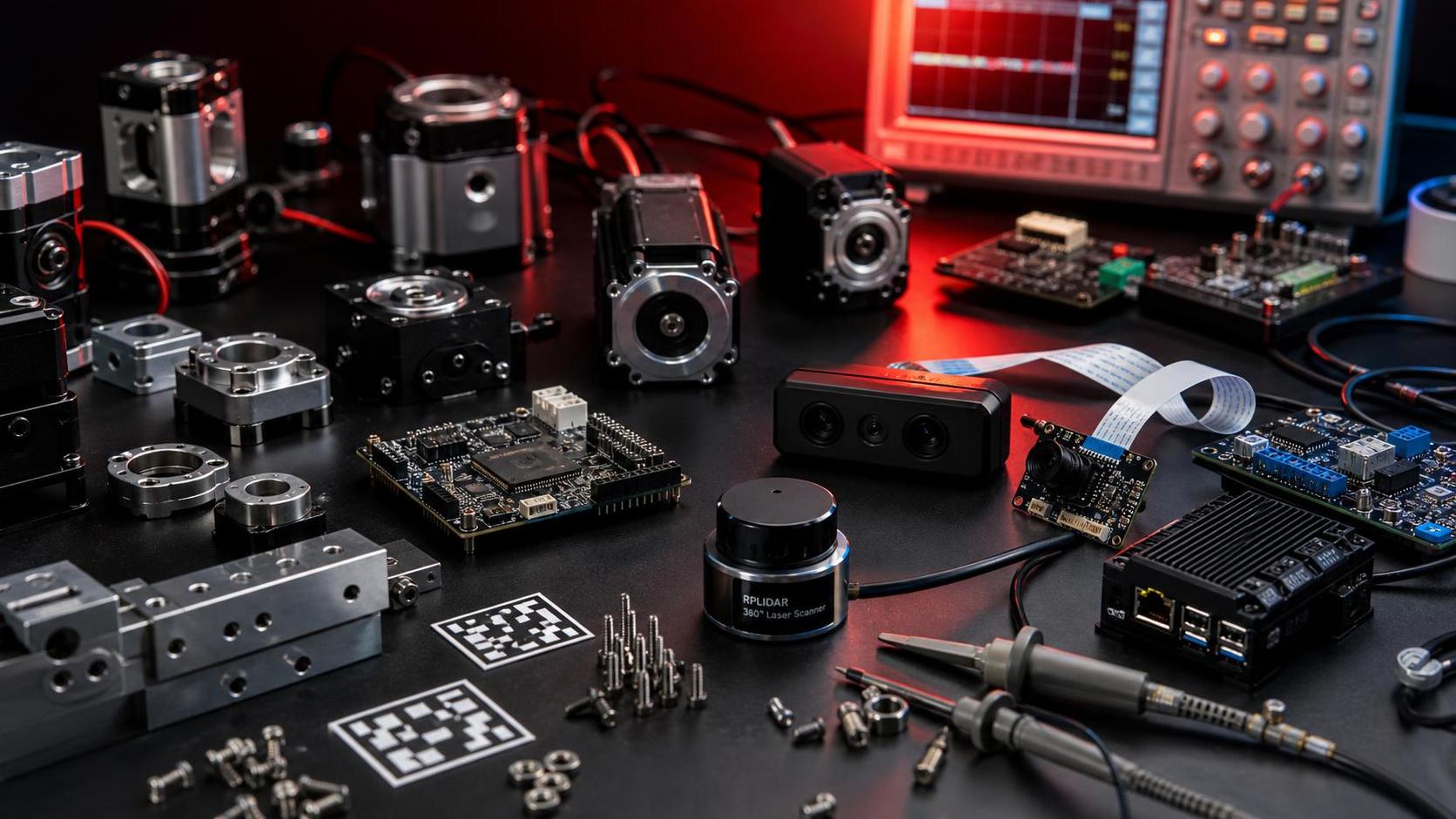
The sensing stack is also aimed at real experiments. T2 lists binocular cameras in the head and waist, optional wrist cameras, optional LiDAR, microphone array and speaker support, Wi-Fi 6, Bluetooth 5.2, Ethernet, USB, locking Type-C, and external power. That is not glamorous, but it is exactly the kind of detail that matters when a robot has to run in a lab full of calibration targets, motion capture gear, external computers, debugging cables, and safety observers.
 AI-generated image
Developer humanoids depend on sensors, compute, cables, and test infrastructure as much as visible motion. Source: Biped.News
| Spec | Booster T2 | Why It Matters |
|---|---|---|
| Height | About 140 centimeters | Compact enough for lab operation while still supporting whole-body research. |
| Weight | About 42 to 43 kilograms | Lower than many adult-scale humanoids, reducing handling and safety burden. |
| Degrees of freedom | 31 total, excluding optional hand details | Enough articulation for locomotion, reaching, waist motion, and head perception. |
| Walking endurance | 2 hours listed for continuous walking | Useful for repeated experiments, though real task endurance will vary. |
| Walking speed | 2 meters per second | Fast enough for dynamic locomotion research, subject to environment and policy limits. |
Editorial Read
T2 is best understood as a developer platform, not a deployment proof point. The product becomes more important if Booster can pair the body with strong tooling, clear documentation, spare parts, and a community of repeat users.
Why Developer Platforms Decide Physical AI
Humanoid robotics has a data problem. A robot policy trained only on simulation will usually fail when friction, cable routing, backlash, lighting, battery sag, surface changes, and human clutter appear. A robot trained only from human video has to cross a morphology gap because human joints, hands, mass distribution, and balance are not robot joints, hands, mass distribution, and balance. A robot trained only in one lab can overfit to that lab. Developer platforms are one way to widen the feedback loop.
Booster's own research helps explain the point. A 2026 paper from Booster-affiliated authors describes Booster Lab, a data-centric pipeline for deployable humanoid locomotion policies. The paper frames the hard part clearly: motion learning needs behavior that is both natural and physically feasible for the robot. It combines motion data curation, real-to-sim model adaptation, adversarial motion prior reinforcement learning, and sim-to-real deployment. The authors validated the framework on Booster T1 and reported preliminary cross-platform validation on Booster K1.
A previous Booster Gym paper made a similar case from the tooling side. It described an end-to-end reinforcement learning framework for humanoid locomotion, with domain randomization, reward design, training infrastructure, and deployment steps. The authors said trained policies transferred to the Booster T1 platform for omnidirectional walking, disturbance resistance, and terrain adaptability. That matters because a product like T2 is only as useful as the learning pipeline around it.
The strongest developer platforms in robotics often become more valuable because of their software ecosystems. Robot Operating System support, simulation assets, controller examples, calibration utilities, log tools, and community code can turn a piece of hardware into a shared research reference. Booster is already leaning into that idea with documentation, open-source links, Booster Studio, a Booster App, and an Agent Store. The open question is how mature those pieces are for teams outside Booster's own demos.
The China Factor
T2 also sits inside the wider China humanoid supply story. Chinese robotics companies have been moving quickly on lower-cost bodies, public demonstrations, developer kits, and industrial partnerships. That speed is putting pressure on U.S., European, Japanese, and Korean teams. A lab that can buy a capable platform sooner gets more time collecting data, testing policies, breaking parts, and finding the failure modes that marketing videos skip.
There is a policy shadow over this, especially in the United States. Recent U.S. scrutiny of foreign-produced robots shows that humanoids are no longer treated as neutral gadgets. Cameras, microphones, navigation systems, wireless links, and autonomous movement turn robots into cybersecurity and supply-chain questions. That does not make every foreign robot unsafe, but it does mean buyers will ask harder questions about data handling, firmware updates, cloud dependencies, and where sensitive deployments can legally use imported platforms.
For universities and developers, the calculation may be different than for defense contractors or critical infrastructure operators. A research lab may care most about price, openness, and hardware access. A factory running production workloads may care more about support, liability, uptime guarantees, and procurement restrictions. T2's initial center of gravity looks closer to the lab and developer side, where fast iteration can matter more than enterprise certification.
 AI-generated image
The next useful humanoid platforms will be judged in repeatable test spaces, not only launch videos. Source: Biped.News
What To Watch Next
The first thing to watch is pricing and availability. A developer platform can have excellent specs and still miss the market if it is too expensive, hard to source, or slow to repair. Public pricing, lead times, warranty terms, spare-part catalogs, and regional support will tell buyers more than another demo reel.
The second thing is software access. Developers will want to know how much of the stack they can control. Can they run their own locomotion policies? Can they access camera, joint, torque, and IMU data cleanly? Can they simulate the exact robot configuration? Can they recover safely from bad policies? Can they log failures in a format that helps training rather than just debugging?
The third thing is durability. Labs are hard on robots. A useful humanoid platform will fall, overheat, drift, miss grasps, collide with fixtures, and endure thousands of test cycles. The winner is not always the robot with the flashiest first demo. It is often the robot that can be reset, repaired, and run again tomorrow.
Booster T2 is not proof that general-purpose humanoids are ready for mass deployment. It is a sign that the developer layer is getting more serious. That layer matters because the real physical AI breakthroughs will need thousands of mundane experiments before they look obvious in public.
FAQ
What is Booster T2?
Booster T2 is a bipedal humanoid robot from Booster Robotics, positioned as a flagship embodied AI development platform for developers, labs, education, research, and robotics competitions.
How big is Booster T2?
Booster lists T2 at about 140 centimeters tall and about 42 to 43 kilograms depending on version and optional configuration.
How many degrees of freedom does T2 have?
The listed body has 31 total degrees of freedom: six per leg, seven per arm, three at the waist, and two at the head. One configuration also supports 6-DOF dexterous hands.
Is this a factory deployment?
No. The current signal is a developer and research platform, not a named customer production rollout. Deployment claims should be judged separately from the product spec sheet.
Bottom Line
Booster T2 is compelling because it points at the part of humanoid robotics that usually gets less attention: the platforms developers use to make the next demos less fragile. Its 140 centimeter body, 31 degrees of freedom, optional hands, onboard compute, binocular vision, and 2-hour walking claim give labs a concrete machine to evaluate. The hard questions now are not about whether it can look good on video. They are about price, support, uptime, safety tooling, software openness, and whether outside teams can use T2 to produce repeatable progress.