Companies
FOURIER: The Humanoid Robot Company That Started With Exoskeletons
FOURIER (formerly Fourier Intelligence) is a Shanghai-based robotics company that started with medical exoskeletons and evolved into one of China's most-funded humanoid robot developers. The GR-2, launched in September 2024, packs 53 degrees of freedom into a 63 kg frame. Here's the full picture.

FOURIER (formerly Fourier Intelligence) spent its first years building exoskeletons for stroke rehabilitation clinics. That turned out to be an unusual training ground for humanoid robotics. The Shanghai company now has the GR-2, a 175 cm, 63 kg bipedal robot with 53 degrees of freedom and 12-DoF dexterous hands packed with tactile sensors.
Founded in 2015 and rebranded in summer 2024, FOURIER has raised roughly $246 million across multiple rounds, with backing from SoftBank Investment Advisers and Prosperity7 Ventures, the VC arm of Saudi Aramco. The company employs around 500 people and ships products across healthcare, manufacturing, and academic research markets.
 AI-generated image
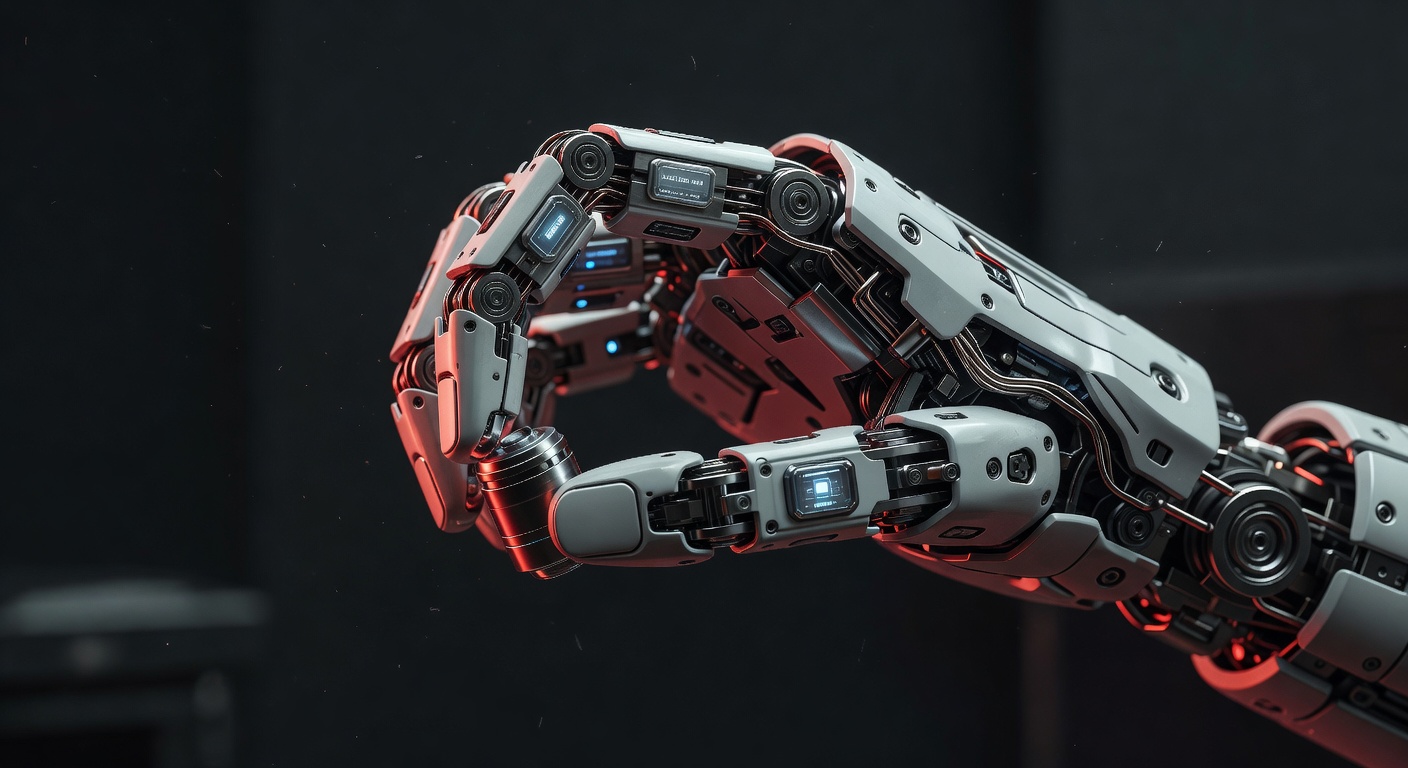
Humanoid robot dexterous hand system. FOURIER's 12-DoF hand includes 6 array-type tactile sensors per hand.
Key Stats
$246M
Total Funding
53 DoF
GR-2 Degrees of Freedom
175 cm
GR-2 Height
~500
Employees (2025)
The Exoskeleton Origins
Most humanoid robot companies arrive from robotics research labs, automotive engineering, or defense contracts. FOURIER's path was different: the company started by helping stroke patients walk again.
Founded in 2015 by a team out of Shanghai, Fourier Intelligence's first product lines were powered lower-limb exoskeletons for neurological rehabilitation. The company built the ExoMotus and later the MetaMotus Galileo platform, devices worn over a patient's legs that support gait retraining after stroke, spinal injury, or neurological damage. These products shipped into clinical rehabilitation centers across China, Europe, and Southeast Asia.
That work forced the engineering team to develop a precise model of human biomechanics. Designing an exoskeleton that works alongside a partially impaired human limb is harder than building one for a healthy person. The control systems have to compensate for irregular torque, anticipate intent from partial muscle signals, and maintain stability without rigid coupling to a predictable load. Those constraints shaped how the team approached actuator design, sensor fusion, and control algorithms -- skills that transferred directly into bipedal humanoid development.
By the early 2020s, the company was making a deliberate pivot. Rehabilitation robotics was proven and commercially viable, but the humanoid opportunity was scaling fast. In 2022, Fourier Intelligence closed a Series D round of RMB 400 million (approximately $62 million), led by SoftBank Investment Advisers and Prosperity7 Ventures. The round funded the expansion into general-purpose humanoid robots.
Rehabilitation Roots: Why It Matters
• Human biomechanics expertise: Years of exoskeleton development gave the team a detailed model of human joint dynamics, gait patterns, and compliance requirements.
• Actuator precision: Clinical rehab requires force control accurate enough to assist without injuring patients. That level of precision feeds directly into humanoid manipulation tasks.
• Regulatory experience: Shipping medical devices into EU and Chinese clinical markets means the company understands regulatory quality management -- relevant as humanoids move into safety-sensitive environments.
• Existing revenue base: Rehabilitation products provide ongoing commercial revenue, which partially funds humanoid R&D without total dependence on VC timelines.
The GR Series: From GR-1 to GR-3
FOURIER released its first humanoid robot, the GR-1, in 2023. At 163 cm tall and 55 kg, GR-1 had 44 degrees of freedom and demonstrated bipedal walking with basic manipulation. It was a research and demonstration platform, not a commercial product, and the company was transparent about treating it as a testbed.
The follow-on, GR-2, launched in late September 2024. The changes were substantial. Height went up to 175 cm (5 ft 9 in), weight to 63 kg. Total degrees of freedom expanded to 53 across the full body. The hands got a significant upgrade: 12 DoF per hand, with 6 array-type tactile sensors embedded in the fingertips and palm. Payload capacity is 3 kg per arm. The torso gained rotation capability, which unlocks a wider range of manipulation tasks that require coordinated whole-body motion.
FOURIER positions GR-2 for two primary markets. In healthcare, the robot can assist with patient mobility and clinical tasks in supervised environments. In industrial productivity, it targets structured pick-and-place, light assembly, and quality inspection workflows. The company is also actively engaging academic and corporate research labs through its Fourier Nexus platform, which provides SDK access, simulation environments, and a developer ecosystem designed to accelerate third-party application development.
GR-1 (2023)
163 cm / 55 kg / 44 DoF. First-generation platform, focused on walking demonstrations and research applications. Laid the foundation for the GR-2 control architecture.
GR-2 (September 2024)
175 cm / 63 kg / 53 DoF. Dexterous 12-DoF hands with tactile sensors. 3 kg payload per arm. Healthcare and productivity positioning. Fourier Nexus integration.
GR-3 (2025)
Third generation, currently emerging. FOURIER has not published full specs as of early 2025, but the platform is expected to build on GR-2's manipulation and sensing capabilities.
Fourier Nexus
Developer and research platform. SDK, simulation, and hardware access for academic institutions and industry partners. Positioned as FOURIER's ecosystem play, comparable to how ROS created a shared infrastructure layer for robotics research.
Under the Hood: GR-2 Technical Architecture
The GR-2's 53 degrees of freedom break down across the full kinematic chain: legs, waist, shoulders, arms, and hands. The 12-DoF hands are one of the more notable specifications in this class of robot. Most competitors offer 6-DoF hands or simplified grippers. The array-type tactile sensors embedded in the GR-2's hands give it the ability to detect contact force distribution across the palm and fingertips, which is required for stable manipulation of irregularly shaped objects.
The waist rotation (torso DoF) matters practically. Without it, a bipedal robot has to reposition its entire body to reach objects outside a narrow forward arc. With waist rotation, the robot can keep its feet planted while extending reach significantly -- faster and more energy-efficient for many manipulation tasks. FOURIER's exoskeleton background in gait dynamics likely contributed to the decision to invest in lower-body and torso kinematics rather than maximizing arm DoF alone.
 AI-generated image
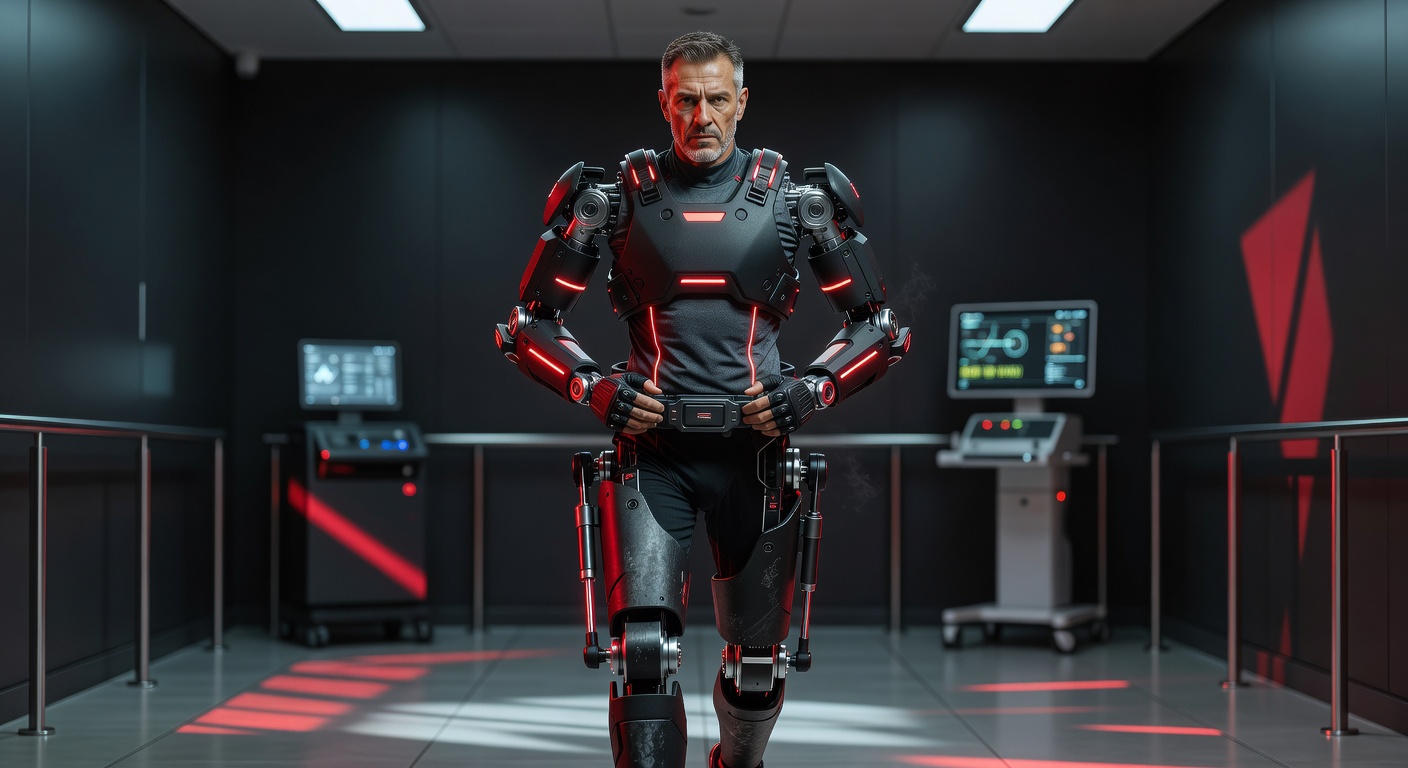
Rehabilitation exoskeleton technology, where FOURIER's engineering expertise originated. The clinical-grade force control requirements shaped the company's actuator and sensor design philosophy.
GR-2 vs. Competitive Humanoids
The humanoid robot field is crowded with competing specs. Here is how the GR-2 stacks up against three key competitors:
| Spec | Fourier GR-2 | Figure 02 | Agility Digit | Unitree G1 |
|---|---|---|---|---|
| Height | 175 cm | 170 cm | 175 cm | 127 cm |
| Weight | 63 kg | 60 kg | 65 kg | 35 kg |
| Degrees of Freedom | 53 | 65+ | 30+ | 43 |
| Payload | 3 kg/arm | 20 kg | 16 kg | 3 kg |
| Commercial Status | Commercial dev | Deployed (BMW) | Commercial (Amazon) | Commercial ($16K) |
The GR-2's payload spec (3 kg per arm) is on the lighter end for the commercial-grade class. Figure 02 claims 20 kg, Agility Digit 16 kg. For FOURIER, the tradeoff is likely intentional: lighter payload with higher dexterity (53 DoF, tactile sensing) targets tasks requiring precise manipulation rather than raw lifting. Healthcare and lab environments reward that tradeoff; heavy industrial environments generally do not.
FOURIER: The Full Funding Picture
FOURIER has raised across several documented rounds since 2022. The company has not publicly disclosed its valuation at any stage.
$62M
Series D (2022)
~$110M
Series E (Jan 2025)
$41.8M
Series E3 (Aug 2025)
The Series D (2022) was led by SoftBank Investment Advisers and Prosperity7 Ventures, bringing in approximately RMB 400 million ($62 million). SoftBank's participation follows the fund's broader bet on robotics and automation across Asia.
The Series E (January 7, 2025) closed at roughly RMB 800 million (approximately $109-110 million), led again by Prosperity7 Ventures, the venture arm of Saudi Aramco. Co-investors included Guoxin Investment, Pudong Venture Capital, Zhangjiang Hi-Tech Investment, Zhangke Yaokun Fund, and Junshan Capital. The Saudi Aramco connection carries strategic weight. Prosperity7 has an active interest in robotic workforces for petrochemical and industrial applications, and FOURIER's full-stack approach -- hardware, software, and AI all developed in-house -- is a meaningful differentiator for industrial deployment scenarios that require customization.
The Series E3 (August 1, 2025) added $41.8 million in additional VC funding, extending the runway and signaling continued investor confidence through mid-2025. Total disclosed funding across all rounds: approximately $246 million.
Why Prosperity7 Keeps Leading Rounds
Prosperity7 Ventures is the VC arm of Saudi Aramco, and it has now led two consecutive FOURIER rounds. The strategic rationale is straightforward: Saudi Aramco operates massive industrial facilities where physical labor is expensive, hazardous, and increasingly difficult to staff. FOURIER's research platform (Fourier Nexus) and full-stack development model give the company flexibility to customize deployments for specialized industrial environments -- exactly what large industrial operators need before committing to fleet-scale investment.
The Competitive Picture in 2025
FOURIER competes in a market that has gotten crowded quickly. On the Chinese side, Unitree is the most aggressive competitor: the G1 ships at roughly $16,000, is already in commercial production, and has 43 DoF in a compact 127 cm frame. Unitree wins on price and iteration speed. UBTECH (Walker series) and Agibot (Zhiyuan) round out China's humanoid field with different target sectors.
Western competitors are better-funded but not necessarily further along in deployment. Figure AI has raised $675 million and has deployed Figure 02 robots at a BMW manufacturing facility in Spartanburg. Agility Robotics (backed by Amazon) has Digit working in Amazon warehouse environments and is in commercial production. 1X Technologies is focused on service environments with its Neo platform.
• Figure AI: $675 million raised, Figure 02 deployed at BMW, targeting manufacturing and logistics. Highest payload (20 kg) in its class.
• Agility Robotics: Amazon-backed, Digit deployed in Amazon fulfillment centers, 16 kg payload, 175 cm. In commercial production.
• Unitree G1: $16,000 price point -- the most commercially accessible humanoid on the market. Targets research and SME industrial applications.
• UBTECH Walker: Chinese competitor with service-sector focus, backed by Tencent and other Chinese institutional investors.
• Agibot (Zhiyuan): Shanghai-based, raised significant funding in 2024, building A2 platform for manufacturing applications.
Where FOURIER differentiates: the exoskeleton heritage gives it a biomechanics depth that competitors built purely from robotics labs do not have. The Fourier Nexus research platform generates recurring institutional relationships with universities and R&D labs. The Prosperity7 backing opens industrial deployment pipelines in petrochemical and heavy industry contexts that Western humanoid companies are not yet addressing directly.
The 12-Month Outlook
FOURIER's near-term priorities are likely GR-2 commercial deployment scaling, GR-3 development, and growing the Fourier Nexus ecosystem. The Series E3 close in August 2025 extends runway well into 2026 and gives the company capital to accelerate manufacturing capacity.
The key metric to watch is actual deployment count. FOURIER has not published fleet numbers the way Figure AI has (70 robots at BMW) or Agility Robotics (Amazon warehouse deployment). Commercial credibility in humanoid robotics in 2025-2026 increasingly depends on documented, real-world deployment data -- not laboratory demonstrations. The company's healthcare positioning is a reasonable entry point: clinical environments are structured, tasks are repeatable, and the regulatory groundwork from the exoskeleton business already partially applies.
GR-3 is the other variable to track. If it meaningfully improves payload capacity -- currently 3 kg per arm on GR-2 versus competitors at 16-20 kg -- FOURIER moves into a different competitive tier for industrial deployment. If GR-3 refines dexterity and sensing without addressing payload, the company is signaling continued focus on healthcare and research markets rather than heavy manufacturing.
Frequently Asked Questions
What is the difference between Fourier Intelligence and FOURIER?
The same company. Fourier Intelligence was the original corporate name, used from founding in 2015. In summer 2024, the company rebranded to FOURIER to accompany its humanoid robot commercial launch. The website (fftai.com) and underlying legal entity reflect the new branding. Industry coverage still uses both names interchangeably.
How does the GR-2 compare to Figure 02 and Agility Digit in payload capacity?
GR-2 is rated at 3 kg per arm, which is substantially below Figure 02 (20 kg) and Agility Digit (16 kg). This is the GR-2's biggest competitive gap for industrial applications involving heavy lifting. FOURIER's counter is dexterity: 53 DoF and 12-DoF tactile hands outspec both competitors in fine manipulation capability. The question is whether the target market values dexterity over payload -- which healthcare and research generally do.
Why does FOURIER still sell rehabilitation exoskeletons?
The exoskeleton business generates real revenue and maintains clinical market relationships that benefit the humanoid program. Products like the MetaMotus Galileo ship into hospitals and rehabilitation centers -- those sales provide cash flow that is less VC-dependent than pure humanoid startups. The clinical user feedback also feeds back into the biomechanics models that inform GR-series development.
What is Fourier Nexus?
Fourier Nexus is FOURIER's platform for academic institutions and industry partners. It provides SDK access, simulation environments, and hardware access designed to let researchers and developers build applications on top of the GR series. The goal is to create a developer ecosystem similar to what ROS (Robot Operating System) did for the broader robotics research community -- standardized tooling that accelerates third-party application development and keeps FOURIER hardware at the center of that work.
Who are FOURIER's main investors, and why does Saudi Aramco's fund keep participating?
Key investors include SoftBank Investment Advisers (Series D lead), Prosperity7 Ventures (Series D and E lead), Shanghai Guoxin Investment, Pudong Venture Capital, and several Chinese institutional funds. Prosperity7 is the VC arm of Saudi Aramco, and its continued participation reflects a strategic interest in robotic workforces for petrochemical and industrial operations. Saudi Aramco runs industrial facilities where physical labor is costly and high-risk -- humanoid robots with customizable AI stacks are a long-term workforce bet for that context.
Where FOURIER Stands
FOURIER is not the most-funded humanoid company, nor the one with the most documented real-world deployments. What it has is a ten-year foundation in human biomechanics (from the exoskeleton work), a full-stack development model, and two high-profile investors with strategic industrial interests. The GR-2 specs are competitive in dexterity but lag on payload, which currently limits the addressable industrial market.
The GR-3 launch and the pace of GR-2 commercial deployments in 2025-2026 will determine whether FOURIER is building toward a leadership position in the China humanoid market or settling into a niche in healthcare and research. With $246 million raised and fresh capital from August 2025, the company has the resources to execute on either path.
The Bottom Line: FOURIER's exoskeleton roots give it a genuine biomechanics edge that pure-play humanoid startups lack, but converting that advantage into commercial deployments at scale is the unfinished work of 2025 and 2026.
Track three things: GR-3 specs (especially payload), documented GR-2 fleet deployments (healthcare and industrial), and whether Fourier Nexus generates meaningful third-party developer activity. Those three signals will tell the real story of whether FOURIER is building a platform or a product.