Physical AI
Humanoid Actuators Explained: The Motor, Gearbox, and Torque Stack Behind Physical AI
Sim-to-real transfer lets humanoid robots practice risky movements in physics engines, then adapt those policies to contact, friction, latency, and hardware limits.
Sim-to-real transfer is the reason humanoid robots can learn thousands of risky movements without breaking thousands of expensive machines. The robot practices in simulation, then the policy is adapted for the messy physical world.
For bipedal robots, the gap between simulation and hardware is not a nuisance. It is the central technical fight: contact, friction, backlash, cable flex, latency, impacts, and sensor noise all punish policies that only work in a clean virtual world.
Key Stats
10k+
Parallel simulated robots
1 ms
Control-loop scale
6 axes
Force-torque sensing
24/7
Fleet data goal
What Sim-To-Real Means
Simulation lets robotics teams train control policies in a physics engine before deploying them on hardware. A humanoid can fall, trip, collide, recover, carry awkward payloads, and test rare edge cases without injuring a person or destroying a prototype. The policy learns from synthetic experience, then engineers transfer it to the real robot.
The transfer is the hard part. Real floors are not ideal planes. Gearboxes have backlash. Motors heat up. Cables stretch. Batteries sag. Cameras blur. Feet slip. Contact patches change with dust, rubber wear, and floor finish. A controller trained on perfect physics often fails when the real world adds small errors at every joint.
| Layer | Simulation Need | Real-World Failure |
|---|---|---|
| Contact | Friction, impact, compliance | Foot slip or bounce |
| Actuation | Torque limits and latency | Overheating or lag |
| Perception | Lighting and occlusion | Missed object pose |
| Task | Object variation | Grip failure |
Domain Randomization
The standard defense is domain randomization. Instead of training on one perfect world, the simulator changes mass, friction, motor strength, sensor noise, lighting, object position, floor slope, and latency across many runs. The policy learns a behavior that survives variation instead of memorizing one environment.
Legged robotics labs have used this method for quadrupeds, and humanoid teams are applying the same logic to bipedal locomotion, manipulation, and recovery. NVIDIA Isaac, MuJoCo, Gazebo, Genesis, and custom engines are all part of the current toolchain. The key is speed. If a team can run thousands of robots in parallel, it can generate years of walking experience in hours or days.
Procurement rule
Ask what was randomized, what was measured on hardware, and what failure cases remain excluded. A simulator demo is not deployment evidence by itself.
Why Humanoids Are Harder Than Arms
A factory arm is usually bolted to a known base. A humanoid carries its base with it. Every manipulation task is also a balance task. Picking a tote changes center of mass. Pushing a cart changes foot loading. Reaching into a shelf changes torso posture. A hand failure can become a footstep failure.
That is why whole-body policies matter. The robot has to coordinate ankles, knees, hips, torso, shoulders, wrists, hands, head, and perception. Classical controllers still play a role, especially for safety envelopes and fall prevention, but learning-based systems are increasingly used where hand-coded rules become too brittle.
The Data Loop
The best sim-to-real programs are not one-way transfers. Real robots send logs back to the training stack. Engineers compare expected torque to measured torque, expected contact to foot sensors, expected object motion to camera observations, and expected recovery to actual recovery. Those differences update the simulator and the next training run.
This creates a flywheel. More robots create more failure data. Better failure data makes better randomized simulation. Better simulation creates stronger policies. Stronger policies expand the deployment envelope, which creates more data. Figure AI, Tesla, Agility, Boston Dynamics, Apptronik, 1X, Unitree, and Chinese humanoid firms all talk in different ways about fleet data because this loop is the business.
Safety Gates
A policy that works in simulation still needs hardware gates. Teams test on rigs, tethers, soft fall zones, slow speeds, reduced payloads, and supervised routes before expanding. They monitor near falls, hard contacts, emergency stops, dropped objects, thermal limits, and recovery quality.
The strongest evidence is boring: repeated task success across varied floors, object lots, lighting, shifts, operators, and maintenance states. The weakest evidence is a polished video with no denominator. Ten successful picks mean little without knowing how many attempts failed.
FAQ
Can simulation replace real robot testing?
No. It reduces unsafe exploration and speeds training, but real hardware validation is still required.
Why is contact so difficult?
Small errors in friction, compliance, timing, or geometry can change whether a foot sticks, slips, bounces, or trips.
What should buyers ask vendors?
Ask for task success rates, failure logs, randomized variables, hardware validation results, and limits on floor, payload, speed, and lighting.
The Bottom Line
Sim-to-real transfer is not a side tool for humanoids. It is the training infrastructure that makes physical AI economically possible. The companies that build the best loop between simulation, fleet telemetry, and controlled deployment will improve fastest.
For customers, the practical question is not whether a robot was trained in simulation. It is whether the vendor can prove that the simulated world was harsh enough, the real testing was broad enough, and the remaining limits are written clearly enough to operate safely.
The Actuator Stack
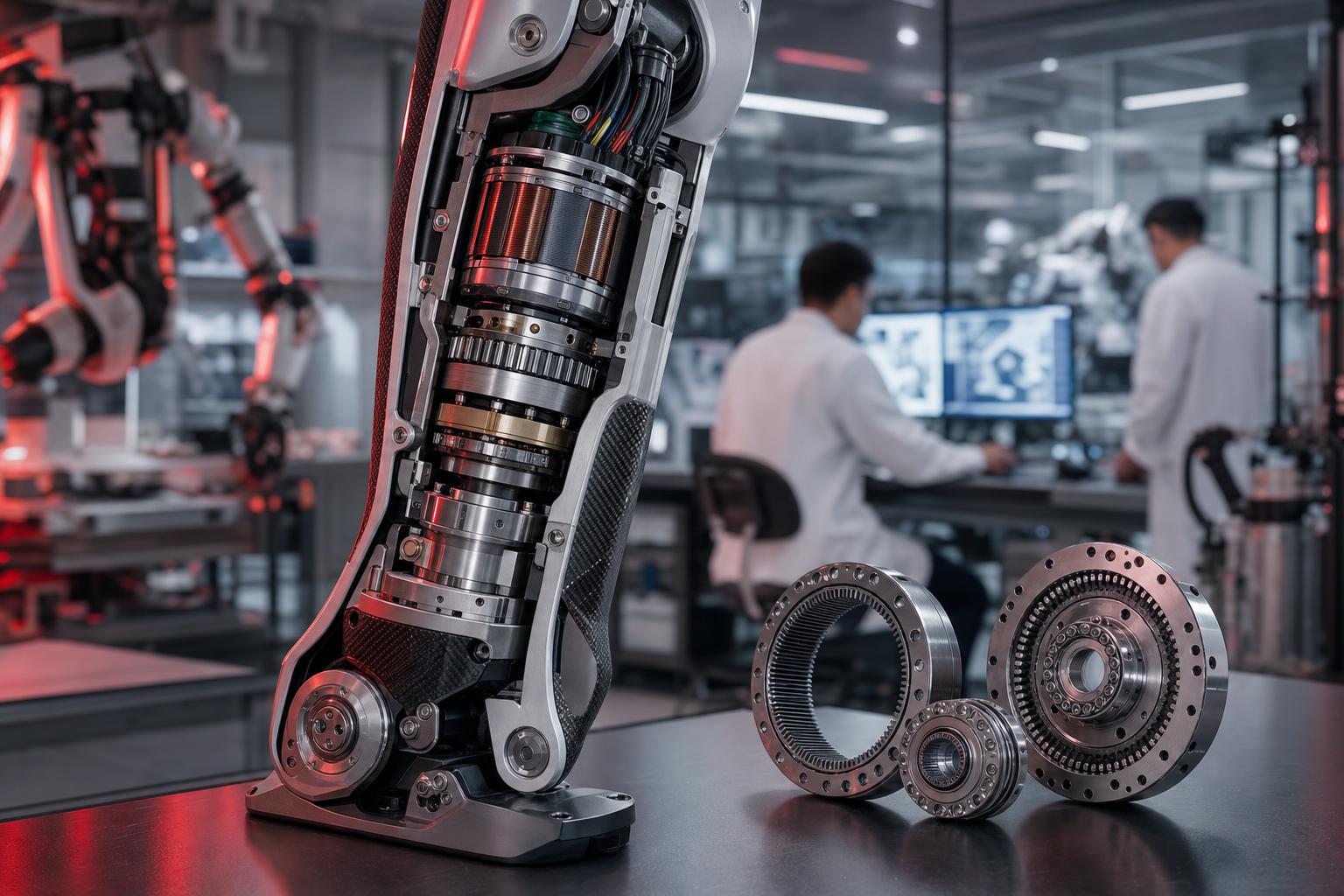
A humanoid actuator is the integrated joint system that turns electrical energy into controlled motion. It normally includes a brushless motor, gearbox, bearings, encoder, thermal sensors, motor controller, housing, seals, wiring, and sometimes a torque sensor or compliant element. The joint has to create torque, move at useful speed, survive impacts, and report enough state for the controller to know what is happening.
The motor creates torque. The gearbox multiplies torque and changes speed. The encoder measures position. Current sensing estimates motor torque. A joint-level controller closes the loop at high frequency, often around the millisecond scale. Higher-level software then coordinates many joints into a whole-body motion. If any part of that chain is noisy, slow, fragile, or hot, the robot's behavior suffers.
Humanoid robots stress actuators in ways fixed factory arms do not. Every step creates impact. Every balance correction demands fast torque changes. Every carried object changes load. Every fall can send shock through knees, hips, wrists, and shoulders. A joint that performs well on a bench can fail when the robot walks for hours, bumps a cart, braces on a shelf, or catches itself during a trip.
This is why actuator design is one of the clearest signs of robotics maturity. A company can buy a commodity motor and gearbox for a demo. A deployment fleet needs thermal headroom, modular replacement, calibration routines, predictable supply, and known failure modes.
Harmonic, Planetary, Cycloidal, and Quasi-Direct Drive
Harmonic drives are common in robotics because they provide high reduction in compact packages with low backlash. They are useful for precise arms and compact humanoid joints. Their limits are shock tolerance, cost, efficiency, and reflected inertia. A high reduction ratio can make the output strong but less transparent, meaning the joint may feel less backdrivable and less naturally responsive to outside forces.
Planetary gearboxes are rugged and efficient, with coaxial packaging and broad supplier availability. They can be attractive for joints that need durability and cost control. Backlash, noise, ratio limits, and packaging diameter still matter. Cycloidal drives can handle high shock loads and high reduction, which makes them interesting for legs and heavy joints, but they can add complexity and require careful manufacturing.
Quasi-direct-drive actuators use high-torque-density motors with low gear ratios. The goal is low reflected inertia, better torque transparency, and more natural force control. This is why QDD has become popular in legged robots and developer humanoids. The joint can respond quickly to ground contact and external pushes. The trade is that the motor often has to be larger and more thermally capable because the gearbox is doing less multiplication.
Series elastic actuators add a spring between motor and output. The spring can absorb shock and improve force sensing, but it also adds control complexity and can limit bandwidth. Direct drive removes the gearbox almost entirely, producing excellent transparency but requiring large motors that are often too heavy for practical humanoid limbs. Every actuator choice is a compromise between torque density, transparency, speed, cost, mass, efficiency, and durability.
Why Torque Control Matters
Humanoids do not only command positions. They have to command forces. A robot foot must press the ground with the right load. A hand must grip without crushing. A shoulder must move a box while absorbing contact. A hip must recover from a push without overcorrecting. Torque control is the difference between a robot that moves through poses and a robot that interacts with the world.
Good torque control depends on hardware and software. Low backlash helps. Low latency helps. Accurate current sensing helps. Joint torque sensors help when cost and packaging allow them. Thermal models matter because hot motors cannot deliver peak torque forever. Contact models matter because the controller has to decide when a foot is planted, slipping, or airborne.
This is also a safety issue. A humanoid working near people should yield, stop, or limit force when contact is unexpected. High-ratio stiff actuators can be powerful but unforgiving. More transparent joints can be safer and easier to control, but they may sacrifice compactness or peak torque. The actuator is where safety standards meet mechanical design.
The best humanoid companies will publish more than walking videos. They will show joint torque limits, duty cycles, thermal behavior, mean time between service, payload effects, fall recovery limits, and repair procedures. Buyers should ask for those numbers before treating a platform as deployable.
Supply Chain and Service
The actuator supply chain is becoming a strategic market of its own. Harmonic Drive, Nabtesco, Leaderdrive, SKF, Nidec, CubeMars, T-Motor, and many Chinese and Japanese suppliers all sit near the problem. Some humanoid companies design custom joints to protect performance and cost. Others use supplier modules to move faster. Both approaches can work if the company understands service requirements.
Custom actuators can create a moat, but they can also trap a company in manufacturing problems. Supplier actuators can speed development, but competitors may buy similar parts. The long-term differentiator may be integration: how the joint, controller, thermal model, software stack, diagnostics, and field service system work together.
Fleet operation changes the design target. A lab robot can be repaired by engineers. A customer robot needs replaceable modules, spare inventory, remote diagnostics, and clear maintenance intervals. If a knee actuator fails after a few hundred hours, the business model fails with it. If a wrist module can be swapped in minutes and calibrated automatically, the fleet becomes easier to support.
Humanoid actuators are not glamorous compared with foundation models, but they decide whether physical AI leaves the lab. Every useful robot task passes through motors, gears, sensors, heat, bearings, and control loops. The companies that make those joints reliable will shape the cost curve of the whole category.
How to Read a Humanoid Joint Spec Sheet
A serious actuator spec sheet should list continuous torque, peak torque, peak duration, no-load speed, rated speed, mass, diameter, gear ratio, encoder resolution, voltage, maximum current, thermal limits, ingress protection, expected service life, and allowable shock load. Peak torque alone is the least useful number because many joints can produce impressive torque briefly before overheating.
Continuous torque is closer to deployment reality. A warehouse robot may walk for hours, hold objects, brace against shelves, and recover from small disturbances all day. If the joint cannot shed heat, software will derate it and the robot will slow down. Thermal management is therefore a product feature, not an afterthought.
Backdrivability and reflected inertia tell buyers how naturally the joint responds to external force. A backdrivable joint can be pushed and can sense interaction more cleanly. A stiff high-ratio joint may hold position well but transmit impacts and require careful safety controls. The correct choice depends on the task: walking, lifting, manipulation, or precise placement.
Maintenance should be part of the spec. Buyers should ask how a joint is replaced, whether calibration is automatic, whether lubricant service is required, how failures are logged, and what spare parts cost. The actuator is often the most expensive recurring hardware risk in a humanoid fleet. A cheaper robot with weak joint serviceability can become more expensive than a premium robot with predictable modules.
Why Actuators Decide Unit Economics
Actuators drive the bill of materials for humanoids because each robot needs many powered joints. A full-size humanoid may have actuators in ankles, knees, hips, waist, shoulders, elbows, wrists, neck, and hands. Even small cost differences per joint multiply quickly. A custom high-performance knee may be justified, but using premium hardware everywhere can make the robot impossible to sell at fleet scale.
Reliability has the same multiplier. If one actuator has a low failure rate but a robot uses dozens of them, fleet maintenance can still become painful. Companies need joint-level telemetry so they can predict failures before a customer sees downtime. Temperature history, impact events, torque saturation, calibration drift, vibration, and current anomalies all become maintenance signals.
Software can protect hardware, but only within limits. A controller can avoid repeated peak torque, reduce speed when motors heat, soften impacts, and detect abnormal friction. It cannot turn a weak gearbox into a deployment-grade joint. This is why serious humanoid companies increasingly treat actuator hardware and control software as one product.
The market will reward boring joints. The best actuator is not the one that looks impressive in a launch video. It is the one that survives thousands of hours, ships on time, can be replaced quickly, and gives the controller clean force information. Physical AI needs models, data, and compute, but every useful action still passes through a joint.
The Practical Bottom Line
Humanoid actuator progress will show up first in field behavior. Robots will walk longer without thermal throttling, recover more gracefully from bumps, manipulate with softer contact, and need fewer joint replacements after ordinary work. Those changes will matter more than top speed or a single peak torque number.
For buyers, the actuator questions are direct. How many hours has the joint run under load? What fails first? How long does replacement take? What torque can it hold continuously? How does the robot limit force near people? How much does a spare module cost? The answers reveal whether a humanoid is a product or a prototype with a polished shell.
Physical AI may be trained in data centers, but it succeeds in bearings, windings, magnets, gears, sensors, and heat sinks. The actuator stack is where intelligence becomes work.
That is why actuator roadmaps deserve close attention in every humanoid announcement. A new model, training method, or factory pilot depends on joints that can repeat work under load. Better actuators lower control burden, improve safety margins, reduce service cost, and make fleet learning possible because robots stay online long enough to collect useful data. The motor stack is not a supporting detail. It is the physical foundation of the category.
For operators, actuator maturity is the difference between a robot that performs once and a robot that can be scheduled, repaired, insured, and trusted beside workers every day.