Technology
Teleoperation and Fleet Learning: How Humanoid Robots Get Useful Before Full Autonomy
A detailed explainer on how teleoperation, remote supervision, and fleet learning let humanoid robots deploy before full autonomy is solved.
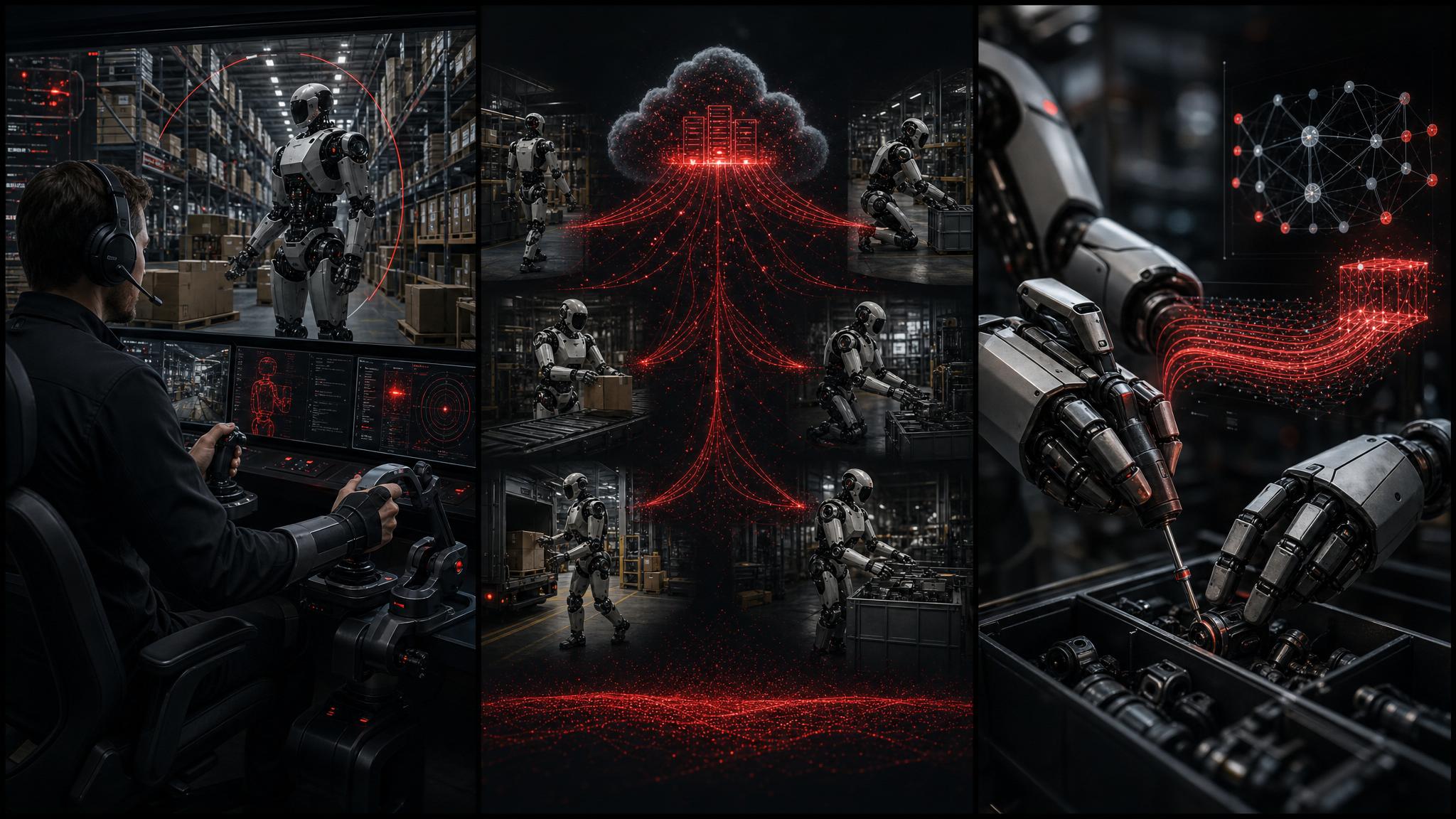
Teleoperation is the unglamorous bridge between robot demos and useful humanoid fleets. A humanoid that can do one task autonomously is impressive. A humanoid that can recover when it fails, learn new tasks from humans, and send lessons back to the whole fleet is much closer to a product.
The industry is not waiting for perfect autonomy. Companies are using remote operation, human demonstrations, data pipelines, and fleet-management software to put robots in factories, warehouses, labs, and early home trials while the models improve. Teleoperation is not a retreat from AI. It is one of the ways physical AI gets its training data.
Key Stats
ms
Latency budget
1:N
Operator ratio goal
24/7
Fleet monitoring
TBs
Robot data
What Teleoperation Actually Controls
A teleoperated robot can be controlled through VR, motion capture, joysticks, handheld controllers, or shared autonomy tools where the robot handles balance and low-level motion while the human guides intent. The best systems do not stream every motor command from the operator. They divide the problem: the robot keeps itself stable, avoids obvious collisions, and tracks local constraints while the human supplies task knowledge.
That split matters for latency. A warehouse robot cannot wait for a round trip to a cloud operator before catching its balance. Locomotion, force limits, reflexes, and safety stops have to run onboard. The remote human is most useful for high-level manipulation choices, exception handling, task labeling, and teaching the robot what success looks like.
The data value is enormous. Every teleoperated pick, wipe, plug insertion, box move, door opening, and recovery maneuver can become a training example. The robot records camera views, proprioception, force estimates, joint states, commands, and outcomes. With enough data, imitation-learning and vision-language-action models can learn policies that repeat the skill without the human.
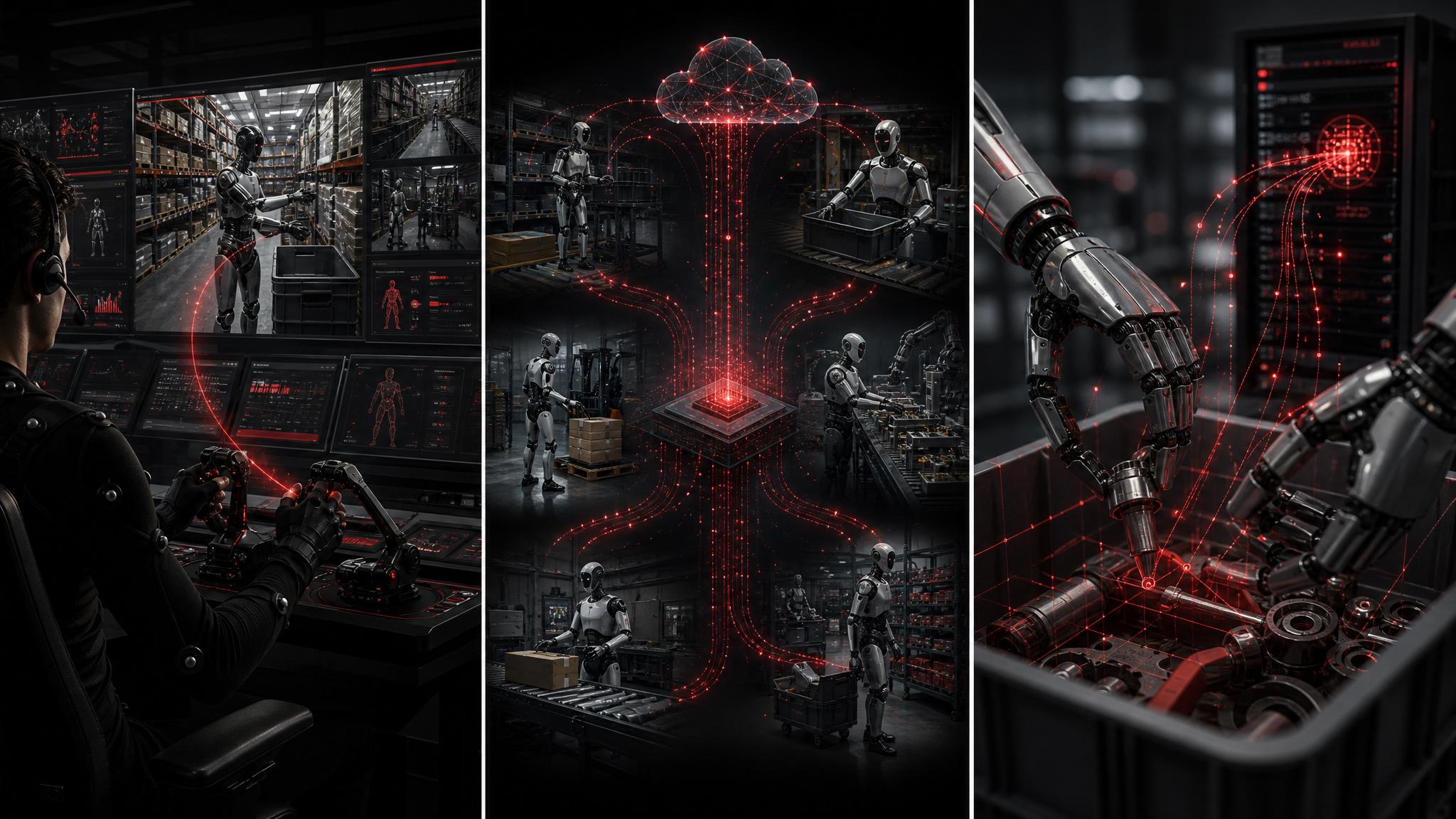 AI-generated image
Remote operators are most useful for teaching, exceptions, and manipulation choices. Credit: AI-generated illustration
Why Fleet Learning Is the Real Product
Fleet learning is the next layer. If one robot learns a better way to grasp a tote handle, that update can be evaluated and sent to other robots with similar hardware. If a factory deployment discovers a failure mode, the data can seed simulation tests, model updates, or operational rules. The fleet becomes a sensor network for edge cases.
Agility Robotics' Digit shows the commercial shape of the idea. Digit is aimed at logistics work, and Agility's Arc platform manages robot fleets, workflows, and deployment data. The goal is not a one-off robot with a laptop operator. It is a managed labor system where robots perform repeatable tasks, report exceptions, and improve through software.
Figure, Apptronik, Tesla, 1X, Boston Dynamics, and Chinese firms such as Unitree and AgiBot all face the same data bottleneck. Simulation is cheap and scalable, but homes, warehouses, and factories contain messy contact physics, unusual objects, bad lighting, human interruptions, and corner cases. Teleoperation turns that mess into supervised data.
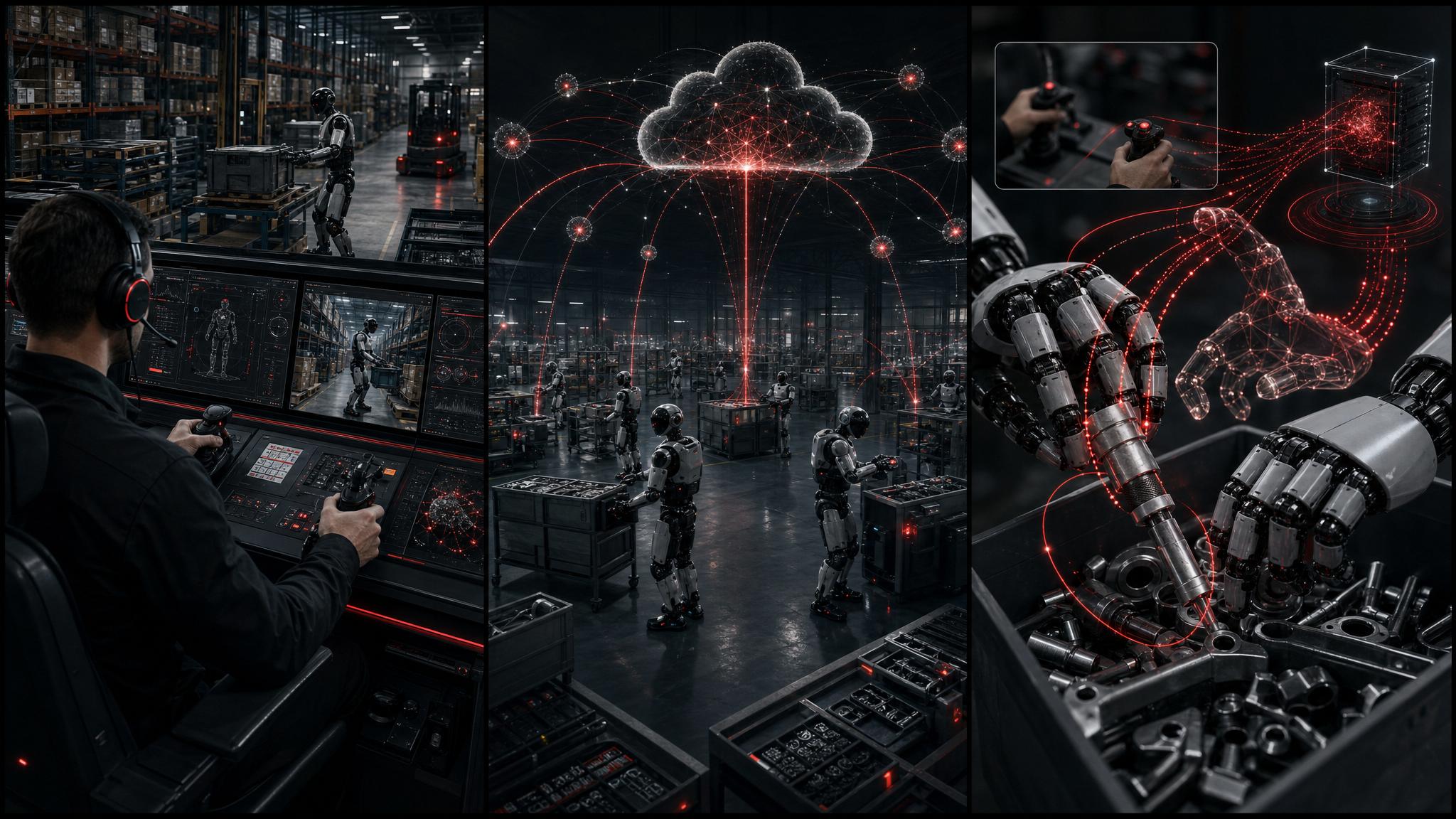 AI-generated image
Fleet learning turns deployment edge cases into model updates. Credit: AI-generated illustration
The Deployment Economics
The business reason is just as important. Customers do not want to buy research projects. Remote supervision can improve uptime during early deployments because a human can recover from a stuck state, relabel a task, or guide a difficult manipulation. That makes pilots more useful while autonomy matures.
There is a labor model hidden inside the autonomy story. One operator controlling one robot is expensive. One operator supervising a fleet of robots that only ask for help occasionally is a product. The autonomy ratio, meaning robots per operator, becomes a key business metric. It improves as routine tasks move from human control to autonomous policies.
Safety boundaries define what can be teleoperated. A remote operator should not be able to drive a robot into a person or apply uncontrolled force. Sites need geofencing, speed limits, emergency stops, local perception, audit logs, and clear responsibility for interventions. Teleoperation adds capability, but it also adds cybersecurity and operational risk.
| Mode | Human role | Robot role | Business meaning |
|---|---|---|---|
| Direct teleoperation | Controls task continuously | Executes local balance and motion | Useful for data collection, not scalable labor |
| Shared autonomy | Guides intent and exceptions | Handles routine motion | Early deployment mode |
| Fleet supervision | Handles rare escalations | Runs standard workflows | Target commercial model |
| Autonomous fleet | Audits and maintenance | Runs most tasks | Long-term goal |
Risks: Safety, Security, and Data
Data governance matters too. Home robots and workplace robots can record sensitive video and audio. Companies need policies for retention, labeling access, anonymization, and customer control. Fleet learning should not mean every private environment becomes raw training data with no boundaries.
The technical stack is converging. Robots need onboard control, perception, manipulation policies, remote operation interfaces, cloud fleet management, data labeling, simulation replay, model training, validation, and software deployment. The winner may not be the robot with the flashiest walking demo. It may be the company with the best closed-loop data factory.
Teleoperation will fade from the sales pitch as autonomy improves, but it will not disappear. Aviation has autopilots and air traffic control. Data centers have automation and human operators. Humanoid fleets will likely have autonomous routines, remote exceptions, maintenance crews, and continuous model training for years.
The Bottom Line
That is the practical path to physical AI. First humans teach and rescue. Then robots repeat. Then the fleet shares what worked. The headline may be the humanoid on the factory floor, but the moat is the data loop behind it.
The Data Loop
The core loop is straightforward: deploy a robot, observe failures, collect human-guided corrections, train or fine-tune policies, validate them, then deploy updates. The quality of that loop decides whether a humanoid fleet gets better each month or stays trapped in demos.
Not all data is equally useful. Ten thousand hours of a robot standing idle is far less valuable than a few thousand high-quality demonstrations of hard contact-rich tasks. Companies need data selection, labeling, task metadata, and failure taxonomies so training sets reflect real operational pain.
Simulation still plays a central role. Real demonstrations can be replayed in simulation, perturbed with variations, and used to test updated policies before they touch customer sites. The strongest systems combine real data, synthetic variations, and controlled hardware validation.
Where Teleoperation Fits in the Stack
Teleoperation sits above low-level control. Balance, torque limits, foot placement constraints, collision checking, and emergency stops should remain local. The operator should not need to think about every joint angle. They should think about task intent: pick that object, open that drawer, recover from that jam.
Shared autonomy reduces bandwidth. Instead of streaming precise motions continuously, an operator may select a grasp, approve a plan, or demonstrate a short segment. The robot fills in stable motion. This makes supervision more scalable and less sensitive to network jitter.
Good interfaces are a competitive advantage. If an operator becomes tired after 20 minutes, data quality falls. If the interface makes failures easy to label, every intervention improves the dataset. Human factors become robotics infrastructure.
The Commercial Filter
A humanoid deployment has to beat an alternative: a conveyor, AMR, fixed robot arm, outsourced labor, or doing nothing. Teleoperation helps only if it moves the system toward lower cost or higher uptime. It cannot become a permanent hidden labor bill that erases the robot case.
The metric to watch is escalation rate. If a robot asks for human help every few minutes, it is a telepresence machine. If it asks a few times per shift, it begins to look like automation. Fleet learning is the mechanism for pushing common escalations into autonomous routines.
Customer trust also depends on clear boundaries. Sites need to know when a human is watching, what is recorded, who can intervene, and how safety incidents are handled. The operational playbook is as important as the neural network.
Practical Engineering Checklist
A fleet-learning company needs a clean separation between demonstration data and production control. Raw teleoperation can be messy. Training pipelines must filter out operator mistakes, unsafe maneuvers, and site-specific shortcuts before models inherit them.
Hardware consistency matters. A policy trained on one hand, wrist, or actuator set may not transfer cleanly to another. Fleet learning works best when robots share common kinematics, sensors, calibration procedures, and software versions.
Calibration is a boring but critical layer. Camera poses, joint offsets, force estimates, and gripper parameters drift over time. Bad calibration poisons data and makes successful demonstrations harder to reproduce on other robots.
Remote recovery has to be designed into tasks. If a robot drops an object, blocks an aisle, or loses localization, the system needs safe recovery modes. The operator may need camera views, map context, force feedback, and authority to pause nearby robots.
Latency requirements differ by task. Sorting objects on a table can tolerate more delay than catching balance or carrying a heavy box around people. Systems should reserve local autonomy for time-critical control and use remote humans for decisions with wider timing margins.
Fleet management software becomes the customer interface. It schedules tasks, monitors state, reports productivity, manages exceptions, and pushes updates. Without that layer, humanoids are isolated machines rather than deployable labor capacity.
The data flywheel has a cold-start problem. Early robots are not very capable, which limits deployments, which limits data. Teleoperation helps break that loop by making early deployments useful enough to generate the data needed for better autonomy.
Regulation will likely follow deployment. Factories already manage robots through safety standards, but general-purpose humanoids blur categories. A remotely supervised humanoid near people raises questions about certification, logging, liability, and site training.
Cybersecurity is physical safety. If remote operation channels are compromised, the result is not just leaked data. It could be unsafe motion. Strong authentication, encrypted links, limited operator permissions, and local safety enforcement are required.
Companies will differ in how much teleoperation they reveal. Some will market autonomy and hide remote assistance. Customers will eventually demand transparency because staffing, privacy, safety, and uptime all depend on the real operating model.
The operator workforce will become specialized. Good robot operators understand task goals, failure modes, safe manipulation, and how to create clean demonstrations. They are closer to pilots and process technicians than call-center staff.
Long term, teleoperation becomes a quality-control valve. Even mature fleets will meet novel objects, broken fixtures, spills, blocked paths, and unusual human behavior. The system that escalates cleanly will outperform one that pretends edge cases do not exist.
The teleoperation data stream also supports evaluation. If a new policy reduces interventions from 20 per hour to five per hour on the same workflow, the company has a measurable autonomy gain. Without deployment data, claims about intelligence stay fuzzy.
Robots should ask for help intelligently. A system that escalates too late may create unsafe failures. A system that escalates too often destroys productivity. Confidence estimation and task-state monitoring become core AI functions.
There is also a social layer. Workers sharing space with robots need to understand when the robot is autonomous, when a remote human is involved, and how to stop it. Confusion lowers trust even if the hardware is safe.
Fleet learning makes maintenance predictive. Repeated joint temperature patterns, gripper failures, battery behavior, or perception faults can reveal hardware issues before a robot fails during a shift. The same data loop that trains manipulation can train operations.
Humanoids have a special data challenge because they are general-purpose bodies. A mobile manipulator built for one warehouse workflow can narrow its dataset. A humanoid aimed at many environments needs broader coverage, which makes teleoperation more valuable.
The near-term winners will pick constrained tasks anyway. Loading totes, moving bins, tending machines, simple kitting, and inspection routes create repeatable data loops. Generality will be earned through many narrow deployments, not declared in a launch video.
Pricing will expose the truth. If a robot requires constant remote control, customers are paying for hidden labor plus hardware. If remote help is rare, the robot can be priced as automation. The intervention rate is the economic tell.
The practical conclusion is optimistic but grounded. Teleoperation does not make humanoids fake. It makes the autonomy roadmap measurable, deployable, and connected to real work.
The best companies will treat teleoperation as a product discipline, not a temporary hack. They will build dashboards, operator training, escalation policies, privacy controls, safety cases, and data pipelines from the beginning. Retrofitting those systems after deployment is expensive.
A useful humanoid fleet also needs site design. Marked pickup zones, consistent containers, clean charging locations, and clear walking paths can reduce interventions dramatically. General-purpose robots become commercial sooner when environments are prepared intelligently.
The human operator will often teach more than motion. They provide intent, context, and judgment: which object matters, which mess is acceptable, which action is unsafe, and when to stop. That judgment is hard to synthesize without real deployments.
Fleet learning should also include negative data. Failed grasps, near collisions, confused perception, and aborted tasks are valuable because they define the edge of competence. A company that only trains on success videos will miss the real distribution.
The near future is hybrid. Robots will walk, pick, carry, and inspect autonomously in narrow workflows, then ask for help when the world gets strange. That is not a weakness. It is how physical AI will leave the lab without pretending the hard parts are solved.
There is an important cultural point too. Robotics teams love autonomy benchmarks, but customers buy outcomes. Teleoperation and fleet learning matter because they connect the benchmark world to the messy place where the robot has to move boxes, open doors, and avoid people.
The strongest deployment strategy starts narrow, measures everything, and expands only when intervention data says the robot is ready. That may sound slower than a general-purpose pitch, but it builds trust and creates better training data.
Humanoid robots are still early products. Teleoperation is the scaffolding that lets them work while the autonomy improves. Over time, the scaffolding should become less visible, but the data loop it created will remain central.
The companies that learn fastest will not be the ones with the most viral clips. They will be the ones with reliable robots in constrained jobs, clean intervention records, disciplined updates, and customers willing to expand after the first pilot. That is a less cinematic story, but it is how robotics usually becomes real, one measured workflow at a time.
FAQ
Is teleoperation cheating?
No. It is a practical way to collect real-world data, maintain uptime, and teach policies before full autonomy is reliable.
What is fleet learning?
Fleet learning means robots use deployment data and software updates so one robot or site can improve performance across many robots.
Why not train everything in simulation?
Simulation is essential, but real environments contain contact physics, lighting, objects, damage, clutter, and human behavior that are hard to model perfectly.