Technology
Robot Hands: Why Dexterous Manipulation Is Humanoid Robotics' Hardest Problem
Human hands have 23 degrees of freedom, 17,000 tactile receptors, and decades of learned motor control. Building something comparable in metal and silicon is one of robotics' most unsolved challenges.
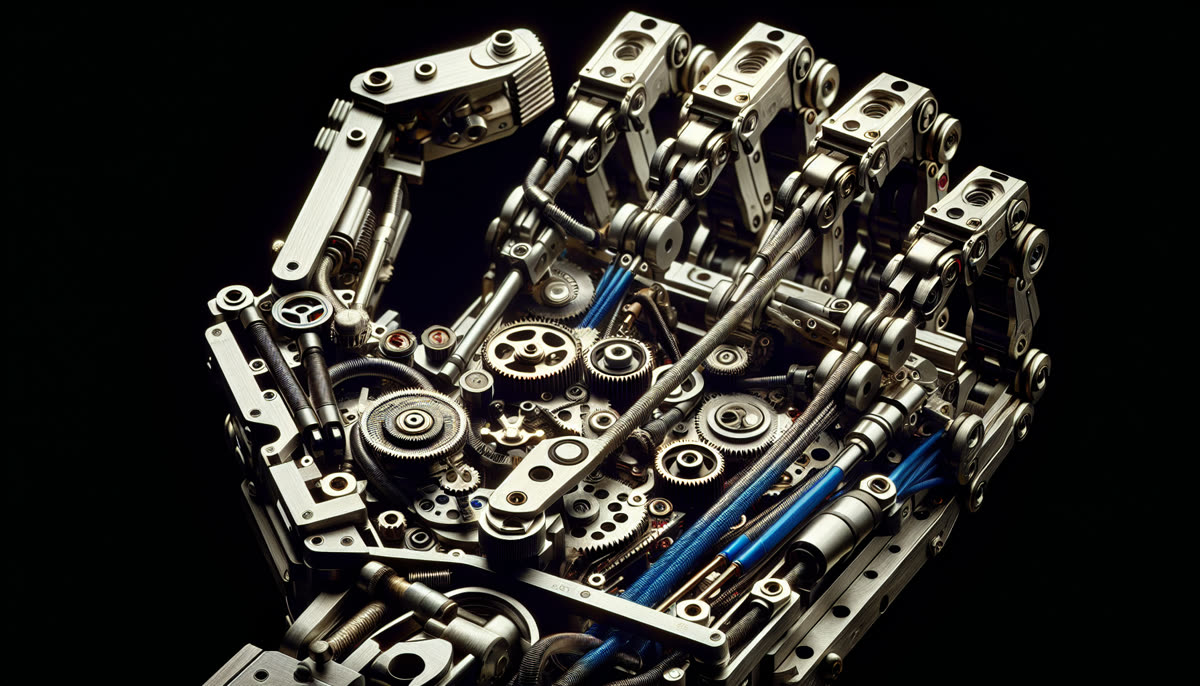
The human hand contains 27 bones, 29 joints, 34 muscles, and roughly 17,000 tactile receptors. It can apply less than a gram of force to thread a needle, and upwards of 450 newtons to crush a can. It can reposition a coin between fingers without looking at it. It learns a new grip after a few tries. Engineers have been trying to replicate this for 50 years, and the honest assessment is that they are still nowhere close.
That gap sits at the center of every humanoid robotics company's roadmap. You can build a bipedal robot that walks on uneven terrain. You can bolt on vision systems that recognize 10,000 objects. But none of it matters in a warehouse or a kitchen until the robot can pick up an unfamiliar object, reorient it, and set it down in the right place without breaking it. That last step is called dexterous manipulation, and it remains the field's hardest open problem.
This is a complete breakdown of why that problem is so hard, what the engineering tradeoffs look like, which companies are building the most capable hands today, and where AI is beginning to change the equation.
Key Stats
23+
Degrees of freedom in human hand
17,000
Tactile receptors per human hand
$150K
Shadow Dexterous Hand (research)
$400M
Physical Intelligence Series A, 2024
Why This Is Actually Four Hard Problems at Once
When a roboticist talks about dexterous manipulation, they are not talking about a single challenge. They are talking about four distinct computational and mechanical problems that must all be solved simultaneously, in real time, on hardware that cannot weigh more than a human arm or draw more power than a laptop.
The first is contact mechanics: where exactly should fingers make contact with an object to achieve a stable grasp? The math here involves computing friction cones, force closure conditions, and surface normals for objects whose geometry may be partially unknown. A human does this unconsciously in under a second.
The second is grasp stability: once contact is made, will the object stay put when the hand moves, rotates, or encounters an unexpected external force? Stability analysis requires predicting how contact forces interact across all contact points, which changes as fingers shift even slightly.
The third is force control: applying exactly the right amount of grip. Too little and the object slips. Too much and a wine glass becomes shards. Human fingers manage this through a closed loop between muscle force and tactile feedback that updates faster than conscious thought. Replicating that loop in hardware requires both precise actuators and sensors that can detect micro-Newton-scale force changes.
The fourth is in-hand manipulation: repositioning an object without setting it down. Rotating a screwdriver in the palm, flipping a coin, sliding a card to the fingertips. This requires coordinating all fingers simultaneously against a free object, with no external support surface. It is arguably the hardest of the four, and most commercial robots cannot do it at all.
The Human Benchmark
A human hand operates at 23+ degrees of freedom, coordinated by both the central nervous system and a dense peripheral nervous network that provides real-time tactile feedback. The hand can apply forces across a range of more than five orders of magnitude (under 1 gram to 450 newtons) and adjust grip in under 100 milliseconds when an object starts to slip. No robot hand built as of early 2026 matches this combination of range, precision, and speed.
Technical Deep Dive: Actuation Approaches
The mechanical heart of any robot hand is its actuation system: how motors translate into finger movement. Four approaches dominate research and commercial hardware, each with a different set of engineering tradeoffs.
Tendon-Driven Systems
In tendon-driven designs, motors sit in the forearm (or wrist housing) and pull cables that run through the finger structure, much like the extensor and flexor tendons in a human arm. This keeps the fingers themselves lightweight and compact. Tesla's Optimus Gen 2 uses this approach: 22 actuators per hand drive 11 degrees of freedom, with tendons routed through the palm to each finger joint.
The tradeoffs are significant. Tendons stretch slightly under load, introducing backlash and hysteresis that makes precise force control harder. Routing cables through a small finger structure is mechanically complex. Long cable runs introduce friction. And if a cable breaks, the hand loses function. The Shadow Dexterous Hand from Shadow Robot Company (UK) uses 40 pneumatic muscles routed as tendons to achieve 24 DOF — the highest of any commercially available hand — but at a price of around $150,000 per unit, it stays firmly in research labs.
Direct-Drive and In-Finger Motors
The alternative is putting small motors directly inside each finger joint. This eliminates cable routing complexity and provides cleaner torque control with less hysteresis. Agility Robotics took this direction with Digit, using direct-drive motors in each of its four multi-jointed fingers, optimizing for warehouse box-handling rather than fine manipulation.
The downside is mass. Motors inside finger links make fingers heavier, which increases the inertia the wrist and arm must manage. Heavier fingers also create larger impulse forces when contact is made unexpectedly, raising the risk of damage to delicate objects. Miniaturizing motors sufficiently for high-DOF in-finger designs remains an active area of motor engineering.
Soft Robotics and Pneumatic Actuators
Soft robotics uses air-inflated silicone or polymer chambers that deform to conform around objects. This inherent compliance is a genuine advantage: a soft hand can wrap around irregular objects without precise grasp planning, tolerating uncertainty in object geometry. Pneumatic designs like those in the Shadow Hand exploit the same principle.
The limitations are precision and speed. Inflating and deflating chambers is slow compared to electric motors. Controlling intermediate positions requires precise pressure regulation. Soft actuators are also harder to miniaturize, and the compressors or pumps required add system weight and complexity. Most commercial deployments treat soft robotics as a specialized gripper technology rather than a general-purpose hand solution.
Series Elastic Actuators
Series Elastic Actuators (SEAs) place a compliant spring element between a motor and the load. This does two things: it allows force to be inferred from spring deflection (useful when you cannot fit a torque sensor at every joint), and it provides a mechanical buffer that prevents impulse forces from damaging gears or motors. SEAs appear frequently in wrist and shoulder joints of humanoids where force sensing and compliance matter more than raw stiffness. They are less common in finger joints where the geometry constraints are tightest.
Robot Hand Comparison: 2026 State of the Field
| Hand | DOF | Actuation | Tactile | Price | Status |
|---|---|---|---|---|---|
| Tesla Optimus Gen 2 | 11 per hand | Tendon (cable) | Yes | N/A (internal) | Internal only |
| Figure 02 | ~16 per hand | Tendon | Limited | N/A | Deployed (BMW) |
| Shadow Dexterous Hand | 24 | Pneumatic muscle | Yes | ~$150,000 | Research only |
| Inspire-Robots RH56DFX | 12 | Motor-tendon | Optional | ~$15,000 | Commercial |
| Agility Digit | 4 fingers | Direct drive | Basic | N/A | Commercial |
| 1X Neo | 7 per hand | Tendon | Yes | N/A | Beta |
| Wonik Allegro Hand | 16 | Direct drive | Optional | ~$20,000 | Research/commercial |
The DOF gap between research hardware (Shadow at 24 DOF) and deployed commercial hands (Optimus at 11, Digit at roughly 8-10 effective DOF) reflects a deliberate engineering choice: more DOF means more complexity, more failure modes, and harder control problems. Commercial teams are betting they can hit 80% of real-world manipulation tasks with fewer joints.
Tactile Sensing: The Missing Sense
 Illustration
Vision-based tactile sensors embed a camera inside a soft gel fingertip. Deformation patterns reveal contact location, force magnitude, and slip onset before an object actually falls.
Vision solves object recognition. Force/torque sensors at the wrist solve gross load measurement. Neither tells you what is happening at the point of contact with a finger. That gap is why tactile sensing research has exploded over the past five years.
The dominant approaches break into three categories. The first is point force sensors embedded in fingertips, typically piezoelectric or capacitive elements that measure normal and shear force at discrete locations. ATI Industrial Automation makes widely used miniature force/torque sensors in this category, accurate to millinewtons but expensive and mechanically complex to integrate.
The second category is vision-based tactile sensors, which embed a small camera inside a soft, compliant gel fingertip. When the gel deforms during contact, the camera records the deformation pattern and software reconstructs the contact geometry and force distribution. GelSight, originally developed at MIT and now available commercially, pioneered this approach. Meta AI Research released DIGIT in 2021 (approximately $30 per sensor, open-source design), which put vision-based tactile sensing within reach of academic labs worldwide. The Bristol Robotics Lab's TacTip uses a similar principle with an array of pins whose movement is tracked optically.
The third is distributed capacitive or barometric arrays: arrays of pressure-sensitive elements that cover larger areas of the finger or palm. These give spatial pressure distribution across the whole contact surface but typically at lower resolution than vision-based sensors. Several research groups are printing these directly onto robotic skin substrates.
All three approaches share a common bottleneck: processing speed. The human tactile system detects slip onset and triggers a corrective grip reflex in around 75 milliseconds, much of it handled at the spinal cord level without waiting for the brain. Matching that response loop in software running on a robot's onboard compute stack is non-trivial, particularly when tactile data is being fused with visual and proprioceptive streams simultaneously.
AI-Driven Grasp Planning: From Databases to Diffusion
 Illustration
Modern grasp planning uses physics simulation to generate millions of training examples, then transfers learned policies to real hardware through domain randomization.
Classical grasp planning relied on databases. Given a known 3D model of an object, algorithms like GraspIt! would enumerate candidate grasps, filter for force closure, and rank them by stability metrics. This works well when objects are pre-catalogued and conditions are controlled. It fails immediately when you put a robot in a kitchen with arbitrary objects in arbitrary orientations.
The shift to learned grasp planning started in earnest around 2019. OpenAI's Dactyl project trained a neural network in simulation to manipulate a Rubik's cube one-handed using the Shadow Dexterous Hand. The key insight was domain randomization: instead of trying to precisely model real-world physics, Dactyl trained across thousands of randomly varied simulated environments (different friction values, object sizes, visual appearances, lighting conditions). The resulting policy was robust enough to transfer directly to the real robot without fine-tuning. It solved the cube with one hand reliably, something that had seemed decades away.
That result established simulation-to-real transfer as a viable path for dexterous manipulation. The problem is that hand-design of task curricula in simulation is slow, and each new task requires new simulation setup. The next wave of methods addresses this through large-scale imitation learning. Tesla films humans performing tasks and trains manipulation policies on the resulting video. The Diffusion Policy approach from MIT and Columbia University applies denoising diffusion models (the same class behind DALL-E and Stable Diffusion) to robot manipulation, representing the policy as a distribution over actions that the model learns to sample efficiently. Diffusion Policy has achieved state-of-the-art results on standard dexterous manipulation benchmarks with relatively small amounts of demonstration data.
The most recent wave is vision-language-action models (VLAs), which connect the reasoning capabilities of large language models directly to robot action outputs. Google DeepMind's RT-2 demonstrated that a model trained on internet text and images could transfer knowledge to manipulation tasks it had never been trained on explicitly, by reasoning about the task in language and mapping that to action sequences. OpenVLA (an open-source VLA) and Physical Intelligence's Pi0 model follow similar architectures. Pi0 was demonstrated folding laundry, making sandwiches, and packing boxes — multi-step tasks requiring sustained dexterity across minute-long time horizons.
Physical Intelligence (Pi): The Pure-Play Bet
Founded in 2023 by former Google Brain and DeepMind researchers including Sergey Levine and Chelsea Finn, Physical Intelligence raised a $400M Series A in late 2024 at an implied valuation placing it among the most highly valued AI robotics startups. The company's thesis: general-purpose manipulation needs a foundation model, not task-specific programming. Pi0 is their first public demonstration — a single model handling dozens of distinct manipulation tasks with real hardware. No commercial product yet, but the architecture represents the current frontier of what AI can do for robot hands.
Key Players: Who Is Closest
• Tesla (Optimus): 11 DOF hands with 22 actuators, tendon-driven, tactile sensing on fingertips. Has demonstrated needle threading and egg handling. Training pipeline pulls from video of human hands. The manufacturing scale ambition (millions of units) means they are optimizing for producibility as much as capability.
• Figure (Figure 02): Approximately 16 DOF hands deployed at BMW's Spartanburg, SC plant. Has demonstrated laundry folding and small object handling. Partnership with OpenAI for the language understanding layer on top of manipulation skills. Currently the leading commercial deployment of a humanoid with dexterous hands in an industrial setting.
• Shadow Robot Company: The research standard since 2004. Shadow's 24-DOF hand is the most DOF-complete commercial hand available. Used by OpenAI (Dactyl), DeepMind, and dozens of university labs. At $150,000 per hand, it is not a product that scales — it is a platform that advances the field.
• Inspire-Robots (China): RH56DFX at 12 DOF and approximately $15,000 makes it the most accessible capable hand commercially. Positioned as the mid-tier option for integrators who need more than a parallel gripper but cannot justify research-grade pricing.
• Physical Intelligence: Software only, but driving the AI frontier. Pi0's results on unstructured manipulation tasks are the most impressive demonstrated to date from a general-purpose model.
• Agility Robotics (Digit): Four-finger direct-drive design optimized for warehouse logistics. Not built for fine manipulation — built for reliable box movement at scale. Already deployed with Amazon.
• Boston Dynamics (Atlas): The newer electric Atlas has significantly more capable hands than the hydraulic predecessor. Boston Dynamics has not published detailed DOF specs, but demonstrations show multi-object handling and tool use. Hyundai backing gives them manufacturing resources most robotics startups lack.
Industry Impact: The Billions Riding on This Problem
750K+
Amazon warehouse robots deployed (mostly mobile, not dexterous)
$775M
Amazon paid for Kiva Systems in 2012 — before the dexterity gap was the focus
30-40%
Of warehouse task-hours McKinsey estimates dexterous automation could affect by 2030
Amazon has deployed over 750,000 robots across its fulfillment network, but almost all of them solve mobility, not manipulation. The Kiva-style drive units Amazon operates so well are brilliant at moving shelves; they cannot pick a hairdryer out of a bin. Amazon has invested over a billion dollars in manipulation R&D since the Kiva acquisition, including the Sparrow system that handles single-item picking and the Robin system for sorting. The results are real but narrow: each system handles a defined product category with engineered consistency, not the arbitrary variety of a real product catalog.
That gap is what the humanoid robotics wave is targeting. McKinsey's analysis estimates that 30-40% of warehouse task-hours involve manipulation that could be automated with dexterous hands by 2030 if the technology matures on its current trajectory. At current warehouse labor costs in the US, that represents a multi-hundred-billion-dollar addressable automation opportunity — which explains why Figure, Agility, and 1X are all announcing warehouse deployments before their manipulation technology is fully proven.
Beyond warehousing, the same dexterity stack matters in electronics assembly (circuit board handling, connector insertion, cable routing), food processing (where product variability is extreme), and ultimately home assistance (loading a dishwasher is a genuinely hard manipulation problem). Each domain has a different set of force and precision requirements, but all of them require the same underlying capability: reliable, general-purpose dexterous manipulation.
What's Next: The Three Gaps That Must Close
The field is making real progress, but three specific gaps still block general-purpose deployment.
Sensor density and bandwidth. Current tactile sensors give a robot some sense of contact force, but far less information than the 17,000 receptors in a human hand. More importantly, the bandwidth pipeline from sensor to action still lags biological response times. Closing this gap requires both better sensor hardware and faster inference on embedded compute. Neuromorphic computing approaches (event-driven silicon that processes sensor data asynchronously, as biological neurons do) are a promising research direction but are years from commercial integration.
Generalization across objects. Current AI manipulation policies work well in the distribution of objects they were trained on, and degrade unpredictably outside it. A policy trained on warehouse boxes may fail on a slightly different box shape or material. The VLA approach (connecting language models to manipulation) is the leading candidate for solving generalization, but requires substantial compute at inference time, which is currently hard to run on the onboard hardware of a robot that also needs to walk and navigate simultaneously.
Reliability and graceful failure. A human hand that misses a grasp recovers automatically — the object shifts, the fingers feel it, the grip adjusts. Current robot hands that fail tend to fail completely: the object drops, or the hand freezes waiting for a replanning cycle. Building manipulation systems with the same kind of continuous, reflex-level error correction as biological hands requires tight integration of sensing, actuation, and learned control that no commercial system has achieved yet at scale.
Frequently Asked Questions
Why don't robot hands just use parallel grippers for everything?
Parallel grippers (two flat jaws that close together) work excellently for objects that are uniform in shape and can be approached from a predictable angle. They handle most industrial manufacturing tasks and structured pick-and-place operations reliably. The problem is the real world: a kitchen counter, a hospital supply room, or an e-commerce fulfillment center has thousands of object shapes, orientations, and material types. A parallel gripper that handles one requires retooling for another. Dexterous hands change the constraint — a hand that can wrap fingers around an object from multiple approach angles can handle arbitrary object variety with a single hardware configuration.
What did OpenAI's Dactyl project actually prove?
Dactyl (2019) proved that a dexterous manipulation policy trained entirely in simulation could transfer to real hardware without real-world fine-tuning, if the simulation was randomized enough during training. The robot solved a Rubik's cube one-handed using the Shadow Dexterous Hand. The specific contribution was demonstrating that domain randomization — varying friction, lighting, object geometry, and motor dynamics across thousands of simulation variants — produced policies robust enough to handle the messy reality of physical hardware. This established sim-to-real transfer as a serious research direction and influenced every major manipulation learning project that followed.
How much does a capable robot hand cost, and who can buy one?
The commercial range runs from roughly $15,000 for the Inspire-Robots RH56DFX (12 DOF, motor-tendon) up to $150,000 for the Shadow Dexterous Hand (24 DOF, pneumatic). The Wonik Allegro Hand (16 DOF, direct drive) sits around $20,000. These are all research or integration-grade products, not consumer items. The hands inside deployed humanoids like Optimus, Figure 02, and Digit are not sold separately — they are proprietary hardware integrated into complete robot systems. For researchers or system integrators who need a standalone dexterous hand, Inspire-Robots currently offers the best capability-to-cost ratio for a commercially available product.
What is the "pick problem" and why does Amazon care about dexterity?
The pick problem is the challenge of having a robot reach into a bin containing arbitrary, jumbled items and reliably grasp a specific one. Amazon's fulfillment network handles tens of millions of unique SKUs, each with different shapes, weights, and fragility. The Kiva robots Amazon operates so efficiently handle transportation — moving shelves of products to human pickers. The human picker still has to reach in, identify the item, and extract it without damaging it or neighboring items. That last step has resisted automation because it requires exactly the combination of dexterous fingers, force sensing, and visual-tactile integration that the current generation of robot hands is just beginning to approach. Amazon has invested over $1B in manipulation R&D specifically to close this gap.
Will humanoid robots ever match human hand dexterity?
For most practical tasks, probably yes — and the timeline is compressing faster than most predicted five years ago. The combination of higher-DOF hardware, vision-based tactile sensing, and large-scale AI training is producing demonstrable improvements year over year. The more precise question is when "good enough for deployment" arrives, which is well before "matches human biology." A robot hand that can handle 95% of warehouse SKUs reliably is transformative even if it cannot thread a needle. Most industry observers place task-specific commercial-grade dexterity at 3-7 years out, with general household-level dexterity taking considerably longer.
Where This Lands
Robot hands are harder than robot legs, and robot legs took 30 years to go from lab curiosity to commercial product. The reasons are structural: dexterity requires solving contact mechanics, force control, in-hand manipulation, and tactile sensing simultaneously, in real time, on hardware that must be lightweight and affordable. Progress on any single axis — better actuators, better sensors, better AI — is not enough. All three must advance together.
The 2024-2026 period represents the first time all three axes are advancing simultaneously and at meaningful pace. Tendon-driven hands at 11-16 DOF are being mass-produced inside humanoids. Vision-based tactile sensors are under $30 per fingertip. VLA models are handling unstructured tasks no hardcoded system could approach. That convergence explains why billions of dollars are flowing into companies whose flagship product is still a robot that needs supervision to fold a shirt.
The commercial unlock is not general human-level dexterity. It is reliable dexterity on a defined task set at industrial throughput. Figure 02 at BMW is the current proof point. What comes next is whether that proof point can be generalized and replicated at the cost and reliability levels warehouses, factories, and eventually households demand.
The Bottom Line: Dexterous manipulation is not a software problem or a hardware problem — it is both, inseparably. The companies that solve it will not do so by excelling at one axis. They will win by being the first to close the gap between actuation precision, tactile sensing bandwidth, and AI generalization simultaneously. As of early 2026, no one has done that. But the rate of progress makes it a question of when, not whether.