Technology
Vision-Language-Action Models Explained: How Robot AI Moves
Vision-language-action models connect camera input and language instructions to robot actions. This guide explains VLA architecture, OpenVLA, pi-zero, fine-tuning, cross-embodiment limits, and the gap between benchmarks and production reliability.
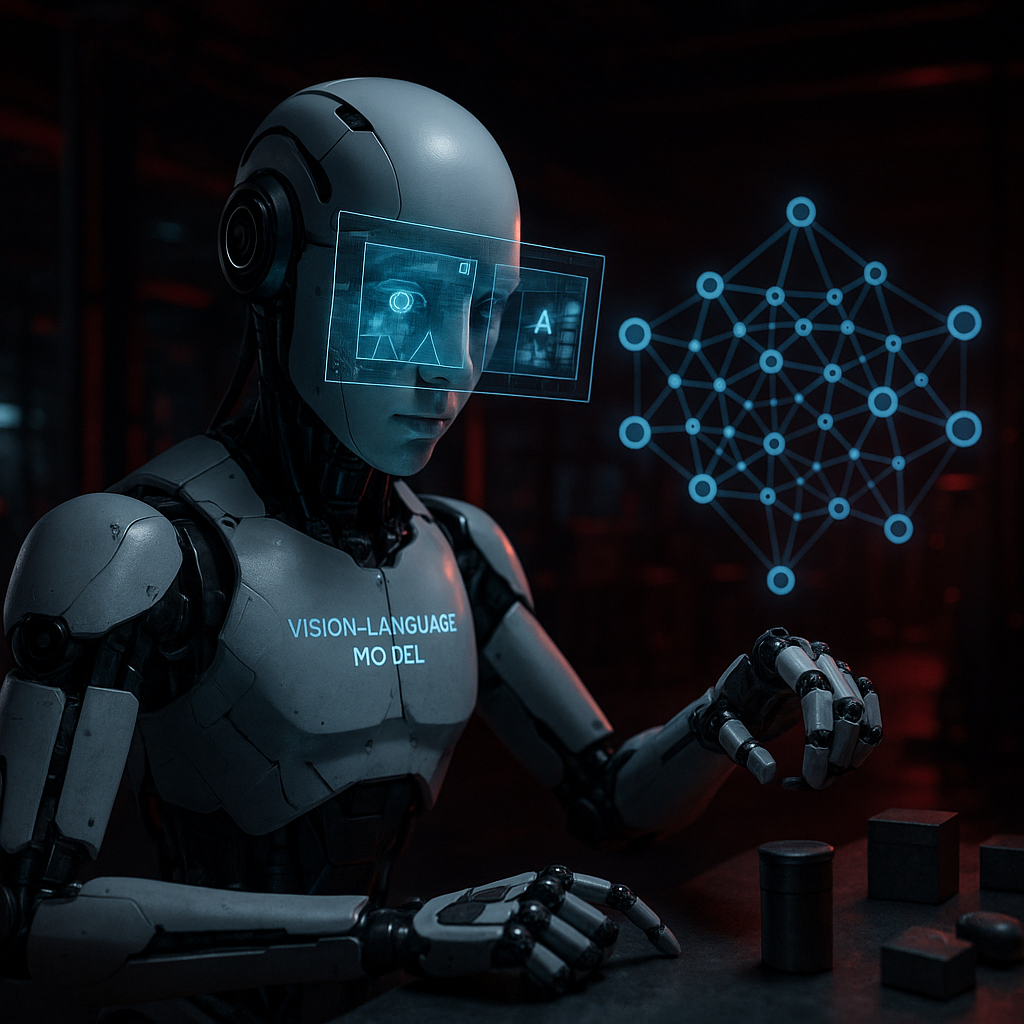
Vision-language-action models, or VLAs, connect camera observations and language instructions to robot actions. Instead of writing a separate control program for every object and task, developers adapt a pretrained model with robot demonstrations and embodiment-specific data.
The important promise is broader task and object generalization, not human-like reasoning. A VLA may emit tokenized actions, continuous trajectories, or commands for a lower-level controller. Performance still depends on training coverage, robot kinematics, sensors, latency, safety constraints, and recovery when the scene differs from the data.
 AI-generated image
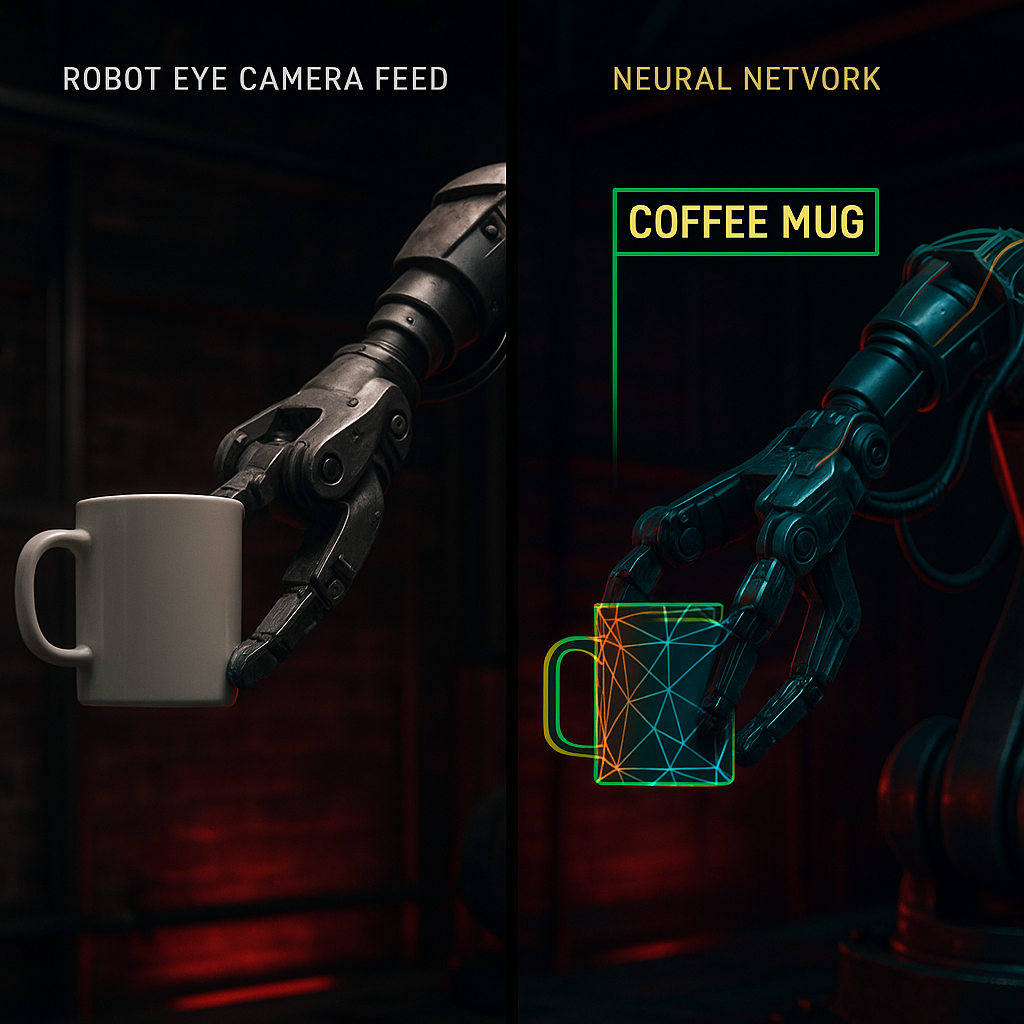
A VLA processes camera input alongside a natural language instruction and outputs robot joint commands, bridging perception and action in one model. Source: AI visualization
Key Stats
7B
Parameters in OpenVLA (open-source baseline)
970K
Real-world robot episodes in OpenVLA training set
85%
OpenVLA success rate on unseen tasks
<100ms
On-device VLA inference latency (2026 deployments)
How VLAs Work: From Pixels and Words to Motor Commands
A Vision-Language-Action model takes three things as input and produces one output. The inputs are an image (or video stream) from the robot's camera, a natural language instruction from a human operator or a higher-level planning system, and optionally the robot's current proprioceptive state (its joint positions and velocities). The output is a robot action: typically a target end-effector position, a set of joint torques, or a velocity command that gets sent to the robot's low-level controller at 20 to 50 times per second.
The architecture builds on the transformer models that power large language models. A vision encoder, typically derived from models like CLIP or SigLIP, converts the camera image into a sequence of token embeddings. Those visual tokens are concatenated with tokenized text embeddings of the language instruction and fed into a transformer backbone. The transformer produces output tokens that get decoded into continuous robot actions rather than words.
What makes this powerful is the pre-training. The vision and language components of the model are initialized from weights trained on billions of internet images and text. That pre-training gives the robot model a rich semantic understanding of the world before it has seen a single robot demonstration. When fine-tuned on even modest numbers of robot trajectories, the model generalizes far better than a system trained on robot data alone.
VLA vs. Classic Robot Learning
• Classic imitation learning: Train a policy on demonstrations of one specific task. Works well but doesn't generalize. Change the object color or position, and success rate drops sharply.
• Reinforcement learning: Optimize for a reward signal. Can discover novel strategies but requires millions of interactions and careful reward engineering. Hard to deploy safely.
• VLA approach: Start with a foundation model pre-trained on internet data, fine-tune on robot trajectories. Inherits semantic generalization from pre-training. One model handles hundreds of tasks.
Under the Hood: OpenVLA and pi-zero
 AI-generated image
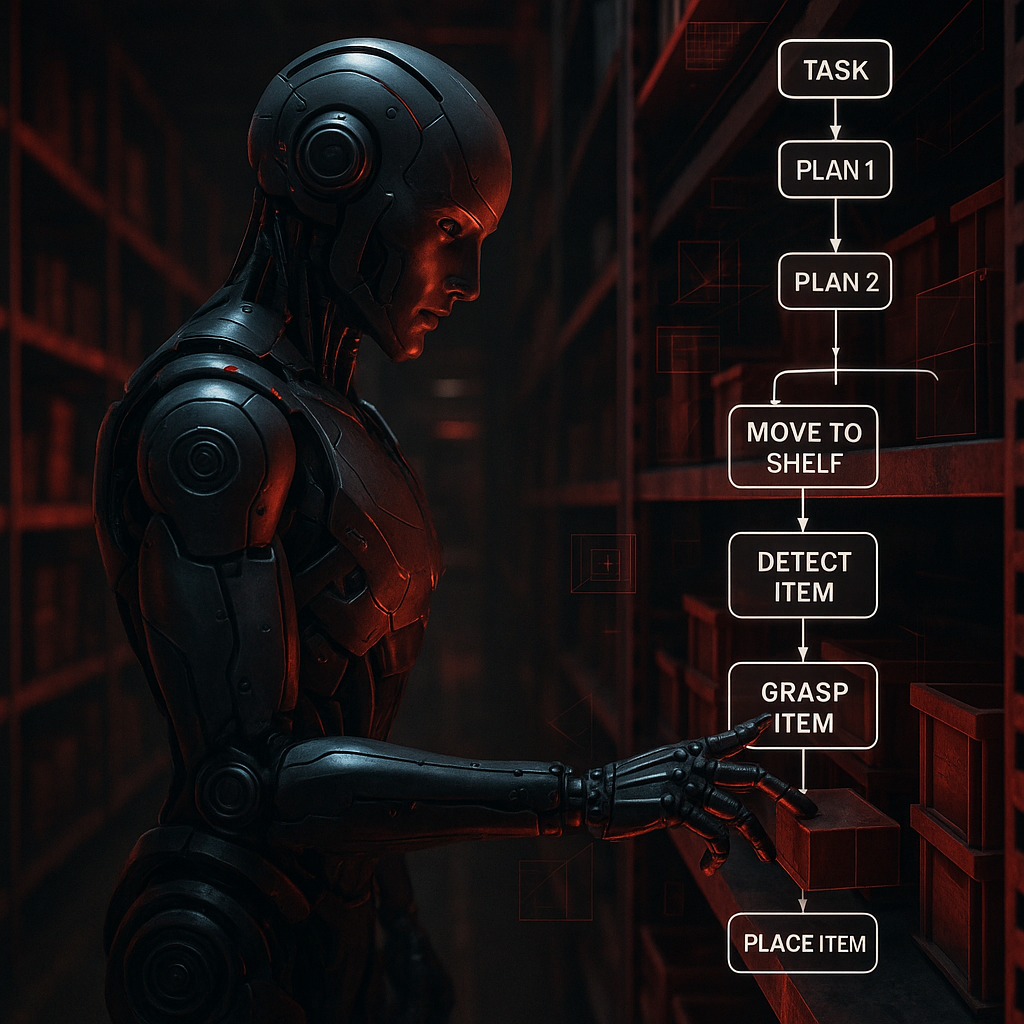
VLA-powered robots use natural language to understand context and plan multi-step manipulation tasks in unstructured environments. Source: AI visualization
Two models, released in 2024, defined the VLA baseline for the industry and remain reference points for comparing new approaches.
OpenVLA (June 2024)
Released by a team from Stanford, Google DeepMind, Toyota Research Institute, and others, OpenVLA is a 7-billion-parameter open-source VLA trained on the Open X-Embodiment dataset, which contains roughly 970,000 real-world robot episodes collected across 29 different robot platforms. OpenVLA uses a Prismatic visual encoder (combining SigLIP and DINOv2 features) and the Llama 2 7B language model as its backbone.
On a benchmark of 29 manipulation tasks across multiple robot platforms, OpenVLA achieves around 85 percent success on unseen tasks. Notably, it outperforms Google's RT-2-X, a 55-billion-parameter closed model, by 16.5 percentage points despite being 7 times smaller. The key insight is that the Prismatic encoder captures richer visual features for robotics tasks than the encoders used in earlier VLAs, and the open-source training data provides more relevant robot experience than internet data alone.
A follow-up variant, OpenVLA-OFT (Optimized Fine-Tuning), speeds up inference by 26 times through parallel action decoding rather than auto-regressive token prediction. This is important for deployment: the original OpenVLA generates actions one token at a time, which adds latency. OpenVLA-OFT predicts all action dimensions simultaneously, enabling real-time control on modest compute hardware.
pi-zero (Physical Intelligence, October 2024)
Physical Intelligence, the San Francisco startup that raised $400 million in Series B funding in 2024, released pi-zero as a demonstration of generalist robot policies for household tasks. Pi-zero uses the Prismatic-7B VLM backbone combined with a flow-matching action head that produces smooth, continuous motion rather than the discrete action tokens used in OpenVLA. This makes pi-zero particularly effective at high-dexterity tasks that require smooth trajectories, like folding laundry, loading a dishwasher, or assembling objects.
Where OpenVLA prioritizes broad task generalization across many robot types, pi-zero focuses on the quality of manipulation for complex household tasks. In head-to-head evaluations on multi-stage manipulation tasks, pi-zero's smoother action generation outperforms OpenVLA-style approaches. Physical Intelligence has since released pi-zero-fast, which improves inference speed for real-time deployment, and the company describes its commercial model as licensing the policy architecture to hardware partners.
| Property | OpenVLA | pi-zero | NVIDIA GR00T N1 |
|---|---|---|---|
| Parameters | 7B | ~7B (Prismatic backbone) | Not disclosed |
| Action output | Discrete tokens (auto-regressive) | Continuous (flow matching) | Diffusion policy |
| Open source | Yes (weights on HuggingFace) | Architecture public, weights licensed | API access (Isaac platform) |
| Primary strength | Cross-embodiment generalization | High-dexterity household tasks | Humanoid whole-body control |
| Commercial users | Research labs, startups | Hardware partners (undisclosed) | Figure AI, Agility, 1X, others |
Who's Building VLA-Powered Robots
Many leading robotics teams now describe their manipulation systems as VLAs or closely related multimodal policies. Public implementations vary widely, however, and not every company discloses enough architecture, training, or deployment evidence to make direct comparisons.
Physical Intelligence
San Francisco. pi-zero and pi-zero-fast foundation models. $400M Series B (2024). Licensing model to hardware partners. Focused on household and light industrial manipulation.
NVIDIA (GR00T)
GR00T N1 foundation model for humanoids. Announced at GTC 2025. Integrated into Isaac robotics platform. Used by Figure AI, Agility Robotics, 1X Technologies, and others. Diffusion policy action head.
Figure AI (Helix)
Proprietary VLA called Helix, developed internally. Figure 02 running Helix has logged over 67 hours of unsupervised autonomous operation at BMW. Helix 2 announced in early 2026.
Google DeepMind (RT-2, SARA-RT)
Contributed to OpenVLA dataset and architecture research. SARA-RT optimization makes RT-2-style models 15x faster. Primarily research-focused, supplying insights to commercial ecosystem.
Robot makers can train proprietary policies, adapt an open model, use a platform such as NVIDIA Isaac GR00T, or combine those approaches. The public evidence does not support assigning one supplier to every hardware company. Model choice also changes by task, robot generation, and research stage.
What VLAs Mean for Commercial Deployment
The business case for VLAs is faster adaptation: one pretrained policy can be fine-tuned across several related tasks instead of starting from scratch each time. The size of that savings is deployment-specific and still depends on demonstration collection, validation, integration, and safety work.
With a VLA, the same robot can attempt a new manipulation task after receiving a text description and a handful of demonstrations, sometimes zero demonstrations for tasks similar to what it has seen before. Figure AI reports that their Helix model can generalize to novel object configurations without additional training, which is the key enabler for deploying robots in real factory environments where no two shifts are exactly the same.
Inference remains a systems tradeoff. Quantization, smaller action heads, parallel decoding, and robot-focused accelerators can lower latency, while some deployments serve a model from a nearby workstation. Whether control is fully on-device depends on model size, observation rate, action horizon, hardware, and the fallback behavior required when compute or networking fails.
What's Coming Next
The VLA field is advancing on several fronts simultaneously. The immediate focus in 2026 is on long-horizon tasks: current VLAs handle individual manipulation steps well but struggle with tasks requiring 10 or 20 sequential actions where an error early in the sequence cascades. World model approaches, where the robot simulates future states before acting, are one proposed solution. Dexterity's Foresight World Model, trained on 100 million real-world manipulation actions, demonstrated long-horizon autonomous truck loading in early 2026.
Data is the other major constraint. VLAs improve with more robot demonstration data, but collecting that data at scale is expensive. Simulation is one lever: NVIDIA's Isaac platform generates synthetic robot trajectories, and several teams use domain randomization to train VLAs in simulation before real-world deployment. The sim-to-real gap, how well simulation-trained policies transfer to physical robots, is the key technical problem being worked in parallel with architecture improvements.
Frequently Asked Questions
Can a VLA control any robot, or only specific hardware?
Cross-embodiment VLAs like OpenVLA were explicitly trained on data from 29 different robot platforms and can generalize across hardware to some degree. In practice, best performance comes from fine-tuning on data from the specific robot being deployed. Foundation model providers like NVIDIA offer GR00T as a starting point that hardware companies fine-tune for their specific kinematics and sensor configurations. A model trained only on 6-DOF robot arms won't generalize well to a bipedal humanoid without fine-tuning on humanoid data.
How many robot demonstrations does a VLA need to learn a new task?
This depends heavily on how similar the new task is to the model's training distribution. For tasks closely related to seen training data, current VLAs can sometimes generalize with zero demonstrations (zero-shot). For genuinely novel tasks in new environments, anywhere from 10 to 100 teleoperated demonstrations typically gets the policy to reliable performance. Classic imitation learning methods with no VLA foundation require hundreds to thousands of demonstrations for the same result. The efficiency advantage of VLAs comes from their pre-trained semantic understanding, not any fundamental data-free capability.
What's the difference between a VLA and a diffusion policy?
A diffusion policy is a method for generating smooth, multi-modal robot trajectories by iteratively denoising action predictions, analogous to image diffusion models. It's a technique for the action generation component of a robot policy, not a complete model architecture. A VLA is an end-to-end architecture that includes vision encoding, language processing, and action output. Some VLAs use diffusion for their action head (NVIDIA GR00T does this), while others use auto-regressive token prediction (OpenVLA) or flow matching (pi-zero). Diffusion policies are often used standalone, without a language instruction interface, in purely imitation-learning settings.
Do VLAs work in unstructured environments like homes?
Not reliably yet. Current commercial VLA deployments are in structured factory and warehouse environments where object placement is relatively predictable and lighting is controlled. Household environments, with their infinite variation in object types, configurations, and lighting conditions, remain a harder problem. Physical Intelligence's pi-zero demonstrated household task performance in controlled settings in 2024, but consistent reliability in arbitrary homes, the kind needed for a consumer product, is likely still 2 to 4 years away. The data problem is the main bottleneck: robots haven't been in enough varied homes to train on.
How do VLAs handle task failures and errors?
Current VLAs are not robust to failures in the way a careful human is. If a robot picks up an object incorrectly partway through a task, the policy may not recognize the error state and continue with incorrect assumptions. Error recovery is an active research area. Some approaches add an explicit failure detector that pauses the policy and requests human intervention. Others train on failure demonstrations so the model learns to recognize and recover from common error states. Long-horizon reliability, the ability to complete a 20-step task without any human intervention, is currently the primary performance gap between lab demonstrations and production deployment.
The 12-Month Outlook
VLA research moved quickly from RT-series systems to open models and commercial prototypes. The next useful signals are not announcement counts but task-level success rates, recovery behavior, intervention frequency, and sustained hours on the same hardware and workload.
The competitive dynamic between foundation model providers, hardware manufacturers, and software integrators will also clarify. NVIDIA has the strongest position today, with GR00T integrated into most major hardware platforms. Physical Intelligence is the most sophisticated pure-play foundation model company. Whether this segment consolidates around one or two dominant model providers, or remains fragmented with multiple competing architectures, will shape the economics of the humanoid robot market for the rest of the decade.
The Bottom Line: Vision-language-action models are a promising way to reuse visual and language pretraining for robot control, but benchmark generalization is not the same as reliable, unsupervised production work.
The open questions span both research and engineering: data quality, cross-embodiment transfer, long-horizon error recovery, force-aware control, inference latency, and safety under distribution shift. Progress is real, but the evidence should be read task by task and system by system.