Company Profiles
Figure 02: The Robot Built for Real Work
Figure 02 is the most commercially advanced humanoid robot in 2026 — 60 kg, 16 DOF hands, 25 kg payload, deployed at BMW's Spartanburg plant, backed by $1.75B+ in funding and a $39B valuation. Here's the full technical and business picture.

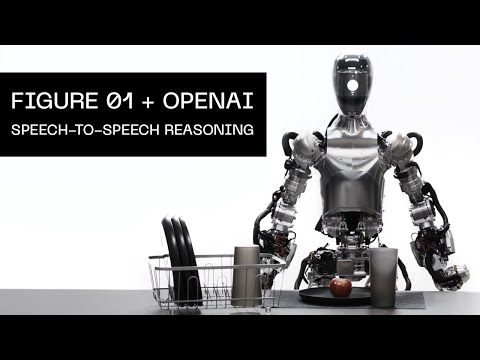 Official source video
Figure 02 launched in August 2024 as the most commercially advanced humanoid robot then available — a 60 kg, 1.70 m bipedal platform with 16 degrees of freedom in each hand, capable of carrying 25 kg, and already deployed at a BMW Group manufacturing facility in Spartanburg, South Carolina. While competitors were still running lab demos, Figure was generating real production data.
The Figure 02 represents a clear philosophical bet: ship early, learn from real environments, iterate fast. Founded in 2022 by Brett Adcock — who previously founded Archer Aviation and Vettery — Figure AI has moved from zero to factory deployment in under three years, backed by $675 million in Series B funding from a consortium that includes Jeff Bezos, Microsoft, Nvidia, Intel, Amazon, and OpenAI. By September 2025, a third round brought the total valuation to $39 billion.
 Illustration
Figure 02 performing assembly tasks at the BMW Spartanburg plant. Source: Figure AI
Key Stats — Figure 02
60 kg
Robot Weight
1.70 m
Height
25 kg
Payload Capacity
16 DOF
Per Hand
6
RGB Cameras
$39B
Company Valuation (Sep 2025)
3×
Compute vs Figure 01
$675M
Series B Raised
Speed as Strategy: The Figure AI Story
Figure AI was founded in 2022 by Brett Adcock with an explicit mandate: build a commercially deployable humanoid robot faster than anyone thought possible. Adcock's prior companies — Vettery (acquired by Adecco) and Archer Aviation (NYSE: ACHR) — gave him a playbook for hard-tech startups: hire fast, move faster, and don't let perfect be the enemy of deployed.
Figure 01, released in early 2024, was the company's first public platform. It was deliberately optimized for speed-to-deployment over technical elegance — a robot capable enough to generate real-world data, not impressive enough to be a research marvel. That philosophy paid off: the BMW partnership announced in January 2024 gave Figure access to a real factory floor before the Gen 1 hardware was even fully proven.
Figure 02, announced in August 2024, represented the lessons learned from that first deployment wave. Every major subsystem was redesigned: integrated cabling replaced exposed wiring, a battery was moved into the torso for better weight distribution, compute was tripled with NVIDIA RTX GPU-based modules, and the hands were completely rebuilt with 16 DOF per hand and 25 kg carrying capacity. The result is a robot that's ready for structured industrial environments — not a demo, but a platform generating production hours.
🏭 BMW Spartanburg Deployment
Figure 02 robots are performing real tasks at BMW's largest North American manufacturing facility — sheet metal parts handling, inspection support, and material transport on the production line.
🤖 Helix VLA Model
Figure's proprietary vision-language-action model, Helix, runs on Figure 02's onboard compute. It enables generalist manipulation — the robot can interact with objects it hasn't explicitly been trained on, guided by natural language commands.
🏗️ BotQ Factory
Announced March 2025, BotQ is Figure AI's dedicated humanoid manufacturing facility targeting 12,000 robots per year — and it plans to use its own robots to help build more robots.
📡 OpenAI Partnership (2024)
Figure's $675M round included an OpenAI collaboration to build specialized vision-language models for Figure's robots. The partnership ended in 2025 as Figure shifted to its own Helix VLA architecture — which it calls generationally superior.
Under the Hood: Figure 02's Hardware Architecture
Figure 02's hardware represents a clean-sheet redesign from Figure 01, driven by six months of real deployment data from the BMW facility. The engineering team identified three core failure modes in Figure 01: cable routing that snagged in tight spaces, insufficient compute for real-time VLA inference, and hands that lacked the fine-motor resolution for precision tasks. All three were addressed in Figure 02.
Hands: The Core Differentiator
The Figure 02 hands are arguably the most sophisticated on any commercially deployed humanoid. Each hand has 16 degrees of freedom — more than the Optimus (11 DOF in Gen 2, 22 in Gen 3 hands) and far more than Boston Dynamics Atlas (which prioritizes whole-body strength over hand dexterity). The hands can carry up to 25 kg and manipulate objects with enough precision to handle automotive assembly components without damage.
The follow-on Helix platform (announced February 2025) pushed this further with 35 total DOF, human-like wrist articulation, embedded palm cameras, and custom tactile sensors capable of detecting forces as small as three grams. Those sensors feed directly into the Helix VLA model, enabling closed-loop manipulation control that doesn't require pre-programmed grasp strategies for every object type.
Vision and AI Compute
Figure 02 is equipped with six RGB cameras providing overlapping fields of view — covering the workspace around both hands, forward locomotion, and overhead clearance. The cameras feed a custom onboard vision-language model running on NVIDIA RTX GPU-based modules, delivering 3× the inference throughput of Figure 01. The compute architecture is split between a high-level planner (System 2, running at 7–9 Hz) for task reasoning and a low-level controller (System 1, running at 200 Hz) for joint-level motion execution — a design shared with the newer Helix platform.
Illustration
Figure 02's five-fingered hands feature 16 degrees of freedom each — enabling precise manipulation of automotive components at the BMW Spartanburg plant.
Specs Comparison: Figure 02 vs. The Field
| Spec | Figure 02 | Tesla Optimus Gen 2 | Boston Dynamics Atlas | Agility Digit |
|---|---|---|---|---|
| Height | 1.70 m | 1.73 m | 1.90 m | 1.75 m |
| Weight | 60 kg | 57 kg | 90 kg | ~65 kg |
| Payload Capacity | 25 kg | 20 kg | 30 kg (sustained) | ~16 kg |
| Hand DOF | 16 per hand | 11 DOF (Gen 2) / 22 (Gen 3) | Not disclosed | ~7 per hand |
| Cameras | 6 RGB | Cameras + ultrasonic | 360° camera array + tactile | Stereo cameras |
| Battery Life | ~4 hrs (work tasks) | ~2–4 hrs | 4 hrs (self-swappable) | ~4 hrs |
| Commercial Status | Deployed (BMW) | Internal (Tesla only) | Pilot (Hyundai) | Deployed (Amazon/GXO) |
| Total Funding | $1.75B+ | Internal (Tesla) | Hyundai owned | ~$150M |
Key Insight: What Figure 02 Does Differently
Where Tesla Optimus prioritizes cost reduction through vertical integration and Boston Dynamics Atlas prioritizes raw physical capability, Figure 02's bet is on hand dexterity plus fast AI iteration. The 16-DOF hands combined with an onboard VLA model that updates via over-the-air software pushes creates a robot where the hardware is good enough today and the software will close the gap on everything else. This is a Silicon Valley product strategy applied to robotics — ship hardware that's 80% right, let software get to 100%.
Figure AI: The Full Picture
2022
Founded (San Jose, CA)
$39B
Valuation (Sep 2025)
12K
BotQ Annual Capacity
180+
Employees
3
Robot Generations (01, 02, 03)
BMW
Primary Deployment Partner
Figure AI's investor roster is a signal of confidence as much as a source of capital. The February 2024 Series B round was led by a consortium that reads like a who's-who of technology and industrial capital: Jeff Bezos personally participated, alongside Microsoft, Nvidia, Intel, Amazon Industrial Innovation Fund, and OpenAI. The $675 million raised in a single round — at a $2.6 billion valuation — was among the largest single rounds in robotics history at the time. By September 2025, a third financing round valued the company at $39 billion, with investors including Qualcomm, T-Mobile, Salesforce, and Brookfield Asset Management.
The funding is being deployed in two directions simultaneously: accelerating Figure 02 hardware iteration and building the software stack. The March 2025 announcement of BotQ — a dedicated humanoid manufacturing facility in California targeting 12,000 robots per year — signals that Figure is now in production-scaling mode, not just R&D mode. BotQ is designed with an unusual recursive element: Figure's own robots will help build future robots, creating a compounding feedback loop for both manufacturing throughput and robot learning.
The October 2025 introduction of Figure 03 — a complete hardware and software redesign aimed at general-purpose home environments — further signals that Figure's commercial strategy spans both industrial B2B and eventual consumer B2C markets. Figure 03 adds wireless inductive charging, soft exterior materials for home safety, washable textiles, and UN38.3-certified battery safety layering. The separation of industrial (Figure 02, deployed at BMW) and consumer (Figure 03, built for homes) use cases positions Figure to pursue multiple addressable markets simultaneously.
Leadership
• Brett Adcock (CEO/Founder): Serial entrepreneur — founded Vettery (acquired by Adecco Group) and Archer Aviation (NYSE: ACHR). Known for aggressive hiring and timeline compression.
• Ashok Elluswamy (AI Direction): Previously led Tesla Autopilot. Helix VLA model development reflects Tesla-style end-to-end neural network architecture philosophy.
• Investors: Jeff Bezos, Microsoft, Nvidia, Intel, Amazon, OpenAI, Qualcomm, T-Mobile, Salesforce, Brookfield Asset Management.
What Figure 02 Means for Manufacturing
The BMW Spartanburg deployment isn't just a proof of concept — it's a commercial template. BMW isn't running a charity pilot; they're deploying robots where they generate measurable ROI. The specific tasks Figure 02 performs at Spartanburg — sheet metal handling, component transport, inspection assistance — are precisely the roles that are physically demanding, highly repetitive, and increasingly difficult to staff in the current labor market. Average turnover rates in automotive assembly exceed 30% annually; robot turnover is zero.
The implications for automotive manufacturing are significant. BMW's Spartanburg plant produces approximately 1,500 vehicles per day and employs over 11,000 people. Even a modest deployment of 50–100 humanoid robots at a facility that size represents a meaningful productivity uplift on specific tasks. More importantly, the data those robots generate — about task performance, failure modes, manipulation strategies — feeds back into Figure's AI training pipeline, accelerating capability development for future deployments.
The Robot-as-Data-Source Model
Figure 02's commercial deployment isn't primarily about revenue from robot sales — it's about generating training data at scale. Every hour a Figure 02 robot spends at BMW creates more vision-manipulation data than weeks of lab simulation. The robots that are commercially deployed today are building the AI capability that will make the next generation dramatically more capable. This is the flywheel that justifies $39 billion in valuation despite minimal revenue.
The broader labor market signal is nuanced. Humanoid robots in 2026 are not replacing human workers wholesale — they're filling specific task slots in structured environments where repeatability and endurance matter more than adaptability. The more meaningful displacement risk in manufacturing is further out: as VLA models like Helix become capable of handling novel objects and unstructured environments, the task set robots can perform expands. Industry analysts at Goldman Sachs projected in 2024 that the humanoid robot market could reach $38 billion annually by 2035, which implies a significant acceleration of robotic penetration into manufacturing, logistics, and services.
The 12-Month Outlook: Figure in 2026–2027
Figure's near-term roadmap centers on three concurrent tracks. First, scaling the BMW deployment: the January 2024 partnership agreement outlined plans for up to 1,000 Figure robots at BMW facilities — the current deployment is in double digits. Reaching hundreds of deployed units will require both BotQ manufacturing capacity and the software reliability that comes from iterating on real deployment data.
Second, Figure 03 is targeting consumer markets in 2026–2027. The home robot use case is fundamentally different from automotive manufacturing — unstructured environments, unpredictable human cohabitation, extreme safety requirements. Figure 03's soft exterior materials, wireless charging, and multi-density foam coverings reflect genuine engineering investment in home-safe operation. BotQ's 12,000-unit annual capacity would need to scale substantially to meet any meaningful consumer demand, but the architecture is being established now.
Third, Helix VLA is Figure's platform play. The vision-language-action model that currently runs on Figure 02 is the same model that will run on Figure 03 — and on any future hardware. If Helix becomes the industry's leading generalist manipulation model, Figure doesn't just sell robots; they control the AI layer that makes humanoid robots commercially viable. That's a platform business, not a hardware business, and it's valued accordingly.
Key Milestones to Watch
• BotQ production ramp (2026): First robots rolling off the new manufacturing line — confirms production scalability.
• BMW deployment count (2026): Movement from tens to hundreds of deployed units validates commercial contract terms.
• Figure 03 pre-order/launch (2026–2027): Consumer pricing, delivery timeline, and initial deposit campaign.
• Helix external licensing: Any announcement of Helix VLA licensing to third-party hardware manufacturers would signal a platform strategy pivot.
• New enterprise contracts: BMW was announced partner #1. Who's partner #2, #3, #4? Next contracts define the market addressability.
Frequently Asked Questions
How much does Figure 02 cost to purchase or lease?
Figure AI has not publicly disclosed unit pricing for Figure 02. The BMW partnership is structured as a commercial deployment contract rather than a robot sale. Industry estimates for early-commercial humanoid robots range from $100,000 to $250,000 per unit at current production volumes. Figure's long-term target — shared by most players in the space — is sub-$50,000 per unit at high-volume manufacturing scale, comparable to industrial robot arms from Fanuc or Kuka.
What specific tasks does Figure 02 perform at BMW?
Based on available disclosure from Figure AI and BMW, Figure 02 is performing sheet metal parts handling, component transfer between workstations, and inspection support tasks at BMW's Spartanburg, South Carolina facility. These are structured tasks with defined start/end states — not fully autonomous general manipulation. The robots operate on defined routes and task sequences, with human supervisors monitoring performance remotely via Figure's fleet management software.
What is the Helix model and how does it relate to Figure 02?
Helix is Figure AI's vision-language-action (VLA) model — the AI system that translates natural language commands and camera input into robot motion. It runs on Figure 02's onboard NVIDIA GPU compute. The Helix system uses a two-tier architecture: System 2 handles high-level task planning at 7–9 Hz, while System 1 manages low-level joint control at 200 Hz. The Helix platform announced in February 2025 refers to an evolved hardware+software combination (35 DOF, new hands) distinct from Figure 02, but the Helix VLA model itself runs on both platforms.
Why did Figure end its OpenAI partnership?
Figure AI terminated its OpenAI collaboration in 2025, stating that large language models are "getting smarter yet more commoditized." The implication: the general-purpose AI layer is becoming a commodity, and the differentiated value in robotics is the robot-specific manipulation model (like Helix), not the underlying language model. By building Helix in-house, Figure retains full control over their AI stack and avoids dependency on a third-party provider that also competes (indirectly) in the robot intelligence space.
When will Figure robots be available for non-automotive industries?
Figure's current commercial focus is automotive manufacturing, where the BMW partnership provides a controlled environment for iterating on hardware and software. Figure 03, announced in October 2025, targets home environments — suggesting a consumer launch in 2026 or 2027. Logistics and warehousing are the most likely next industrial vertical, given the similarity to automotive: structured environments, high repetition, clear ROI metrics. An expansion announcement into a second industry vertical is expected in 2026.
Conclusion: Deployment Is the Moat
Figure 02 isn't the most technically impressive humanoid robot on the market. Boston Dynamics Atlas has more raw physical capability; Tesla Optimus has the advantage of scale manufacturing from a company that builds 1.8 million vehicles annually. But Figure 02 has something both competitors lack as of early 2026: a real commercial deployment generating real production data. Every shift Figure 02 works at BMW is a data collection session that makes the next version smarter.
At a $39 billion valuation with BotQ ramping toward 12,000 units per year and three robot generations in three years, Figure is executing with a pace that the field hasn't seen before. The question for 2026 and 2027 isn't whether Figure 02 works — it's whether the BMW deployment can be replicated across other OEMs, other industries, and eventually, homes. That's the $39 billion question.
The Bottom Line: Figure 02 is the commercial vanguard of the humanoid robot industry — not the most capable platform technically, but the most commercially advanced, generating real deployment data that compounds into AI capability at a pace no lab-only competitor can match.