Robot Hardware
Humanoid Robot End Effectors Explained: Hands, Grippers, and Tooling for Real Work
Humanoid robot end effectors range from dexterous hands to rugged grippers and tool changers. The choice shapes payload, reliability, cost, and deployment speed.
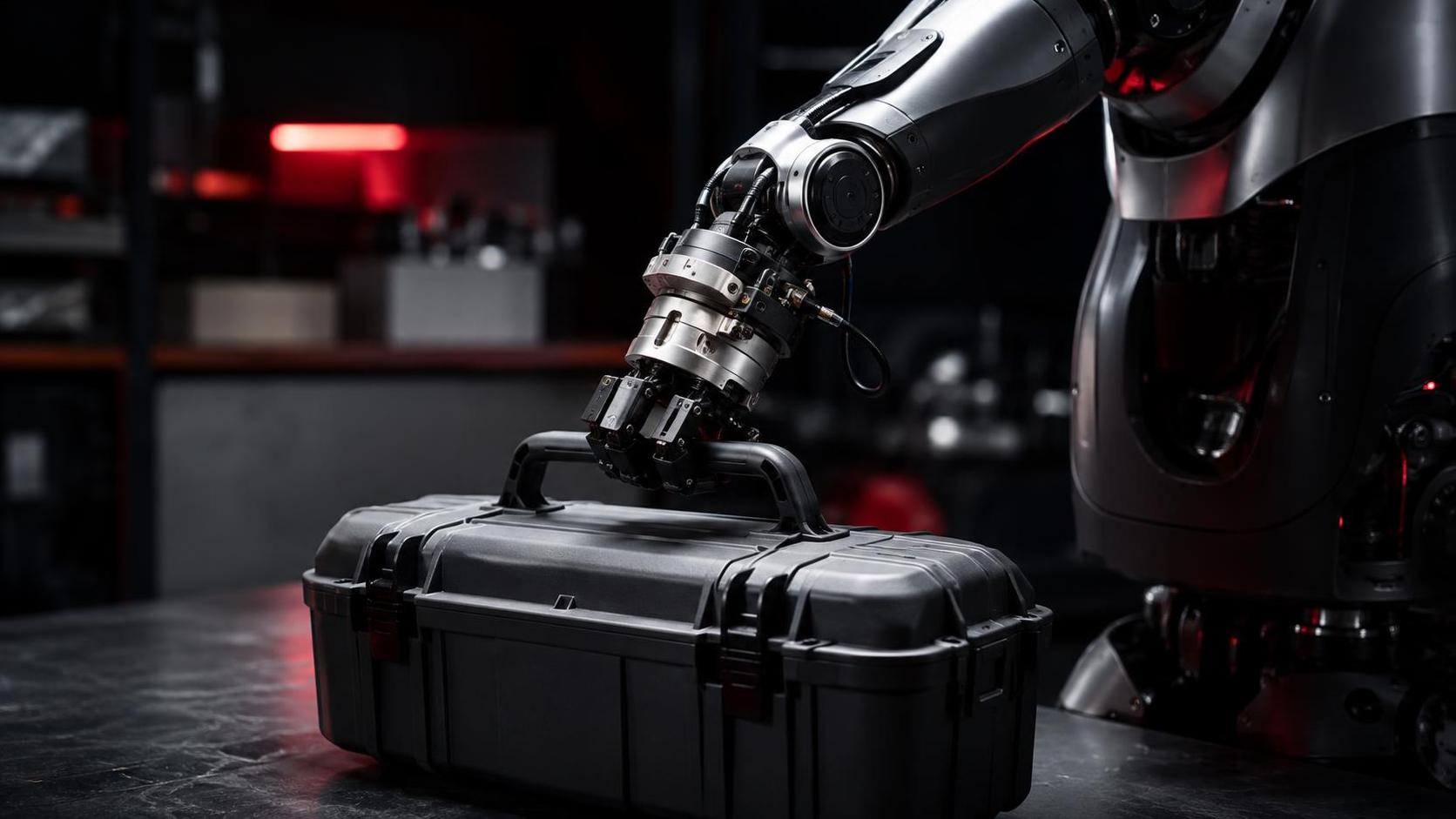
Walking gets the demo views. End effectors decide whether a humanoid can actually move parts, use tools, and survive the factory.
Humanoid robot end effectors range from dexterous hands to rugged grippers and tool changers. The choice shapes payload, reliability, cost, and deployment speed.
Why the wrist matters
Locomotion gets a humanoid to the task. The end effector determines whether it can complete that task repeatedly, safely, and at an acceptable maintenance cost.
Key Stats
5-20+
Typical hand DOF range
24/7
Factory uptime target
kg-level
Payload constraint at wrist
mm-scale
Repeatability target for fixtures
Humanoid robots are usually judged by their gait, their face, or the smoothness of a demo video. Factory customers judge something more practical: what happens at the wrist. The end effector is the part that touches the job, whether it is a five-finger hand, a two-jaw gripper, a suction cup, a tool changer, a scanner, or a custom fixture.
A humanoid with impressive locomotion but a fragile hand is a research platform. A robot with modest walking ability and a reliable end effector can become useful in a warehouse, lab, or factory cell. That is why end effectors are becoming one of the quiet dividing lines between video-ready humanoids and deployable robots.
What an End Effector Does
An end effector is the terminal device attached to a robot arm. Industrial robots have used them for decades: weld guns, grippers, suction tools, screwdrivers, polishers, sprayers, and inspection sensors. Humanoids bring the same question into a mobile, human-shaped package. The machine still has to grasp, press, pull, twist, scan, carry, place, and release with enough reliability to justify its cost.
The human hand is a tempting reference, but it is not always the best engineering target. A human hand has high dexterity, rich tactile sensing, soft tissue compliance, and a lifetime of learned manipulation. A robot hand can imitate some of that behavior, but every joint, tendon, motor, sensor, cable, and fingertip adds cost and failure modes.
That is why many commercial deployments start with constrained tools. A simple parallel gripper can be stronger, cheaper, easier to seal, easier to repair, and easier to certify than a dexterous hand. A tool changer can let one robot use several specialized tools without asking one hand to do everything.
| End Effector Type | Strength | Tradeoff |
|---|---|---|
| Dexterous hand | Can handle varied objects and human tools | Higher cost, more parts, harder control |
| Parallel gripper | Reliable for totes, boxes, trays, and fixtures | Limited object variety |
| Suction tool | Fast picking of flat or packaged goods | Poor on porous, dusty, or irregular surfaces |
| Tool changer | Lets one robot swap specialized tools | Needs fixtures, alignment, and process design |
| Custom fixture | Best reliability for one task | Least flexible across tasks |
Dexterity Versus Uptime
The core tradeoff is dexterity versus uptime. A hand with more degrees of freedom can wrap around more shapes, recover from imperfect grasps, and use human-designed tools. It also has more joints to calibrate, more parts to break, and more control decisions to make. In a lab, that complexity is exciting. In a factory, it is a maintenance question.
Tesla has emphasized high-actuator hands for Optimus because the company wants a general-purpose humanoid that can work in spaces designed for people. Figure, Apptronik, Agility Robotics, Sanctuary AI, Fourier, Unitree, UBTECH, and others make different hardware choices depending on whether they prioritize manipulation, payload, cost, or deployment speed.
A logistics task often rewards robustness more than finger count. Moving totes, carts, bins, and boxes can be solved with handles, grippers, hooks, or purpose-built attachments. Fine assembly, lab work, tool use, and mixed-object picking need richer contact sensing and control. The right answer depends on the work cell, not the press photo.
Deployment rule
If the object can be redesigned with a handle, fixture, or presentation tray, the robot may not need a human-like hand at all.
Sensing at the Contact Point
End effectors are also sensor platforms. Cameras see the scene before contact, but the wrist and fingers learn what happened during contact. Force-torque sensors estimate load and contact direction. Tactile sensors detect pressure distribution. Motor current can reveal stalls or slipping. Encoders report joint position. All of that data feeds grasp planning and safety.
Tactile sensing is especially important for deformable, slippery, or fragile objects. A robot lifting a cable, plastic bag, or foam tray cannot rely on geometry alone. It needs to know whether it has contact, whether the object is shifting, and whether more force would damage the item. That is why tactile sensing is tied closely to dexterous manipulation research.
For industrial tasks, wrist force sensing may be enough. A robot inserting a part, opening a drawer, or pushing a cart needs to feel reaction forces through the arm. The end effector does not need human-like skin for every job. It needs the right contact signal for the process.
Tool Changers Matter More Than Demos Admit
A tool changer is a mechanical and electrical interface that lets a robot swap end effectors. Industrial automation uses tool changers when one robot needs to weld, grip, inspect, or dispense during different steps. Humanoids can use the same idea, but mobility makes the interface harder. The robot must align itself, dock reliably, confirm the tool is latched, route power or data, and recover if the swap fails.
Tool changing can reduce the impossible requirement that one hand solve every job. A humanoid might use a rugged gripper for totes, a scanner for inventory, a screwdriver for maintenance, and a soft gripper for irregular packages. The deployment becomes less magical and more like conventional automation with legs.
The downside is process design. Tools need storage positions. Workflows need swap time. Software needs to know which tool is attached. Safety systems need to understand each tool’s hazard profile. A sharp tool, powered driver, or heavy gripper changes the risk model around nearby people.
What Customers Should Ask
Customers evaluating humanoids should ask end-effector questions early. What payload is rated at the wrist, and at what arm extension? How many cycles has the hand survived? How long does replacement take? What happens when a fingertip wears out? Can the robot detect a dropped object? Can it cleanly release a failed grasp? Can the gripper be washed, sealed, or used near dust?
The answers will reveal whether a vendor is selling a platform or a deployment. A serious warehouse pilot should include object libraries, grasp success rates, mispick rates, recovery behaviors, maintenance intervals, spare parts, and tool life. A serious factory pilot should include fixtures, tolerance stackups, force limits, lockout procedures, and safe-state behavior.
This is also where economics show up. A dexterous hand that costs more but eliminates custom fixtures may win in a changing environment. A cheap gripper that needs every item redesigned may lose flexibility. A tool changer may be the middle path if the customer can standardize a few high-value workflows.
The 2026 Bottom Line
Humanoid robotics is moving from walking demos to work demonstrations. That shift moves attention from legs to wrists. The end effector decides whether the robot can touch the world productively, safely, and repeatedly.
The winners may not be the robots with the most human-like hands. They may be the platforms that combine acceptable dexterity with rugged tooling, fast maintenance, good sensing, and honest process design. In real deployments, the best hand is the one that finishes the shift.
That makes end effectors one of the most important hardware choices in physical AI. The robot’s brain can plan the task. The wrist has to close the deal.
The Mechanical Interface
The wrist interface is a small part with large consequences. It has to carry payload, transmit torque, route electrical power, carry data, tolerate impacts, survive dust, and stay compact enough that the robot can still reach human workspaces. If the wrist is weak, the arm rating becomes theoretical. If the connector is fragile, tool changing becomes a downtime source.
Industrial arms often solve this with standardized flanges and known payload ratings. Humanoids complicate the problem because the arm is lighter, the body moves, and the robot may be working around people. A gripper that looks fine on a fixed arm may create balance and collision problems on a walking platform. The end effector has to be evaluated as part of the whole body.
Cable routing is another deployment issue. External cables snag. Internal cables fatigue. Finger tendons stretch. Connectors loosen after repeated tool swaps. A maintenance team cares about these details because they decide whether a robot can run a full shift without a technician hovering nearby.
Software at the Wrist
Manipulation software has to bridge perception and contact. The robot identifies an object, estimates pose, plans an approach, closes the gripper or fingers, senses contact, lifts, monitors slip, moves, places, and releases. Each step can fail. A good end-effector stack detects failure early and recovers gracefully.
Dexterous hands raise the planning burden. The robot has to choose contact points, finger poses, force levels, and sometimes in-hand manipulation. A simple gripper reduces that search space. This is why a less flexible tool can outperform a clever hand when the task is repetitive and the objects are known.
Learning systems are changing the equation. Vision-language-action models and imitation learning can help robots generalize across objects, but the hardware still defines what actions are possible. A policy trained on a five-finger hand does not automatically transfer to a two-jaw gripper. Hardware choice and model training are linked.
Human Tools Are a Trap and an Opportunity
Humanoid vendors often argue that human-shaped robots can use human tools. That is partly true and partly dangerous. A screwdriver, box cutter, cart handle, valve, or power drill was designed around human grip strength, skin friction, wrist motion, and judgment. A robot can use some of those tools, but safe reliable use requires sensing, torque limits, fixtures, and recovery behavior.
The opportunity is huge because the built world is full of human interfaces. Door handles, tote handles, shelves, bins, ladders, carts, switches, and tools already exist. A humanoid that can use enough of them avoids expensive facility redesign. The trap is assuming anthropomorphic shape automatically delivers anthropomorphic skill.
The most practical deployments will probably mix approaches. Redesign the easy interfaces with robot-friendly handles and fixtures. Keep human-like manipulation for the cases where redesign is too expensive or the task variety is too high. Use tool changers when a fixed set of specialized tools beats one general hand.
Maintenance Economics
End effectors are wear parts. Fingertips abrade. Pads lose friction. Suction cups age. Bearings loosen. Gearboxes develop backlash. Sensors drift. Tool changers collect debris. A humanoid business case that ignores wrist maintenance is incomplete.
Customers should measure cost per successful manipulation, not just robot hourly cost. If a robot drops items, damages parts, needs frequent recalibration, or requires expensive hand replacements, the apparent labor savings shrink quickly. The end effector may be a small share of purchase price and a large share of operational pain.
This is why rugged grippers will stay relevant even as dexterous hands improve. The market does not reward the most elegant hand in isolation. It rewards the system that completes useful tasks at acceptable cost, with predictable maintenance and documented safety behavior.
The Pilot Checklist
A customer running a humanoid pilot should define the end-effector problem before the robot arrives. List the objects, weights, surfaces, handles, tolerances, orientations, cycle times, and failure consequences. A robot that can grasp ten friendly demo objects may struggle with a glossy bag, a warped tote, a loosely stacked tray, or a part presented a few centimeters out of position.
The pilot should measure grasp success by task stage. Did the robot identify the object, approach without collision, make stable contact, lift cleanly, carry without slip, place accurately, and release without dragging? A single success rate hides where the system is failing. A useful pilot separates perception errors from contact errors, motion errors, and recovery errors.
Maintenance should be tracked from day one. Count fingertip replacements, pad cleaning, gripper recalibration, tool-change failures, loose fasteners, cable wear, and sensor faults. These may look like small notes during a demo week. At fleet scale, they decide staffing levels and service margins.
Safety teams should evaluate the end effector as a hazard source. A soft hand, rigid gripper, powered tool, hook, suction cup, or sharp fixture all create different risks. The robot’s safe speed, force limits, emergency stop behavior, and human proximity rules should reflect the attached tool. A tool changer makes this dynamic because the hazard profile can change during the shift.
The strongest commercial signal is repeatability. A humanoid that completes one impressive manipulation once is interesting. A humanoid that completes the same useful manipulation hundreds of times with logged failures, fast recovery, and cheap maintenance is a product candidate. End effectors are where that difference becomes visible.
How to Read the Signals
Readers should separate hand demos from task economics. A video can show dexterity, but deployment requires cycle counts, recovery behavior, spare-part cost, safety limits, payload at reach, and repeatability across messy objects. Watch pilots that publish grasp success rates, maintenance intervals, tool-life data, and customer workflows. The strongest signal is not a single clever manipulation. It is a boring shift log showing the robot completed useful work again and again with limited human reset.
The companies that matter most are the ones testing end effectors against actual customer jobs. Tesla, Figure, Apptronik, Agility Robotics, Sanctuary AI, Boston Dynamics, Unitree, Fourier, UBTECH, and component suppliers will all make different wrist choices. The market will sort those choices by uptime, repairability, and task value. That makes cost per successful manipulation the key metric.
The reader should also expect mixed hardware. Some humanoids will use dexterous hands because the customer needs flexibility. Others will use grippers because the job is repetitive. Some will use tool changers because several constrained tasks beat one broad promise. That mix is healthy. It means the field is moving from theater toward process engineering.
FAQ
Why does this topic matter in 2026?
Because the sector is moving from isolated demonstrations toward repeatable infrastructure, procurement, and operations.
What should readers watch next?
Watch for standards, field data, supplier choices, and operating metrics. Those signals are more durable than single-company claims.
What is the main risk?
The main risk is treating a systems problem as a single component problem. Hardware, software, rules, data, and maintenance all have to mature together.