Technology
Tactile Sensing in Humanoid Robots: How Machines Learn to Feel
When a robot closes its hand around an object, the camera goes blind. Tactile sensors fill that gap. Here is how the technology works and why the humanoid robot industry cannot scale without it.
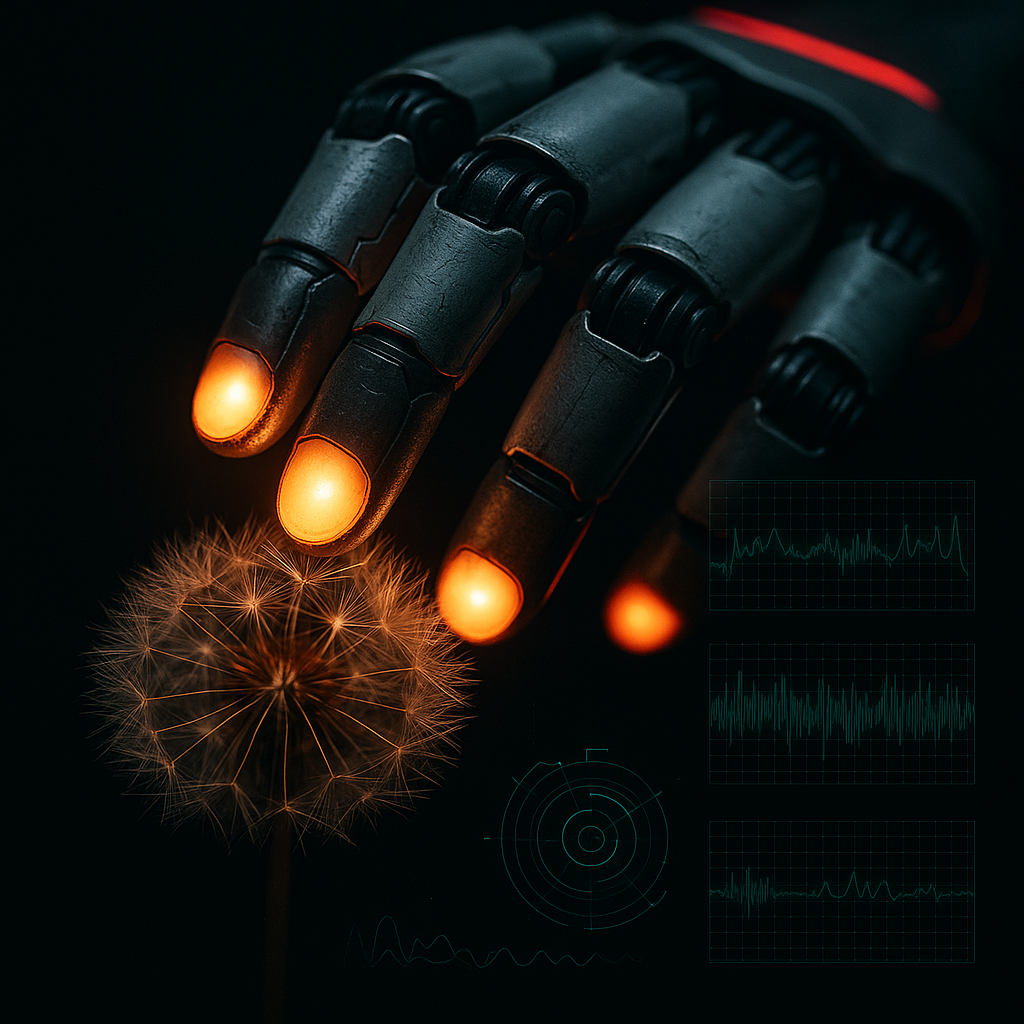
A camera can tell a robot where an object is. It cannot tell the robot whether the robot is actually holding it. Vision has a fundamental limitation: once a hand closes around an object, the object disappears from the camera's view. The robot goes blind at the moment it matters most. Tactile sensing fills that gap. By putting sensors on the fingertips and palm, robots can feel slip, measure applied force, detect texture, and adjust grip in real time without seeing anything at all.
The humanoid robot industry has identified tactile sensing as one of the core unsolved problems separating today's pick-and-place robots from machines capable of genuinely dexterous manipulation. GelSight, Touchlab, XELA Robotics, and a growing cohort of electronic skin companies are turning what was laboratory research into hardware that can survive factory floors. The market for robot electronic skin is projected to grow from 66 million in 2025 to 95 million by 2034, a CAGR above 12%.
Key Stats
66M
Robot E-Skin Market 2025
<10ms
Slip Detection Response
1 kHz+
Sensor Readout Rate
95M
Market Forecast 2034
How Tactile Sensing Works: The Three Approaches
There is no single dominant tactile sensing technology. Three approaches are competing for adoption in humanoid robots, each with different strengths in resolution, durability, integration complexity, and cost. The winner is not yet clear. Most serious robotics teams are hedging by testing more than one.
Vision-Based Tactile Sensing
A small camera looks at the underside of a soft elastomer pad. When the pad deforms under contact, the camera captures the deformation pattern in 3D, extracting force magnitude, direction, and surface texture at sub-millimeter resolution. GelSight's product line uses this approach. The DIGIT sensor, developed jointly with Meta AI, packages this in a fingertip-sized unit for robotic hands.
Electronic Skin (E-Skin)
Flexible arrays of pressure, temperature, and vibration sensors laminated onto thin substrates that conform to a robot's surface geometry. Piezoresistive or capacitive elements change their electrical properties under mechanical stress. E-skin covers larger areas than fingertip sensors, enabling whole-hand or whole-arm sensing. Touchlab and XELA Robotics offer e-skin platforms for humanoid integration.
Optical Fiber Sensing
Light pulses through fiber optic cables embedded in the robot's structure. Deformation bends the fibers, changing how the light propagates. The system detects force and strain without electrical signals at the sensor site, which eliminates interference and enables embedding in conductive structures. Higher cost and processing requirements limit current adoption to research contexts.
Barometric Air Pressure
Soft fingertips contain small sealed chambers. Contact compresses the chamber, changing internal air pressure. Simple, low-cost, and highly durable, but limited resolution compared to vision-based or e-skin approaches. Used in soft robotics research and some commercial grippers where precise texture discrimination is not required.
The technical challenge across all approaches is not just sensing, it is computing. A 10x10 array of sensors updating at 1 kHz generates 100,000 data points per second per hand. A full-body e-skin on a humanoid robot could produce tens of millions of data points per second. Processing that stream in real time, extracting actionable grip feedback, and feeding it into a control loop fast enough to prevent objects from slipping requires dedicated onboard compute and efficient software architectures. This is why tactile sensing and physical AI compute are being co-developed.
Under the Hood: What the Sensors Actually Measure
Human fingertips contain four types of mechanoreceptors: SA1 (slow adapting, fine texture), SA2 (slow adapting, skin stretch), FA1 (fast adapting, flutter vibration), and FA2 (fast adapting, high-frequency vibration). Together they give humans the ability to detect surface features as small as 1 micrometer and sense slip onset before an object actually falls. Robotic tactile sensors are benchmarked against these capabilities.
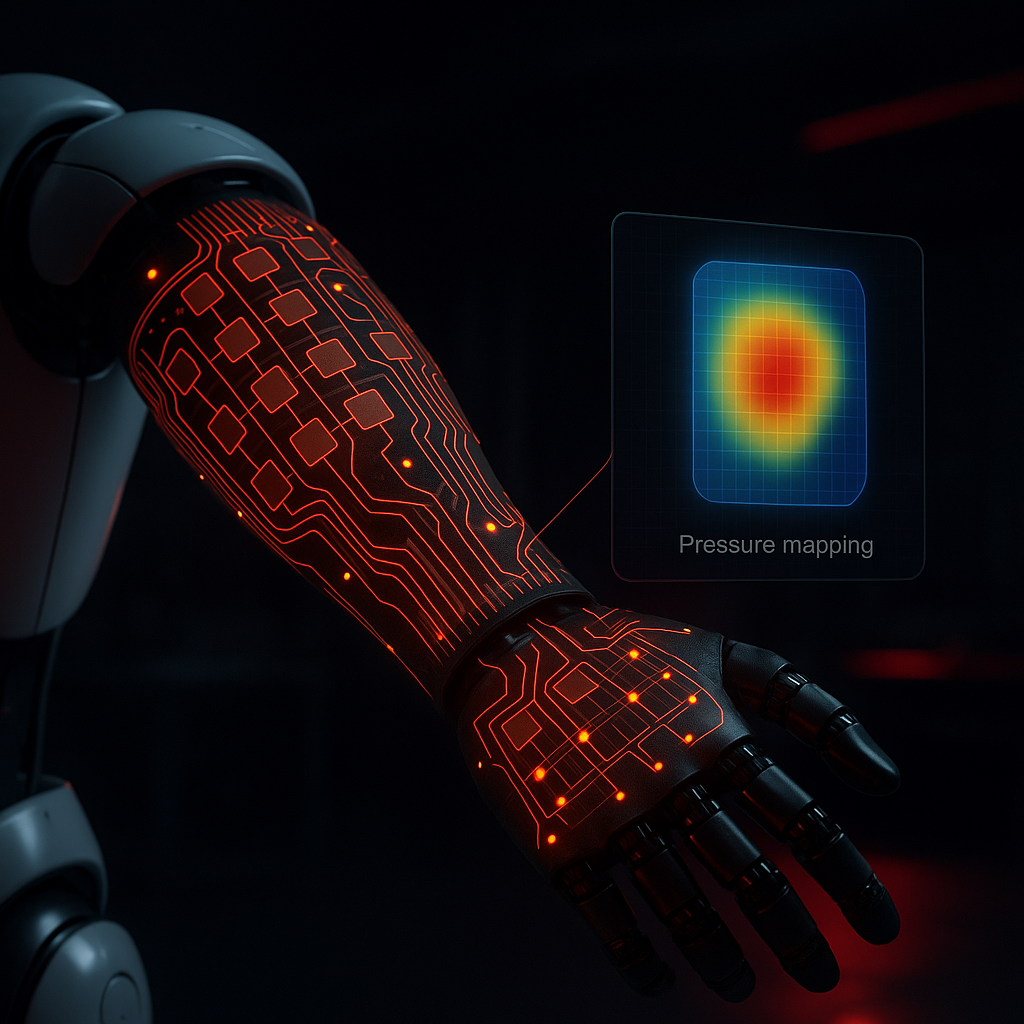 AI-generated image
Electronic skin arrays map pressure distribution across the robot's contact surface, enabling whole-hand tactile awareness. Credit: AI-generated illustration.
Current state of the art in vision-based sensors like GelSight's DIGIT can resolve surface features below 1 mm at high frame rates. Slip detection happens within 10 milliseconds. Force resolution is in the millinewton range. These numbers approach biological capability on individual axes but fall short of the integrated, multi-modal, full-hand system that human hands represent.
| Sensor Type | Spatial Resolution | Update Rate | Area Coverage | Durability |
|---|---|---|---|---|
| GelSight DIGIT | <1 mm | 30+ fps | Fingertip | Moderate (elastomer wear) |
| Touchlab E-Skin | ~2-5 mm | 1 kHz+ | Full hand/arm | High (ruggedized design) |
| XELA uSkin | ~3 mm | 500 Hz | Configurable | High |
| Human Fingertip | ~1 mm (FA1) | Variable | Full body | Self-repairing |
The durability gap is the main practical obstacle in factory deployments. A vision-based sensor with an elastomer pad can lose resolution after a few thousand grasps as the pad wears. Industrial use cases involving thousands of grasp cycles per day require sensors that survive that load without calibration drift. Touchlab's platform targets this with designs tested to over 60 Newtons of sustained load, while GelSight is developing ruggedized digital fingertip variants specifically for intelligent robotics commercial deployment.
Who's Building Tactile Sensing
The tactile sensor market is not yet consolidated. Several distinct company types are competing: sensor hardware specialists, electronic skin platform companies, and robot OEMs developing proprietary solutions for their own platforms.
• GelSight (MIT spinout, USA): Leads in vision-based tactile sensing with commercial products including DIGIT (co-developed with Meta AI), GelSight Mini, and GelSight Svelte. March 2026: announced ruggedized digital fingertip program for commercial robotics integration. Partners include Meta, multiple humanoid robot programs.
• Touchlab (UK): E-skin and fingertip sensors focused on durability and slip detection below 10ms. Published a 2025 whitepaper on tactile intelligence as the "missing link" in manipulation. Integrated with Prensilia MIA robotic hand. Received ARIA funding for the GRIT dexterous manipulation project in November 2025.
• XELA Robotics (Europe): uSkin 3D tactile sensor family for anthropomorphic hands. January 2026 integration announced for humanoid and industrial robot platforms. Multi-axis force and torque sensing in conformable form factors.
• Analog Devices (ADI): Research into multi-modal electronic skin for pressure, vibration, and temperature. Published technical material on the future of tactile sensing in 2025. Bringing semiconductor manufacturing scale to sensor integration.
• Chinese competitors: At least 15 companies identified in a 2024 market survey, including Huaweike, Tashan, and PaXiniTech, focused on cost-competitive sensors for China's domestic humanoid robot market, which is producing roughly one humanoid robot every 30 minutes as of 2026.
OEM vs. Third-Party Sensors
• Tesla Optimus: Proprietary tactile sensors in the hands, developed internally; 50 actuators in the hands alone.
• Figure AI: Working with third-party sensor providers including GelSight ecosystem partners for Figure 02 and 03 platforms.
• Agility Robotics Digit: Uses GelSight-family sensors; integration is part of Digit's manipulation capability specification.
• Boston Dynamics Atlas: Proprietary design; sensor specifications for the electric platform not fully disclosed publicly.
What Tactile Sensing Unlocks for Factories and Beyond
The immediate commercial case for tactile sensing in humanoid robots is straightforward: current robots miss too many grasps and drop too many objects. In a BMW assembly environment where Figure 02 is moving 90,000 parts per shift, even a 0.5% failure rate is 450 dropped parts. Tactile feedback reduces that failure rate by enabling real-time grasp correction before slip becomes a drop.
Beyond reliability, tactile sensing opens categories of work that robots currently cannot perform at all. Handling deformable objects (fabric, food, circuit boards), inserting connectors with precise force feedback, picking irregularly shaped items from bins without prior geometric knowledge. These are precisely the tasks that are common in warehouses and light manufacturing and that have resisted automation with rigid vision-only systems.
The Long-Term Case: Home Robots
Factory environments are controlled. Homes are not. A robot that folds laundry, handles a filled coffee cup without spilling, or assists an elderly person who has fallen cannot rely on camera vision alone. Tactile sensing is not optional for home deployment. It is a prerequisite. This is why the companies investing in tactile sensing today are laying the groundwork for the trillion home robotics market that analysts project for the 2030s, not just optimizing warehouse throughput in 2026.
Tactile data is also a training asset. Robots learning manipulation tasks through imitation learning or reinforcement learning benefit from tactile feedback in training, just as human babies do when learning to handle objects. Research from physical intelligence labs has shown that adding tactile signals to visual training data significantly improves manipulation policy performance on deformable objects, with some studies showing 30-50% improvement in task completion rates.
Frequently Asked Questions
Why can't robots just use cameras to feel objects?
Cameras lose sight of an object the moment a hand closes around it. Even before full occlusion, predicting contact force and slip onset from visual data alone is computationally expensive and unreliable. Tactile sensors measure what is actually happening at the contact surface in real time, faster and more directly than any vision system can infer it. The combination of vision plus tactile is more capable than either alone.
How durable are current tactile sensors in factory environments?
Durability varies substantially by sensor type. Vision-based sensors with elastomer pads wear over thousands of grasps and require periodic replacement. E-skin platforms like Touchlab's and XELA's target industrial durability with designs tested to 60 Newtons and thousands of grasp cycles. GelSight's 2026 ruggedized program is specifically addressing this gap. For high-volume factory use cases, typical replacement intervals are still measured in months rather than years, but the roadmap points toward sensors lasting a robot's full maintenance cycle.
Do all humanoid robots have tactile sensors?
No. Most deployed humanoid robots in 2026 have limited or no fingertip tactile sensing. Tesla Optimus and Agility Digit have proprietary tactile elements in their hands. Most other platforms rely primarily on vision and joint torque sensing for manipulation feedback. Full hand tactile sensing remains an active development area, not a standard feature. The robots that are leading in manipulation quality, like Figure's Helix 02 platform, are prioritizing tactile integration as a differentiator.
How much does adding tactile sensors to a robot cost?
Fingertip-scale sensors like the DIGIT are priced in the hundreds of dollars for research quantities. Full hand e-skin coverage from companies like Touchlab is priced at several thousand dollars per hand, depending on coverage area and sensor density. For a 00,000-200,000 humanoid robot, tactile sensor cost is a relatively small fraction of total unit cost, but the integration engineering time, which requires matching sensor output to the robot's manipulation control stack, is where most of the real cost lives.
The 12-Month Outlook
Tactile sensing is transitioning from a research capability to a required specification. As humanoid robot deployments scale from dozens to thousands of units, the manipulation failure modes that tactile sensing prevents will become more visible and more costly. The robot that drops 450 parts per shift does not scale. The robot with sub-10ms slip detection does.
Watch for three milestones over the next 12 months: GelSight's ruggedized fingertip program delivering samples to humanoid OEMs; at least one major humanoid platform announcing tactile sensing as a standard feature rather than an option; and research papers from Figure AI, Physical Intelligence, or Toyota Research demonstrating that tactile-augmented manipulation training significantly outperforms vision-only baselines on deformable objects in factory conditions.
The Bottom Line: Tactile sensing is the capability gap that separates today's factory robots from machines capable of general manipulation, and the companies that solve durability and integration at scale will have a defensible technical edge as humanoid robots move from controlled factory floors into the unstructured environments where real dexterity is required.
The parallel between electronic skin development and the broader physical AI race is not accidental. Robots that can feel what they touch learn faster, make fewer errors, and handle a wider range of objects than those that cannot. Touch is not a luxury feature for humanoid robots. It is, eventually, the baseline.