Technology
Humanoid Robot Safety Standards Explained: Why Deployment Needs More Than a Good Demo
Humanoid robot safety standards are fragmented. This explainer covers ISO 10218, ISO/TS 15066, ANSI/RIA R15.08, ISO 13482, safety cases, force limits, separation monitoring, and bipedal risk.

A humanoid robot is a moving machine with heavy batteries, high-torque joints, cameras, software models, and feet that can lose traction. Put that machine near people and the central question is not whether it looks friendly. The question is whether the developer, integrator, and operator can prove it is acceptably safe for a specific job.
Humanoid robot safety standards are still catching up with the machines. Existing rules for industrial robots, collaborative arms, mobile robots, and personal care robots cover pieces of the problem. None fully captures a bipedal, actively balanced, general-purpose robot working in open human spaces.
Key Stats
4
Collaborative modes in ISO/TS 15066
2025
ISO 10218 revision year
3
R15.08 mobile robot types
1 job
Minimum unit of safety analysis
Why humanoids do not fit cleanly into old robot rules
Traditional industrial robot safety assumed a powerful arm in a defined cell. The machine stayed in one place. People were kept out by fences, interlocks, light curtains, area scanners, procedures, and lockout rules. That model works for welding, palletizing, machining, and other repeatable tasks where the robot's workspace can be controlled.
Collaborative robots changed part of that model. Standards such as ISO 10218 and ISO/TS 15066 introduced ways for humans and robots to share space under defined conditions. The core collaborative modes include safety-rated monitored stop, hand guiding, speed and separation monitoring, and power and force limiting. Those ideas matter for humanoids, but they were built around industrial robot systems, often fixed arms or clearly bounded cells.
Mobile robots added another layer. ANSI/RIA R15.08 covers industrial mobile robots, including autonomous mobile platforms and mobile manipulators. It defines types of mobile robots and focuses on the specified operating environment. That helps with warehouse AMRs, carts, and mobile arms. A humanoid is mobile, but it is not merely a wheeled platform. It has knees, hips, arms, balance controllers, stepping behavior, fall risk, and whole-body contact surfaces.
Service and personal-care robots have ISO 13482, which covers mobile servant robots, physical assistant robots, and person carrier robots. It is relevant when robots operate outside classic factories, but a humanoid in a warehouse, hospital, construction site, retail back room, home, or public venue may cross categories. The standards map is not empty. It is fragmented.
The practical rule
Do not ask whether a humanoid is safe in general. Ask whether this humanoid, with this software version and payload, is safe enough for this task, in this site, under these operating limits.
The safety stack: stop, separate, limit force, and control the site
The first layer is a reliable stop. Emergency stop hardware must be reachable, understandable, and wired into a safety architecture that does not depend on a cloud model deciding to behave. A humanoid also needs protective stops triggered by faults, sensor loss, localization problems, joint errors, overheating, fall risk, battery faults, or unexpected human proximity.
The second layer is separation. Speed and separation monitoring uses sensors to estimate distance between people and the robot, then slows or stops the machine before contact. The protective separation distance depends on robot speed, human speed, sensor uncertainty, controller reaction time, stopping distance, and intrusion margins. A humanoid makes this harder because its arms, torso, and feet can move in different directions while balance control shifts the whole body.
The third layer is power and force limiting. If contact can happen, the robot has to keep forces, pressures, and energy transfer below acceptable injury thresholds for the body regions and contact situations involved. That requires rounded surfaces, compliant covers, torque sensing or estimation, current limits, series elasticity in some joints, fast reflexes, and conservative manipulation plans. A soft shell is not enough if the robot can pin a hand against a shelf or fall onto a person.
The fourth layer is the site. Floor condition, lighting, pedestrian flow, pallets, forklifts, pets, children, reflective surfaces, stairs, ramps, liquid spills, and narrow aisles can all change the risk. Safety is not shipped in the robot box. It is integrated into an operating environment with rules, training, signs, geofences, remote monitoring, maintenance, incident reporting, and authority to stop the deployment.
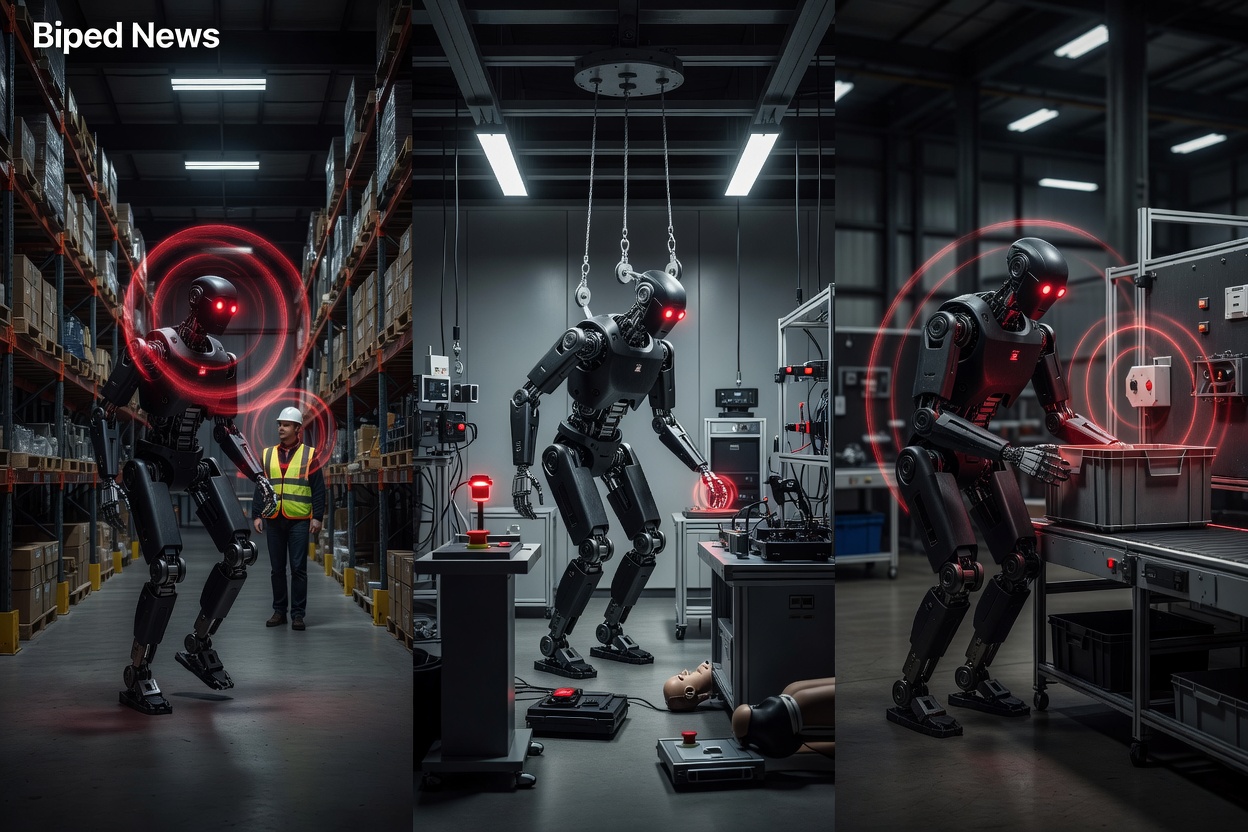 AI-generated image
Safety validation needs measured stopping distances, force tests, fault injection, and site-specific operating limits.
What makes bipedal machines different
A wheeled AMR can brake and sit on its wheels. A fixed arm can hold position inside a cell. A biped must keep balance. That creates hazards that conventional robot cells did not have to handle. The robot can stumble, trip, recover aggressively, step into a human path, swing an arm for balance, drop a payload, or fall with significant stored energy.
Actively controlled stability is the key technical gap. A humanoid is safe only while sensors, state estimation, control loops, actuators, batteries, and software keep it upright. If any part degrades, the safest action may not be an instant full stop. A hard stop during a step can make the robot fall. A controlled sit, crouch, kneel, brace, or retreat may be safer. Standards written for fixed arms do not fully specify those behaviors.
Whole-body manipulation adds another problem. A humanoid lifting a tote uses legs, hips, torso, arms, hands, and balance together. The hazard is not just gripper force. It is the combined motion of the body around the object and the human. Pinch points can appear between the robot and racks, carts, doors, conveyors, walls, and floors. Payload mass changes stopping distance and fall energy.
This is why emerging work on industrial mobile robots with actively controlled stability matters. Standards efforts such as ISO 25785-1 have been discussed for mobile robots that include legged or humanoid forms. ASTM International's F45 work on robotics also points toward more detailed treatment of legged systems. The industry needs common language for stability, fallback states, collision energy, fall testing, human detection, payload limits, and recovery behavior.
| Standard family | Useful coverage | Humanoid gap |
|---|---|---|
| ISO 10218 | Industrial robot and robot-system safety | Built around industrial systems, not full bipedal mobility |
| ISO/TS 15066 | Collaborative modes and contact concepts | Industrial collaborative systems, not general humanoid operation |
| ANSI/RIA R15.08 | Industrial mobile robots and specified operating environments | Limited treatment of legged balance and whole-body contact |
| ISO 13482 | Personal-care and service robot safety | Application scope may not match industrial humanoid work |
| Emerging legged standards | Actively controlled stability and mobile manipulation | Still developing and not yet the universal rulebook |
The safety case is the product
For early humanoid deployments, a safety case may matter as much as the robot demo. A safety case is an evidence-based argument that the system is acceptably safe for its intended use. It pulls together hazard analysis, risk assessment, functional safety design, test results, simulation evidence, field data, operating limits, maintenance procedures, cybersecurity controls, and incident response.
The safety case should identify hazards that are specific to the task. Picking from a bin creates pinch, reach, and dropped-object risks. Tote handling adds payload and backdriving risks. Inspection work near people adds navigation and distraction risks. Work on stairs adds fall risk. Outdoor security patrol adds weather, traction, and public interaction risk. A single generic certificate will not cover all of those jobs.
Evidence has to be measured. How fast can the robot stop from each walking speed and payload? What happens if a depth camera is blinded? How does the system behave after network loss? Can a worker predict the robot's path? What is the maximum contact force at the elbow, shoulder, wrist, knee, and torso? How often does the robot enter a degraded state? How are software updates validated before deployment?
Fleet learning complicates the story. Robots that improve from shared data still need controlled release processes. A behavior that worked in one warehouse may be unsafe in another. Model updates, perception changes, and manipulation policies have to be versioned, tested, rolled back, and tied to operating limits. Autonomy without configuration control is not a safety program.
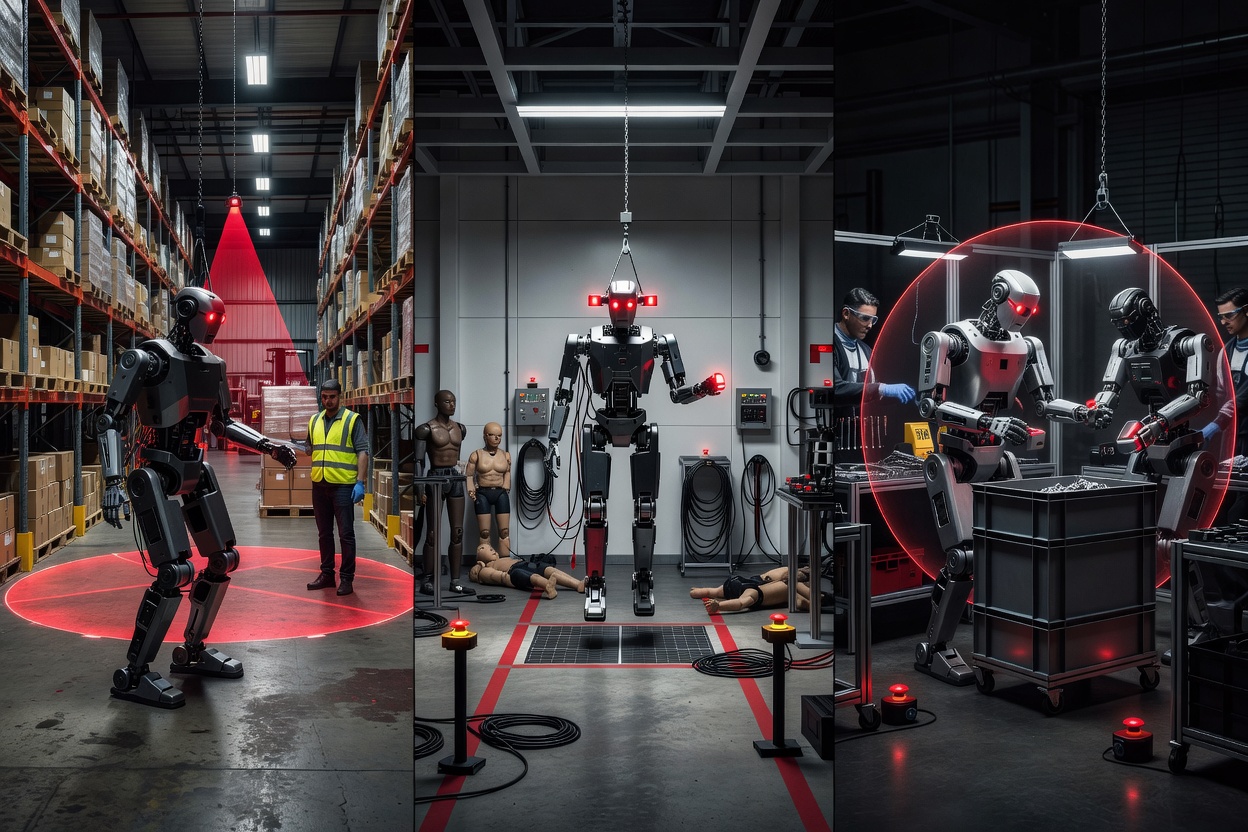 AI-generated image
The site, task, payload, traffic pattern, and software version are part of the safety envelope.
What buyers should ask before deployment
The first question is scope. What exact task is the robot certified or validated to do? If the answer is broad, the evidence should be broad. If the evidence is narrow, the deployment should be narrow. A robot approved to move empty totes in a fenced pilot area is not automatically approved to carry heavy parts through a crowded aisle.
The second question is fault behavior. Buyers should ask how the robot stops, how it recovers, how it communicates uncertainty, and who has authority to intervene. They should ask what happens during sensor faults, localization loss, battery faults, actuator overheating, unexpected contact, payload drops, and software update failures.
The third question is maintainability. Safety functions drift if sensors get dirty, brakes wear, joints develop play, calibration shifts, or covers are damaged. A deployment plan needs inspection intervals, calibration checks, spare parts, training, and logs. Safety is not a one-time acceptance test.
The fourth question is data. Incident and near-miss data should feed the safety case. If a robot repeatedly stops near the same doorway, bumps the same cart, or misreads reflective packaging, that is not just an operations issue. It is a safety signal.
FAQ
Is there one humanoid safety standard?
No. Existing industrial, collaborative, mobile, and service robot standards cover parts of the problem, while dedicated legged and actively stable mobile robot standards are still maturing.
Can humanoids work around people safely?
Yes, but only inside a defined safety envelope with tested speeds, payloads, sensing, stops, force limits, site controls, and trained operators.
Does AI make certification harder?
It can. Learning systems need version control, validation, monitoring, and rollback so behavior changes do not silently expand risk.
The bottom line
Humanoid safety will not be solved by charisma, demo videos, or a single badge. It will be solved by conservative deployment, measured evidence, clear standards, site-specific risk assessment, and machines that fail into safe states instead of surprising people.
That may slow some rollouts, but it is the only path to scale. A humanoid fleet that earns trust will be one that can prove what it will do, prove what it will not do, and prove how it behaves when something goes wrong.
Functional safety has to reach the whole body
Functional safety asks whether safety functions keep working when parts fail. For a humanoid, that can include emergency stop, protective stop, speed limiting, torque limiting, safe direction, safe brake control, safe battery isolation, and safe communication between the robot and site infrastructure. These functions need defined performance targets, diagnostics, redundancy where necessary, and test evidence.
The hard part is deciding what counts as a safety function. A perception model that detects people may be part of the protective system, but machine-learning perception can be difficult to certify in the same way as a simple safety-rated scanner. A balance controller may prevent falls, but it may also create motion that surprises people. A remote operator may reduce risk during complex tasks, but only if latency, authority, training, and handoff rules are controlled.
Humanoid makers will likely separate safety-rated functions from productivity functions. The autonomy stack may plan rich behavior, while a lower-level safety layer enforces speed, workspace, joint torque, stop zones, payload limits, and forbidden motions. That separation is common in industrial automation because it prevents a clever application program from bypassing the guardrails.
Deployment phases should be boring on purpose
A safe humanoid rollout should start narrow. The first site should have defined routes, known floors, simple payloads, low speeds, trained staff, good lighting, clear exclusion areas, and a small set of tasks. The point is not to prove general intelligence. The point is to collect evidence that the robot behaves predictably in the easiest useful version of the job.
As evidence improves, the safety envelope can expand. The robot might handle heavier items, longer routes, more human traffic, more varied lighting, or more complex manipulation. Each expansion should come with an updated hazard analysis and new validation. If the robot moves from nighttime back-room work to daytime customer-facing work, that is not a minor change. It is a new risk profile.
This staged approach may frustrate companies that want fast scale, but it protects the market. One serious injury or viral failure can freeze customer appetite, trigger regulatory attention, and raise insurance costs for everyone. Conservative deployment is not anti-innovation. It is how industrial technologies earn permission to grow.
Human factors matter as much as sensors
People need to understand what a robot is about to do. A humanoid that pauses, turns, reaches, or backs up without clear cues can create risk even if its control system is technically sound. Lights, sounds, body posture, speed choices, projected paths, and operating procedures all shape whether workers trust and predict the machine.
Training cannot be an afterthought. Workers should know where the robot operates, how to stop it, when to stay clear, what warning signals mean, and how to report near misses. Supervisors should understand payload limits, blocked sensor behavior, cleaning requirements, charging rules, and software update windows. Maintenance teams need authority to remove a robot from service when covers, brakes, sensors, or joints are damaged.
The best deployments will treat workers as part of the safety system without making workers responsible for compensating for bad design. If people routinely have to dodge the robot, reset it, rescue it, or guess its intention, the safety case is weak. Human-friendly behavior is not only a user-experience feature. It is a control measure.
What regulators and insurers will care about
Regulators will care about whether existing machinery, workplace, electrical, and product-safety obligations are met. Insurers will care about severity, frequency, controls, logs, training, maintenance, and contractual responsibility. Customers will care about uptime and liability. All three groups will ask for evidence after an incident.
That evidence should be designed in from the start. Robots should log safety events, protective stops, near contacts, falls, manual interventions, software versions, sensor faults, and maintenance actions. Logs must be secure and understandable enough to support root-cause analysis. A black box that cannot explain why the robot moved is a liability problem.
Cybersecurity also connects to safety. A compromised robot, cloud account, update pipeline, or fleet-management console can become a physical hazard. Authentication, signed updates, network segmentation, audit trails, and fallback behavior are not just IT details. They protect people standing near the machine.
The companies with the advantage
The strongest humanoid companies will not be the ones that only move fastest in videos. They will be the ones that build safety engineering into product management, customer success, manufacturing, fleet operations, and software release. They will know their safe payloads, surfaces, speeds, duty cycles, and failure modes. They will publish limits instead of pretending the robot is general before the evidence supports it.
That discipline can become a competitive edge. Large customers do not buy only robots. They buy risk reduction. A vendor that arrives with clear safety documentation, tested stop distances, validated force limits, training material, maintenance procedures, and update controls will beat a vendor that only offers a better demo. In humanoids, trust will be an engineering deliverable.