Technology
Contact Force Control Explained: How Humanoid Robots Push, Brace, Lift, and Stay Safe
Contact force control lets humanoid robots regulate how hard they push, lift, brace, and recover when they touch the world. It is central to deployment because real work involves feet, hands, payloads, friction, and unexpected contact.
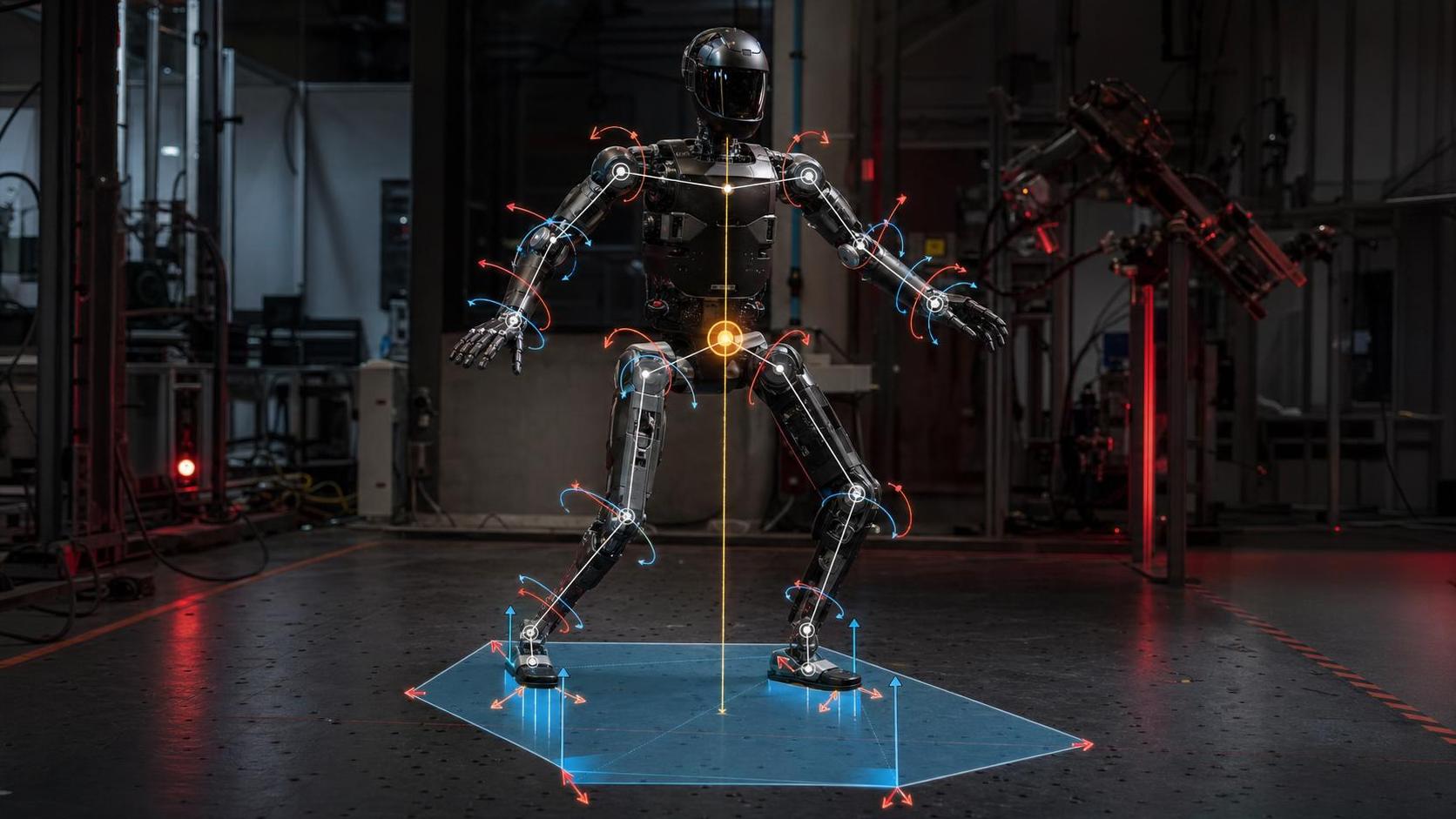
Whole-body control is the software layer that makes a humanoid robot act like one coordinated machine instead of a pile of joints. It decides how the feet, hips, torso, arms, hands, and head share forces while the robot walks, reaches, lifts, recovers, or braces against contact.
For deployment, WBC matters because humanoids rarely get to solve one problem at a time. A robot picking a tote from a shelf may need to balance on two feet, avoid a cart, keep its center of mass inside a support region, limit knee torque, protect a wrist, and still finish the grasp. That is a whole-body problem.
 AI-generated image
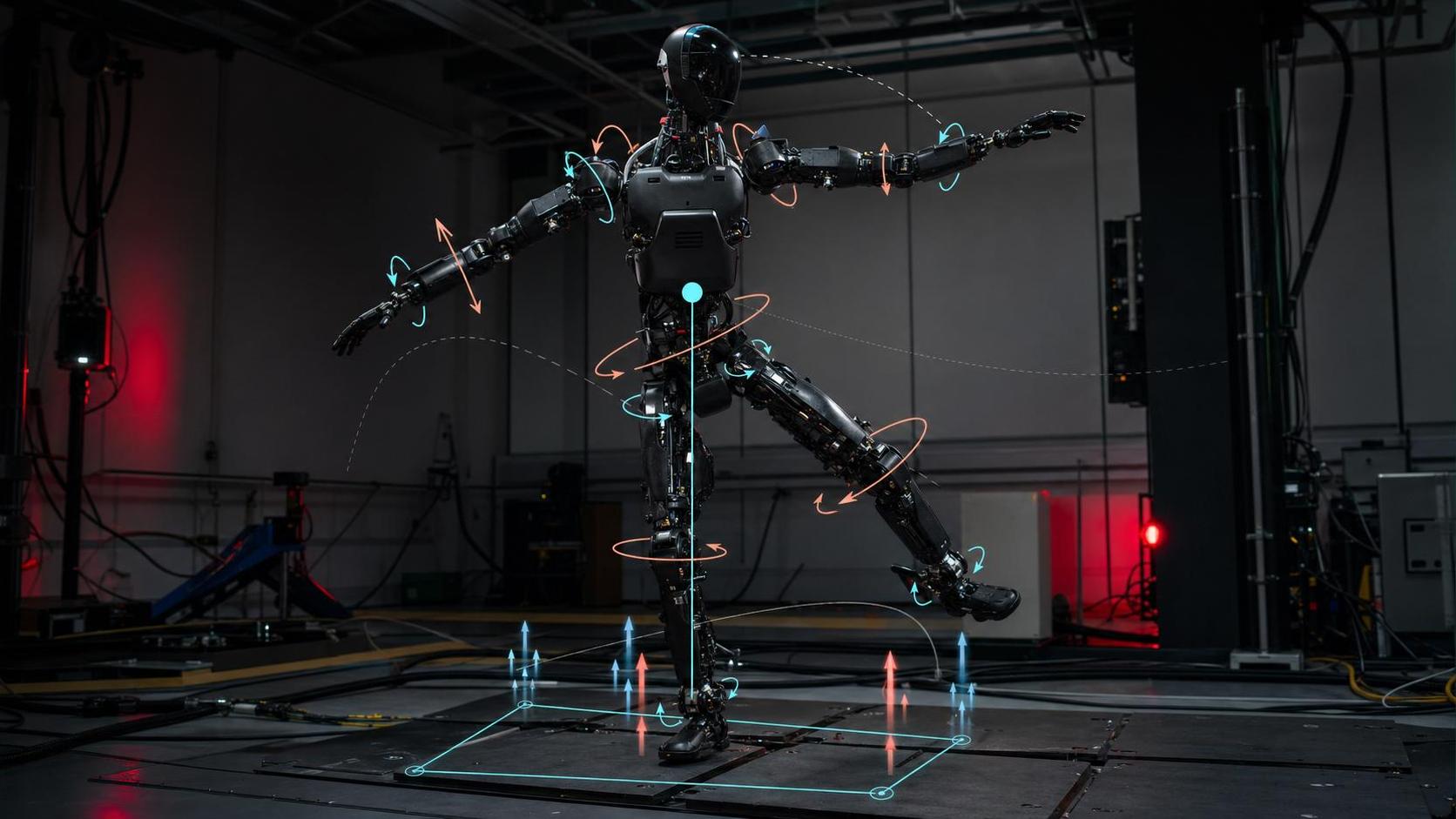
Whole-body control coordinates balance, contact, torque, posture, and task goals at the same time. Source: AI-generated editorial image.
Key Stats
30+
Humanoid DOF
1 ms
Typical Control Loop Target
6D
Contact Wrench
3
Core Constraints
The Core Idea
A humanoid robot has redundancy. It can reach the same hand pose with many elbow, shoulder, torso, hip, and foot configurations. That redundancy is useful only if the controller can choose a good configuration quickly. Whole-body control turns that choice into an optimization problem: satisfy the task, keep balance, obey torque and joint limits, and respect contacts.
The controller usually works with a robot model that knows link masses, joint positions, velocities, inertias, and contact points. It receives goals from higher-level software, such as walk here, hold this box, keep the hand level, or look at that shelf. Then it computes joint torques, accelerations, or target positions that make the whole body cooperate.
The important word is cooperate. A stiff industrial arm bolted to the floor can ignore balance. A humanoid cannot. If the arm reaches too far, the feet must respond. If the robot lifts weight, the torso and legs must share load. If the floor contact changes, the controller has to reallocate forces before the robot falls.
 AI-generated image
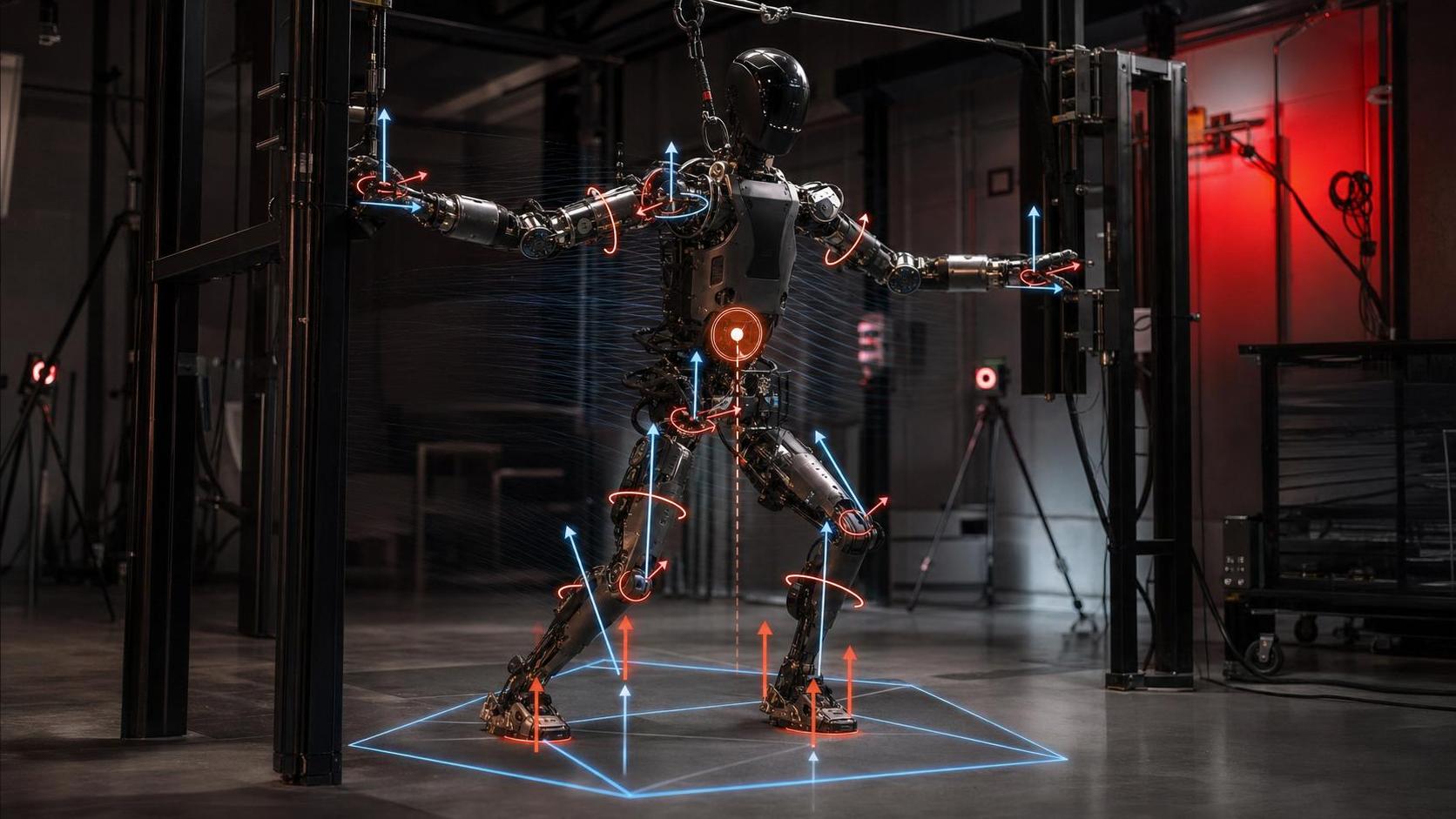
The control stack has to convert task goals into feasible forces under real hardware limits. Source: AI-generated editorial image.
Balance Is a Constraint, Not a Feature
Humanoid balance is often described visually: the robot does not tip over. In software, balance is a set of constraints. The center of mass, center of pressure, zero moment point, foot contact region, friction cone, and angular momentum all describe whether the robot can apply forces without losing support.
In double support, both feet can share load. In single support, one foot carries the robot while the other swings. During a reach, the support polygon may stay fixed while the upper body moves the center of mass toward an edge. During a push or collision, angular momentum can change faster than the feet can move. WBC gives the robot a way to prioritize survival before task completion.
This is where demos and deployments diverge. A lab demo can choreograph motion on clean floors. A warehouse robot meets uneven mats, dropped packaging, humans, carts, and objects with unknown mass. The controller needs margin, not just elegance.
| Control Layer | What It Does | Typical Time Scale | Deployment Risk |
|---|---|---|---|
| Task planner | Chooses goals and sequence | Seconds | Bad task order |
| Whole-body controller | Allocates motion and forces | Milliseconds | Falls or overloads |
| Joint servo | Tracks local torque or position | Sub-millisecond to milliseconds | Heat and vibration |
| Safety monitor | Stops unsafe states | Continuous | False stops or missed faults |
Optimization Under Hardware Limits
Modern WBC often uses quadratic programming or related constrained optimization methods. The controller minimizes task error while satisfying equations of motion, contact constraints, torque limits, joint limits, and friction constraints. The result is not a philosophical best motion. It is the best feasible command available right now.
Hardware makes that hard. Gear backlash, actuator bandwidth, motor heating, sensor latency, foot compliance, calibration errors, and payload uncertainty all distort the model. A controller that works in simulation can become unstable if the real robot cannot produce the requested torque quickly enough.
That is why robot companies obsess over actuator data, force sensing, inertial measurement, foot pressure, and state estimation. Whole-body control is only as good as the state it receives and the hardware it commands.
How WBC Works With Learning
Whole-body control is not the opposite of AI training. It is often the layer that makes learned behavior usable. A reinforcement-learning policy might decide a walking style or recovery behavior. A vision-language-action model might decide to pick up a tote. WBC can translate those goals into feasible motion while enforcing safety and balance constraints.
Some companies push more of the stack into learned policies. Others keep model-based WBC as a safety and feasibility layer beneath learned planners. The practical answer will vary by task. Fast locomotion on rough terrain may use learned policies heavily. Industrial lifting near humans may keep more explicit constraints.
The most credible deployment stacks will likely mix both. Learned models handle perception, task selection, adaptation, and behavior priors. Whole-body control keeps the robot inside the physical envelope.
Why Buyers Should Care
Buyers do not purchase WBC directly. They purchase uptime, task completion, safety, and low intervention rates. Whole-body control affects all four. If a humanoid cannot recover from small disturbances, it creates supervision work. If it cannot manage contact forces, it breaks objects or itself. If it overheats joints by choosing poor postures, the shift ends early.
Good WBC also broadens the task envelope. A robot that can brace with one hand, lean into a reach, or shift weight while lifting can work in tighter spaces than a robot limited to upright poses. That matters in factories and warehouses built for people rather than robots.
The buying signal is not whether a vendor says whole-body control. The signal is measured performance: intervention rate, fall rate, payload while walking, cycle time under load, recovery behavior, and how often the robot refuses a task because constraints are violated.
What This Means for the Industry
Humanoid companies are now competing on bodies, actuators, data, foundation models, and production scale. WBC sits in the middle of all of them. A better actuator gives the controller more bandwidth. Better data teaches better behavior. Better state estimation reduces uncertainty. Better manufacturing makes the model match the robot fleet.
This is why the field is moving from isolated walking videos toward full-stack evaluation. A robot that can walk across a stage is not the same as a robot that can walk, carry, reach, twist, avoid a human, place an object, and recover after a bump. Whole-body control is the difference between motion clips and useful work.
Expect vendors to expose fewer raw controller details over time, but more deployment metrics. The companies that can turn WBC into reliable fleet behavior will have a stronger story than those that only show athletic one-offs.
Failure Modes That Matter
The most common WBC failures are not cinematic. They are small errors that compound. A foot contact estimate is slightly wrong. A wrist force sensor drifts. A package is heavier than expected. The torso leans to compensate, the knee torque rises, the controller asks for more ankle authority, and the robot enters a posture with little recovery margin. The fall may look sudden, but the system was running out of feasible options before it happened.
Contact changes are especially hard. When a humanoid touches a shelf, wall, cart, box, or human, the robot gains or loses support depending on the force direction and friction. A good controller can use contact as a resource. A bad one treats contact as disturbance only. In factories, contact is everywhere. Robots brush fixtures, press buttons, lift bins, push doors, and lean into tasks. Whole-body control has to decide which contacts are allowed, which are useful, and which require retreat.
Payload uncertainty creates another failure path. A tote marked for 5 kilograms may actually weigh 8 kilograms. A soft bag shifts during a lift. A box center of mass sits off to one side. If the robot assumes the wrong load, the arm command affects balance and joint stress. This is why deployment systems combine WBC with online estimation, conservative payload limits, and task policies that reject risky grasps.
Thermal limits are less visible but just as important. A controller can keep a robot upright while quietly overheating hip, knee, or shoulder actuators. That may be fine for a demo. It is bad for a shift. Commercial humanoids need controllers that include heat, wear, and duty cycle in the definition of feasible motion. Useful robots do not merely survive a task. They repeat it without cooking the hardware.
Deployment Metrics for WBC
A serious buyer should ask for data that exposes whole-body behavior under load. Payload while walking matters. So does reach distance while carrying mass, recovery after a shove, step success on imperfect flooring, joint temperature after repeated cycles, and the intervention rate when humans move nearby. These metrics reveal whether the controller has useful margin.
Cycle time should be measured with constraints active. A robot can move quickly when safety limits are relaxed and payload is light. The more meaningful test is how fast it works while respecting torque limits, collision envelopes, foot placement rules, and task accuracy. If a robot slows dramatically under realistic constraints, the deployment economics change.
Fall rate is not enough by itself. A robot that never falls because it refuses half of its assigned tasks is not useful. A robot that completes tasks but needs frequent human resets is also not useful. The strongest metric is completed work per human intervention, with safety events, hardware faults, and thermal throttling included. Whole-body control should improve that number by making the robot both capable and conservative in the right moments.
Fleet learning will make this sharper. When one robot discovers that a shelf reach creates poor balance margin, that lesson should improve task policy for the fleet. WBC produces rich failure data: constraint violations, torque saturation, contact slips, near falls, and rejected motions. Companies that turn those signals into better planning will compound faster than companies that treat controller failures as isolated bugs.
How WBC Shapes Robot Hardware
Control software and hardware co-design are inseparable. A humanoid with weak actuators, poor torque sensing, slow communications, or flexible structure gives the controller fewer good options. A humanoid with high-bandwidth actuators, accurate encoders, useful force sensing, and predictable compliance gives the controller room to recover. The same algorithm can look brilliant on one body and fragile on another.
Feet are a good example. A flat foot with pressure sensing gives the controller information about load distribution and slip risk. A small foot may improve agility but reduce support margin. A compliant sole can absorb impact but complicate state estimation. These choices affect how WBC computes safe contact forces and how quickly the robot can react when the floor is not ideal.
Arms and hands matter too. A humanoid doing warehouse work cannot treat manipulation as an upper-body-only task. If a box is heavy or far from the torso, the legs and hips must help. If the hands lack grip force or tactile data, the body may compensate with awkward postures. Whole-body control exposes weak links in the machine because every subsystem affects the feasible motion set.
This is why credible humanoid roadmaps talk about actuators, batteries, thermal design, sensors, simulation, data, and control together. Whole-body control is the place where those claims meet physics. If the body cannot produce the forces, the controller cannot command them into existence.
Simulation, Testing, and Reality Gaps
Simulation is essential for whole-body control because testing every fall on hardware is expensive and dangerous. Engineers can simulate pushes, payload changes, foot slips, joint limits, and bad grasps thousands of times before risking a robot. The controller can be tuned against many scenarios, and learned policies can collect experience faster than a physical fleet could.
The gap is that simulation never captures every detail. Real floors flex. Rubber soles heat up. Gearboxes wear. Cables tug. Cameras overexpose. Humans move unpredictably. A controller trained or tuned only in clean simulation may fail when contact timing changes by a few milliseconds. Good teams use simulation as a filter, then validate aggressively on hardware.
Hardware-in-the-loop testing helps close the gap. A company can run controllers on production computers, feed them simulated sensor data, and measure timing before the robot moves. It can also replay field logs through new controller versions to see whether the new code would have made a safer decision. This is how WBC becomes a fleet discipline rather than a lab demo.
The final test is boring repetition. Can the same robot run the same task hundreds of times without growing unstable, overheating, damaging objects, or needing resets? Can the tenth robot in the fleet behave like the first? Whole-body control quality shows up in variance. Low variance is what customers pay for.
Why WBC Will Stay Mostly Invisible
Customers will rarely see a product page that says the whole-body controller improved by 14 percent. They will see a robot carry heavier totes, recover from bumps, work closer to shelves, or stop less often. That invisibility can make WBC easy to underrate. It is infrastructure inside the robot.
The same happened in drones and self-driving systems. Flight controllers, state estimators, and low-level safety systems became decisive even when marketing focused on cameras or autonomy. Humanoids will follow a similar path. The visible AI model may choose the task, but the low-level control stack decides whether the task can be performed safely and repeatedly.
This also means WBC will be a defensible advantage. Data helps, but controller tuning, hardware characterization, safety cases, and deployment logs are difficult to copy. A company that has thousands of hours of real whole-body failures and recoveries has an asset that a new entrant cannot instantly recreate. The strongest humanoid companies will treat those logs as core training material for both model-based and learned control.
For the industry, the practical message is clear. The humanoid race is not only about who has the best foundation model or the most human-looking body. It is about who can turn physics, contacts, motors, batteries, and task goals into reliable work. Whole-body control is where that race becomes measurable.
Frequently Asked Questions
What is whole-body control in robotics?
It is a control method that coordinates all robot joints and contacts together so the machine can satisfy task goals while balancing and obeying hardware limits.
Is whole-body control only for humanoids?
No. It is also used in quadrupeds, mobile manipulators, and other robots with many joints and contacts. Humanoids make the need especially obvious.
Does AI replace whole-body control?
Usually no. Learned models can choose behaviors, but WBC often remains useful for enforcing physical constraints and turning goals into feasible commands.
What metrics show good WBC?
Useful metrics include fall rate, intervention rate, payload under motion, recovery after disturbance, joint temperature, task completion, and contact force control.
The Bottom Line
Whole-body control is not a flashy feature, but it is one of the main reasons a humanoid can become useful. It links planning to physics. It lets the robot use its whole body to finish a task without falling, overheating, overloading a joint, or losing contact with the world.
For the next phase of humanoid deployment, WBC will be judged less by academic diagrams and more by boring operational numbers. The robots that stay balanced while doing paid work will make the strongest case.