Companies
Kepler Robotics: The Chinese Startup That Put a Humanoid in a GM Factory
Kepler Robotics launched its K2 humanoid into an SAIC-GM factory in Shanghai in 2025, becoming one of the first Chinese startups with confirmed real industrial deployment. With a $20,000-$30,000 long-term unit price target and an open OS platform, Kepler is building for volume at a price point Western competitors have not committed to.

Kepler Robotics launched its K2 humanoid into a GM joint venture factory in Shanghai in 2025, becoming one of the first Chinese startups to achieve real industrial deployment with a full-size humanoid robot. The K2, standing 175 to 178 centimeters and weighing up to 85 kilograms, has 52 degrees of freedom and uses planetary roller screw actuators to handle payloads up to 15 kilograms per hand.
Founded in Shanghai around 2023, Kepler moved from concept to commercial hardware faster than most comparable Western startups. It has raised at least $20 million across multiple rounds, with an April 2026 strategic investment of over 100 million Chinese yuan (approximately $14 million) led by SAIF Partners. Mass production of the K2 began in late 2024. The company's stated long-term pricing target is $20,000 to $30,000 per unit, though early commercial units are selling at significantly higher prices.
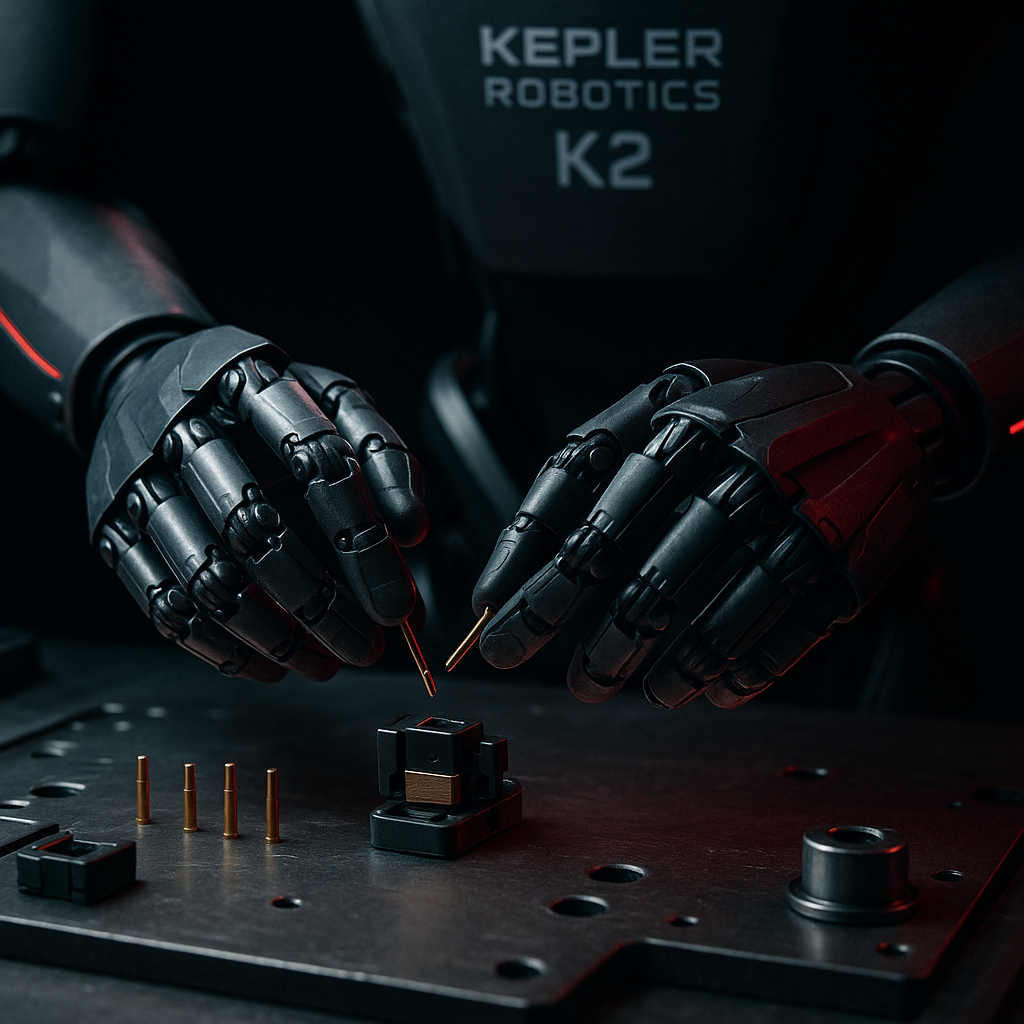 AI-generated image
The K2's dexterous hands feature 11-12 degrees of freedom each, enabling fine manipulation tasks. Credit: AI-generated
Key Stats
52
Degrees of Freedom
85 kg
Robot Weight
15 kg
Per-Hand Payload
$20K
Long-Term Target Price
The K2 Story: From Startup to Factory Floor in Two Years
Kepler Robotics (formally Shanghai Kepler Exploration Robot Co., Ltd.) was incorporated around early 2023 in Shanghai's fast-moving physical AI startup ecosystem. The founding team drew from backgrounds in robotics research, automotive engineering, and AI systems. The company's first public product was the K1, an earlier humanoid model with approximately 40 degrees of freedom, used primarily for R&D and early customer evaluations.
The K2, also referred to internally as "Forerunner K2" or "Bumblebee," represents the commercial-grade follow-on. It has 52 total degrees of freedom, with 11 to 12 DOF per dexterous hand, enabling fine manipulation tasks that simpler 6-DOF grippers cannot handle. The actuator technology is a key design choice: planetary roller screw actuators provide higher force density and precision than the electric motors used in some competitors, at the cost of added mechanical complexity.
Kepler's timeline from incorporation to mass production -- roughly 18 to 24 months -- is aggressive even by Chinese startup standards. The company showcased the K2 at CES 2024, GITEX 2024, and ICRA 2025, building international visibility before the SAIC-GM factory deployment that validated its industrial claims. The SAIC-GM plant in Shanghai represents one of the first confirmed real-factory humanoid deployments by a Chinese startup (as opposed to demonstration environments or company-owned test facilities).
Planetary Roller Screws
Kepler chose planetary roller screw actuators over simpler electric motors for the K2. This provides higher backdrivability and force sensing precision, critical for tasks requiring gentle but accurate contact force -- part inspection, assembly verification, material handling near humans.
Kepler OS
The K2 runs Kepler OS, an open modular operating system that exposes APIs for third-party application development. Combined with 100 TOPS of onboard compute and cloud-based AI for perception and planning, it positions the K2 as a platform, not just a hardware product.
Straight-Knee Gait
Unlike bent-knee walking gaits used in many research humanoids, the K2 uses a straight-knee walking pattern at up to 4 km/h. Straight-knee gait is more energy-efficient for long shifts and mechanically simpler to maintain -- a practical industrial design choice.
Battery Life
The K2 targets 3 to 8 hours of operational battery life per charge, depending on task intensity. Industrial demos at GM's Shanghai plant have demonstrated multi-hour continuous operation in structured pick-and-inspect tasks.
Under the Hood: K2 Specifications and Architecture
The K2's hardware architecture reflects the engineering tradeoffs Chinese startups are making differently from their Western counterparts. Where Figure AI and Apptronik have emphasized AI learning systems and operator-free autonomy, Kepler has emphasized raw physical capability -- high payload, many DOF, long battery life -- at a price point that makes volume deployment feasible sooner rather than later.
The 100 TOPS of onboard compute supports local inference for perception, navigation, and basic manipulation planning. Cloud connectivity enables learning from deployed units and remote model updates. The high-resolution vision and force/torque sensing suite allows the K2 to detect surface defects and apply calibrated contact forces -- capabilities required for automotive quality inspection tasks like checking panel gaps and surface finish.
| Spec | Kepler K2 | Figure 02 | Unitree H1 | Agility Digit |
|---|---|---|---|---|
| Height | 175–178 cm | 167 cm | 180 cm | 175 cm |
| Weight | 75–85 kg | ~60 kg | 47 kg | ~65 kg |
| DOF Total | 52 | 65+ | 19 | ~30 |
| Payload | 15 kg/hand | ~20 kg total | 30 kg total | ~16 kg total |
| Walk Speed | 4 km/h | ~4.3 km/h | 5.4 km/h | ~4 km/h |
| Battery | 3–8 hrs | ~4 hrs work | ~2 hrs | ~4 hrs |
| Target Price | $20–30K (mass) | Undisclosed | $90K current | Undisclosed |
| Industrial Deploy | SAIC-GM (2025) | BMW (2024) | Selected pilots | Amazon (2024) |
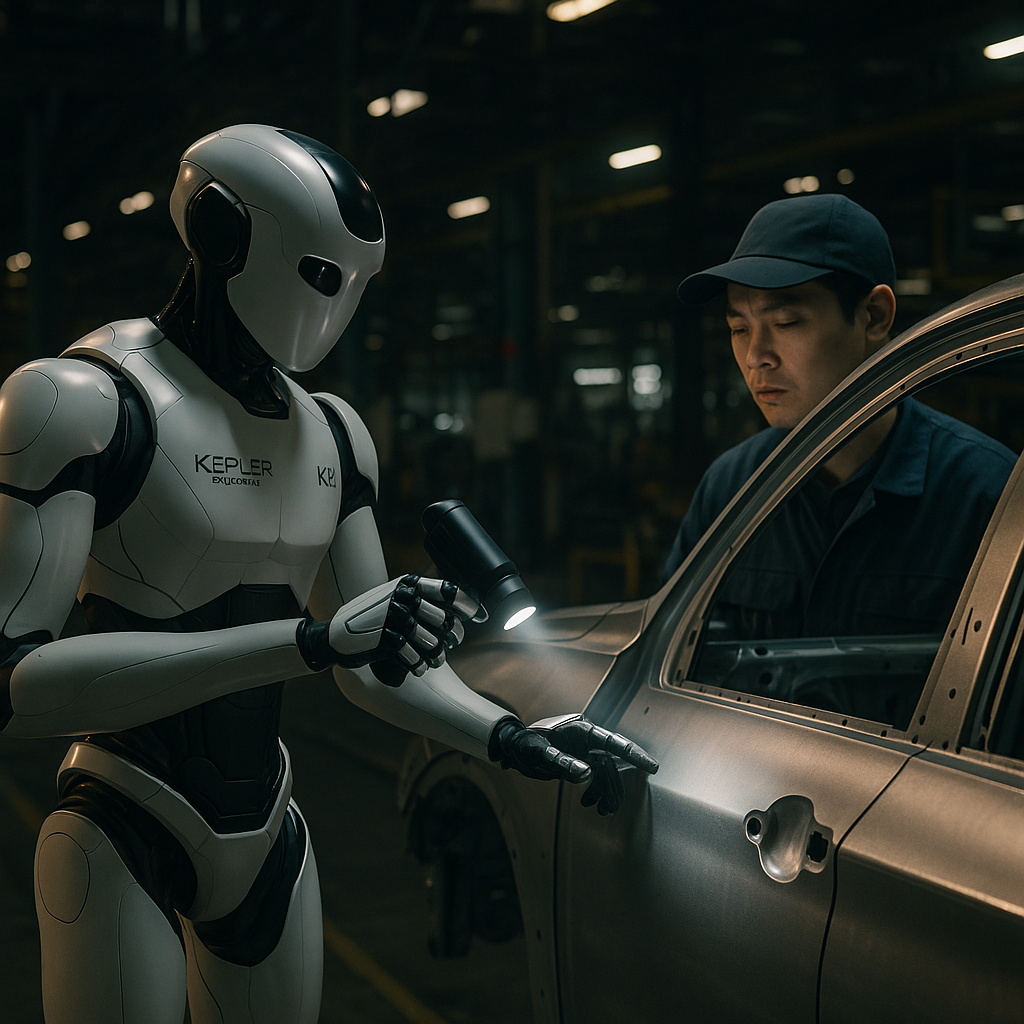 AI-generated image
The K2's deployment at SAIC-GM's Shanghai facility marks one of the first confirmed real-factory humanoid placements by a Chinese startup. Credit: AI-generated
Kepler Robotics: The Full Picture
Kepler is a young company by any measure, but its funding and deployment trajectory put it ahead of many contemporaries that have been operating for twice as long. The April 2026 strategic investment -- over 100 million yuan ($14 million) led by SAIF Partners, with Noblelift Intelligent Equipment and other industrials -- is significant because it brings a strategic manufacturing partner into the cap table. Noblelift builds industrial material-handling equipment, giving Kepler a potential channel into warehouses and logistics facilities beyond the automotive sector.
Total disclosed funding across seed, Series A, and the April 2026 strategic round is at least $20 million in reported figures, but the company has stated that R&D investment has exceeded $120 million across the program's five-year planning horizon. That gap between disclosed external funding and stated R&D investment suggests significant founder capital, government grants (common in China's strategic robotics industry), or undisclosed corporate partnerships contributing to the development budget.
Funding Timeline
• Pre-Seed (April 2025): ~$4.2 million
• Series A (July 2025): Undisclosed
• Strategic Round (April 2026): 100M+ CNY (~$14M), led by SAIF Partners
• Investors include: SAIF Partners, Blue Bear Capital, Noblelift Intelligent Equipment
• Total disclosed: $20M+
The company's 2025 "strategic upgrade" announcement -- coinciding with the April 2026 funding -- indicated a pivot in go-to-market strategy. Kepler moved from treating the K2 as a single product toward positioning it as a platform with Kepler OS at the center. Third-party developers can build applications on top of Kepler OS, which the company hopes will create a software ecosystem around its hardware similar to how Android created an ecosystem around Android-compatible phones.
What Kepler Means for the China vs. US Humanoid Race
Kepler is one of at least a dozen Chinese humanoid startups that have launched since 2022, including Unitree, UBTECH, Fourier Intelligence (now Fourier), EngineAI, AgiBot, and RoboTera. China's government has explicitly designated humanoid robots as a strategic industry, with the Ministry of Industry and Information Technology targeting mass production of humanoid robots by 2025 and international competitiveness by 2027. Government-backed industrial parks in Beijing, Shanghai, and Shenzhen have provided subsidized lab space and test environments to qualifying companies.
The implications for Western competitors are real. Chinese startups like Kepler are reaching commercial deployment at pricing targets ($20,000 to $30,000 per unit at scale) that Western companies have not publicly committed to. Figure AI, Apptronik, and Agility Robotics have not disclosed unit pricing -- in part because their cost structures at current production volumes make consumer-tier pricing impractical. If Kepler achieves volume production at $25,000 per unit and Western competitors are at $100,000 or more, the competitive dynamic in price-sensitive industrial applications (logistics, light manufacturing) will favor Chinese suppliers.
The Pricing Gap
Kepler's $20,000 to $30,000 long-term unit target is not currently achievable -- early K2 units reportedly sell at $85,000 to $300,000 depending on configuration and service terms. But the aspiration reflects a different strategic intent than Western competitors: optimize for volume deployment rather than premium positioning.
The technology comparison is more nuanced. Chinese startups have made rapid hardware progress, but the AI software -- particularly the general-purpose manipulation intelligence that allows a robot to handle novel objects and unstructured environments -- is where Figure AI, Physical Intelligence, and others have concentrated investment. Hardware parity in DOF and payload does not translate to software parity in capability. Kepler's Kepler OS platform is a step toward building a software ecosystem, but it starts from a smaller developer community than the US companies have access to.
Frequently Asked Questions
How does Kepler K2 compare to Figure 02 in actual factory deployment?
Both robots have confirmed industrial deployments: Figure 02 at BMW's Spartanburg plant and Kepler K2 at SAIC-GM's Shanghai facility. The K2 has higher per-hand payload (15 kg vs. Figure's roughly 10 kg per hand) but fewer total degrees of freedom than Figure 02's 65+. Figure AI's partnership with OpenAI gives it access to more advanced AI systems for natural language and general manipulation; Kepler's Kepler OS approach is more open but starts from a smaller ecosystem. The real comparison point will be volume deployment numbers by end of 2026.
Can Kepler K2 be purchased outside China?
Kepler has international ambitions and showcased at GITEX 2024 in Dubai and CES 2024 in Las Vegas, signaling intent to sell outside China. However, there are no confirmed international commercial deployments as of April 2026. Export controls on advanced robotics technology, particularly for military-adjacent applications, and general US-China technology trade tensions could complicate sales to US customers. European and Middle Eastern markets are more likely near-term international targets.
What tasks is the K2 actually doing at the GM factory?
Based on publicly available information, the K2's deployment at SAIC-GM's Shanghai facility involves quality inspection and parts handling tasks -- checking component fit, inspecting surface finish, and moving parts between stations. These are structured, repetitive tasks in a defined workspace, which is the current capability ceiling for humanoid robots. Fully autonomous unstructured task handling remains a research challenge, not a deployed capability.
What does the Noblelift partnership mean for Kepler's go-to-market?
Noblelift Intelligent Equipment is one of China's largest forklift and automated material-handling manufacturers, with established sales channels into Chinese warehouses and factories. Its strategic investment in Kepler likely includes channel partnership terms -- meaning Noblelift can sell or integrate K2 units as part of broader automation projects. This gives Kepler access to industrial customer relationships that a three-year-old startup would otherwise take years to build independently.
The 12-Month Outlook
Kepler's near-term milestones center on three things: expanding K2 deployment beyond SAIC-GM to additional automotive and logistics customers in China, growing the Kepler OS developer ecosystem, and demonstrating progress toward the $20,000 to $30,000 unit price target through production scaling. The Noblelift partnership should accelerate the second and third by providing both distribution and manufacturing insight.
International expansion is a 2027 story at the earliest. The regulatory, sales, and support infrastructure required to deploy humanoid robots outside China -- particularly for enterprise customers with strict vendor qualification requirements -- takes time to build. Watch for Kepler at international trade shows in late 2026 as a signal of commercial readiness versus continued market development.
The Bottom Line: Kepler Robotics is the most commercially advanced of the second-wave Chinese humanoid startups, with a real factory deployment, a credible long-term pricing target, and a platform strategy that goes beyond selling hardware. Whether it can scale production and build an AI software advantage to match its hardware credentials will determine whether it competes globally or remains a China-market leader.
The humanoid robot market is still in its first commercial year. Kepler's progress over the next 18 months -- measured in unit shipments, new customer announcements, and Kepler OS developer adoption -- will be the data that tests whether its rapid early trajectory was a flash or a foundation.