Industry
NEURA Robotics Raises Up to $1.4B for Physical AI Platform
NEURA Robotics announced a Series C financing of up to $1.4 billion on June 10, 2026. The round backs a full-stack physical AI strategy built around Neuraverse, real-world robot training facilities, and the 4NE1 humanoid platform.
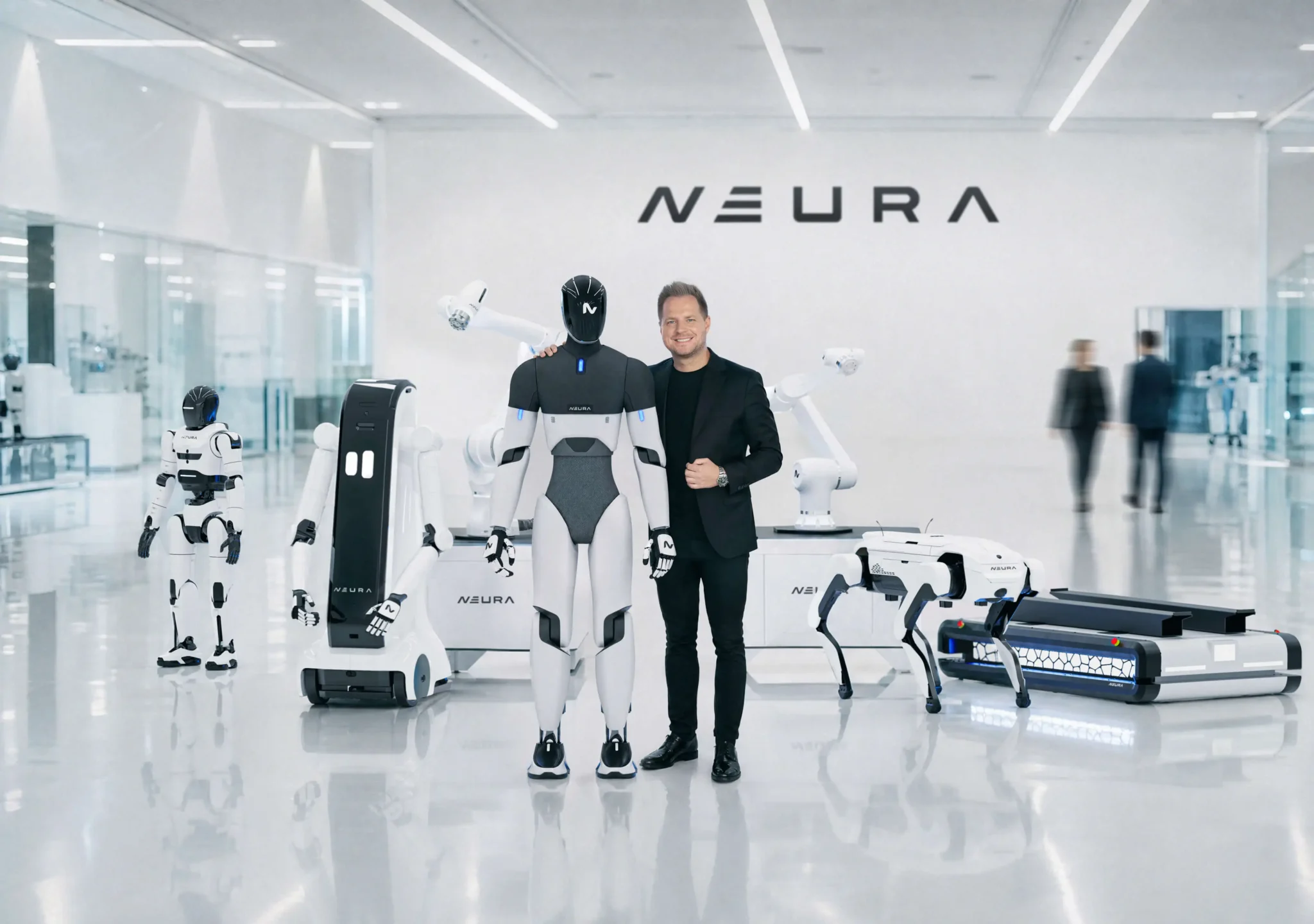
NEURA Robotics announced a Series C financing of up to $1.4 billion on June 10, 2026, one of the largest disclosed rounds in physical AI and robotics to date.
The Metzingen, Germany company says the capital will scale its Neuraverse platform, real-world robot training facilities, and serial production for cognitive robots, including the 4NE1 humanoid line. The investor list matters as much as the number: Tether, Qualcomm Technologies, Amazon, NVIDIA, Bosch, Schaeffler, the European Investment Bank, Lingotto Horizon, InterAlpen Partners, imec.xpand, and others are backing a full-stack European robotics company rather than another pure software model.
Key Stats
$1.4B
Potential Series C
$7B
Reported Valuation
2030
Million-Unit Target Window
180 cm
4NE1 Height
How NEURA's Physical AI Bet Works
NEURA is not pitching a single robot body. The company is trying to sell a vertically integrated physical AI stack that includes hardware, sensing, robot software, edge compute, real-world data collection, and developer infrastructure. Its public product range includes cognitive robot arms, mobile robots, service machines, and the 4NE1 humanoid platform. That breadth is important because physical AI models need repeated contact with messy real environments, not only benchmark videos or simulated tasks.
The company's Series C page describes three near-term priorities: scaling production, expanding globally from Europe into the United States, China, and Japan, and building richer robotics datasets through the Neuraverse and planned NEURA Gyms. The Gyms are real-world training environments where robots can practice complex tasks under controlled but physical conditions. That is the right bottleneck to attack. In 2026, robot intelligence is limited less by clever demo scripts than by reliable task data, safety validation, and repeatable deployment workflows.
Platform, Not Just Product
Neuraverse is NEURA's shared intelligence layer. The claim is that deployed robots can improve the larger fleet by contributing data from real tasks.
Industrial First
NEURA names manufacturing, logistics, and service work as early targets, where controlled spaces and measurable task economics make deployment easier to justify.
The financing also puts Europe into a robotics race that has been dominated by U.S. capital intensity and Chinese manufacturing velocity. Figure AI has turned production cadence into the headline. Unitree has made price and volume the story. AgiBot, UBTECH, and several Chinese startups are linking deployments to industrial policy. NEURA's answer is a partner-heavy European stack with major industrial suppliers and compute companies close to the cap table.
Under the Hood: Capital Meets Data Infrastructure
A $1.4 billion robotics round is not only a confidence vote. It is a cost signal. Full-stack robotics companies need factories, supply contracts, quality systems, field engineers, safety cases, data pipelines, and replacement parts before revenue scales cleanly. Software margins do not arrive on day one when the product includes motors, reducers, batteries, compute modules, calibration rigs, and customer-specific integration work.
 Copyright: NEURA Robotics
NEURA positions 4NE1 as the humanoid extension of its cognitive robotics platform. Image source: NEURA Robotics.
The company's 4NE1 page lists a 180 cm body, 80 kg weight, 5 km/h speed, and a wide 10 kg to 100 kg payload range, depending on configuration and task. NEURA describes 360-degree perception, sensor skin, multimodal AI, reinforcement learning, remote operation, and exchangeable forearms. Those are useful headline specifications, but the funding story is really about production discipline and data capture. A robot with strong specs still needs months of integration before it becomes an asset on a factory floor.
| Spec | NEURA 4NE1 | Figure 03 | Unitree G1 |
|---|---|---|---|
| Primary Position | Cognitive humanoid and platform ecosystem | Industrial humanoid production ramp | Lower-cost research and developer humanoid |
| Height | 180 cm | Not fully disclosed publicly | About 132 cm |
| Weight | 80 kg | Not fully disclosed publicly | About 35 kg |
| Payload | 10 kg to 100 kg, depending on configuration | Task-dependent | Light-duty research and demo tasks |
| Commercial Status | Reservations, partnerships, industrial scale-up | Factory and logistics deployments reported | Commercially available developer platform |
| Core Risk | Turning partner capital into repeatable deployments | Sustaining production quality at scale | Moving from access to enterprise-grade usefulness |
Key Insight
NEURA's round is less about a single humanoid launch and more about whether Europe can fund a complete physical AI supply chain before U.S. and Chinese platforms define the market.
Who's Backing NEURA
The investor mix is unusually strategic. Qualcomm brings edge AI, high-performance compute, and connectivity. Amazon brings cloud infrastructure and a long operational history with warehouse automation. NVIDIA brings the training and simulation tooling that most physical AI companies already use. Bosch and Schaeffler bring industrial manufacturing knowledge, supplier credibility, and a direct view into factory automation demand. The European Investment Bank adds a sovereignty angle that fits Europe's push to own more of the AI and robotics value chain.
• Tether: Named as a lead investor in the June 10 announcement, giving the round an unusual crypto-capital angle.
• Bosch: Publicly frames humanoid robotics as a growth opportunity and already works with NEURA on industrial scaling.
• Schaeffler: A major motion and automotive supplier that can help with actuators, factory validation, and industrial customer access.
• NVIDIA and Qualcomm: Two compute players that benefit if physical AI becomes a high-volume edge workload.
That list does not guarantee deployment wins, but it reduces some obvious scaling risks. Robotics startups fail when their prototypes cannot survive procurement, maintenance, safety review, and supply-chain constraints. NEURA now has investors that understand those frictions from the inside. The harder question is whether those partners become real customers, production enablers, or mainly logos on a financing slide.
What the Round Means for Physical AI
The timing is sharp. The robotics market has spent the last 18 months moving from demo novelty to operational accounting. Buyers now ask for cycle time, uptime, human supervision needs, integration cost, insurance, and fallback procedures. Funding size alone does not answer those questions, but it gives NEURA the resources to build the infrastructure that answers them.
 Biped.News editorial illustration
Physical AI deployment depends on data centers, training labs, test fixtures, and field feedback loops. Source: Biped.News editorial illustration.
For industrial customers, the most interesting part is not whether 4NE1 can walk across a booth. It is whether NEURA can package robot labor into a repeatable deployment model across multiple sites. That means documented safety behavior, predictable support, spare-part availability, and software that can improve without breaking certified workflows. The company is using terms like cognitive robotics and Neuraverse, but the commercial test will be simple: can a customer assign real work and measure output without adding a shadow team of engineers?
Data
Real task logs must replace hand-picked demos.
Safety
Human-adjacent robots need auditable behavior.
Scale
Production quality has to match investor ambition.
What's Coming Next
The next milestones are practical. Watch for named industrial customers, disclosed robot counts, signed service contracts, deployment uptime, and whether NEURA Gyms produce measurable improvements in robot task success. A financing announcement can move the company into the top tier of robotics attention in a single day. Sustained credibility will come from field metrics.
NEURA's global expansion plan also deserves scrutiny. Building in Europe, selling into the United States, competing in China, and serving Japan's automation-heavy market all require different certifications, channel partners, support models, and buyer expectations. The company's strategic investors may open doors, but each region will still demand local proof.
Frequently Asked Questions
How much did NEURA Robotics raise?
NEURA announced a Series C round of up to $1.4 billion on June 10, 2026. Some reports place the valuation near $7 billion, while the company's own materials emphasize the round size, investors, and production goals.
What is 4NE1?
4NE1 is NEURA's humanoid robot platform. The company lists a 180 cm height, 80 kg weight, 5 km/h speed, 360-degree perception, sensor skin, multimodal AI, reinforcement learning, remote operation, and exchangeable forearms.
Is this a confirmed production deployment?
No. The June 10 news is a financing and scale-up announcement, not a named customer deployment with disclosed robot counts. NEURA says it will accelerate humanoid deployment and production, but buyers should wait for site-level metrics.
Why are Bosch, Schaeffler, NVIDIA, Qualcomm, and Amazon important?
Those companies touch the pieces robots need to scale: industrial manufacturing, motion components, simulation, edge compute, cloud infrastructure, and customer operations. Their involvement gives NEURA more than capital, though it still has to prove execution.
The 12-Month Outlook
NEURA has moved into the top funding tier of physical AI. The story now shifts from whether investors believe in cognitive robots to whether the company can convert capital into factory-grade deployments, reliable data loops, and production throughput. That is a different skill set than building impressive prototypes.
The Bottom Line: NEURA's $1.4 billion Series C is a major European physical AI signal, but the next proof point has to be named customers and operating metrics, not a bigger funding headline.
For the humanoid robotics market, the round confirms that capital is still available for companies with a plausible path from robot body to deployment platform. In 2026, the winners will be the companies that turn that capital into boring, repeatable work.