Companies
Neura Robotics: The German Startup Building Europe's First Cognitive Humanoid
Neura Robotics, founded in 2019 in Metzingen, Germany, is building what it calls the world's first cognitive humanoid robot. With $178 million raised, partnerships with Bosch, NVIDIA, and Kawasaki, and the 4NE1 in industrial field trials, the startup is making a serious case that Europe can compete in the global humanoid race.
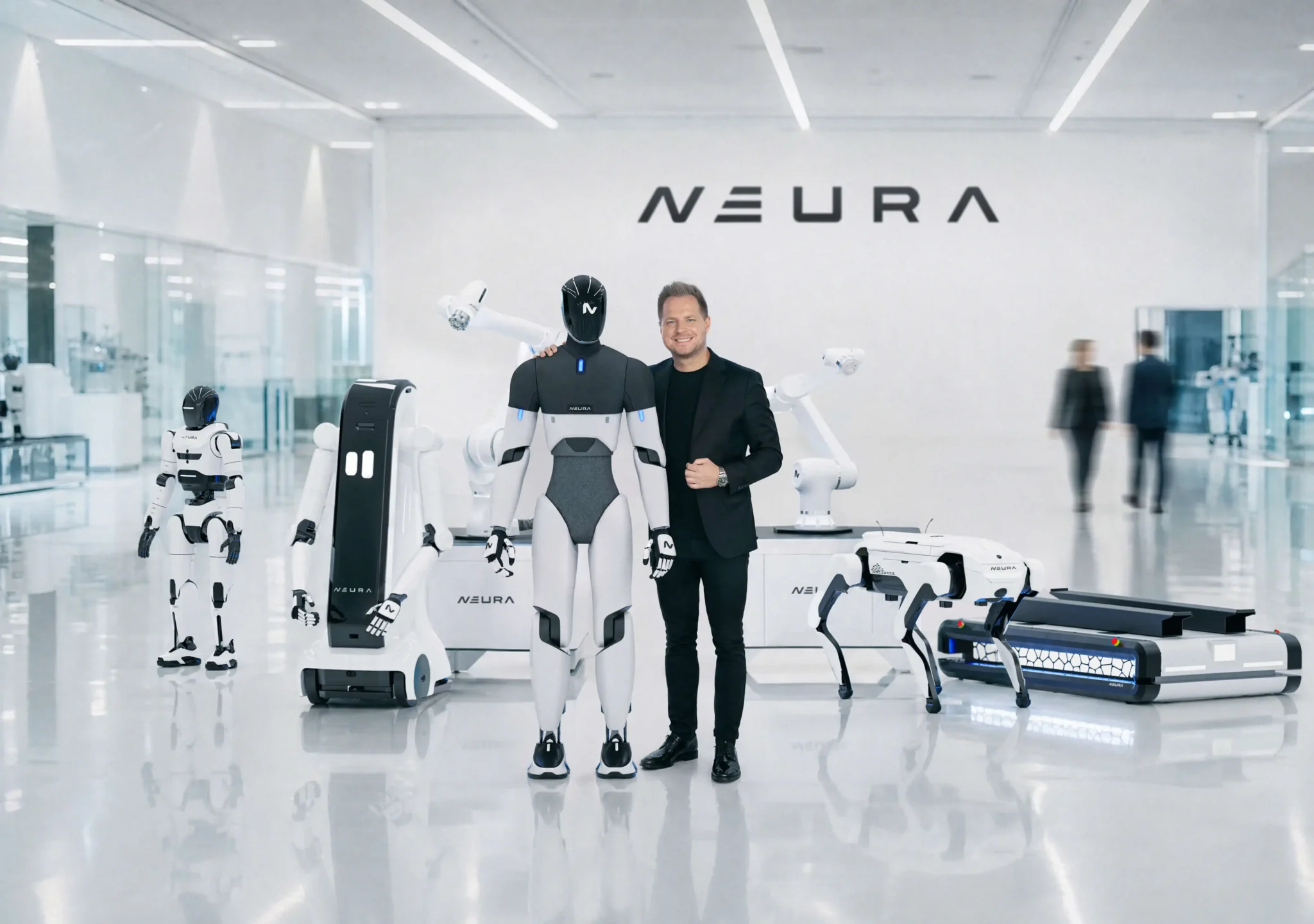
In a global race dominated by American and Chinese competitors, one German startup is making a serious play for the humanoid podium. Neura Robotics, founded in 2019 by David Reger in Metzingen, Germany, has spent six years building what it calls the world's first cognitive robot. That claim rests on a stack of proprietary sensors, onboard AI, and a robotics philosophy that puts perception first.
The company's flagship product, the 4NE1, is a full-size humanoid robot that stands 1.8 meters tall and weighs 80 kilograms. It entered industrial field trials in 2024, backed by $178 million in total funding and partnerships with Bosch, NVIDIA, and Kawasaki. For Europe, which has historically played a supporting role in the robotics arms race, Neura represents a genuine shot at owning a piece of the humanoid future.
This is the full picture of what Neura is building, how it works, and why it matters.
Key Stats
$178M
Total Raised
1.8m
Height (4NE1)
15 kg
Payload Capacity
2019
Founded
How 4NE1 Works: The Cognitive Approach
Most humanoid robots are defined by what they can physically do. Neura Robotics wants its machines defined by what they can understand. The 4NE1 is designed around the idea that robots in real-world environments fail not because their motors are too weak, but because their perception is too narrow. Put a typical industrial robot in an unstructured space and it breaks. The 4NE1 is built to not break.
The cognitive approach starts with 360-degree perception. The 4NE1 uses a combination of cameras, depth sensors, and proprietary sensor skin spread across its body to build a continuous model of its environment. It does not rely on fixed-position cameras mounted to the ceiling of a factory. It carries its awareness with it. That distinction matters in logistics environments where shelving layouts change, pallets move, and human workers share the floor unpredictably.
Neura's cognitive layer runs onboard. The company explicitly claims the 4NE1 does not require a cloud connection to operate, which matters for factory customers worried about network latency, data security, and connectivity reliability on the production floor. The AI stack combines vision processing, natural language understanding, and reinforcement learning. The robot learns from its environment and refines its behavior over time.
At 1.8 meters tall and 80 kilograms, the 4NE1 is built to fit the same physical space as a human worker. It carries 15 kilograms and moves at 3 kilometers per hour. That speed is slower than competitors like Agility's Digit or Figure's 02, but Neura's position is that cognitive reliability in messy environments is more valuable to factory operators than raw speed. An error-prone fast robot is worse than a careful slower one.
The 4NE1 targets two deployment environments: industrial (manufacturing lines, logistics centers, automotive assembly) and domestic (a longer-term vision of household assistance). For now, industrial is the focus. The domestic play exists as a product roadmap for the mid-2030s.
Under the Hood: Sensing, AI, and Actuation
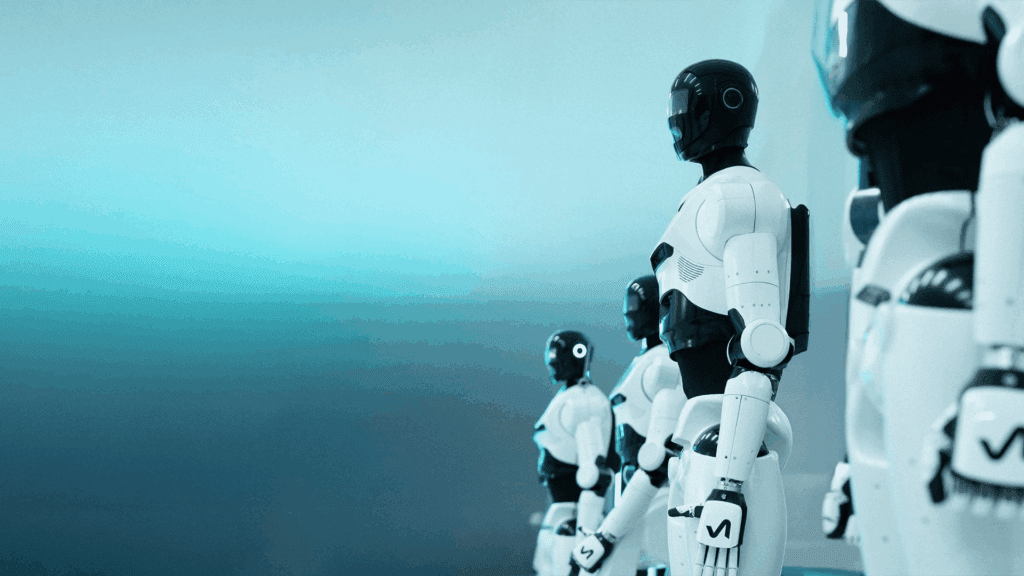
The technical architecture of the 4NE1 has three core pillars: sensing, cognition, and actuation. Neura's differentiation lives primarily in the first two.
 Copyright: NEURA Robotics
Sensor Skin
The most distinctive hardware feature of the 4NE1 is its full-body sensor skin. Traditional robots have tactile feedback at their end effectors, if at all. Neura has distributed sensing across the robot's entire surface, allowing the 4NE1 to detect contact, pressure, and proximity across its body. In shared workspaces where a robot might brush against a human, a shelf, or a moving conveyor, this body-wide awareness reduces collision risk and allows smoother navigation in tight quarters.
Multimodal AI
The 4NE1 runs a multimodal AI stack combining computer vision with natural language processing. In practice, this means the robot can receive instructions verbally, interpret its visual environment, and act on the combination. Neura is part of NVIDIA's Humanoid Robot Developer Program and uses NVIDIA's Isaac GR00T platform, which provides pre-trained foundation models for robot locomotion and manipulation. GR00T accelerates the training pipeline by giving Neura a head start on physical reasoning tasks that would otherwise take months to train from scratch.
Reinforcement Learning
Neura uses reinforcement learning to tune the 4NE1's behavior in specific task environments. Rather than programming explicit rules for every scenario, the robot learns from repeated interaction, improving its grasping, navigation, and task execution over time. This approach is computationally expensive in training but produces behavior that generalizes better across real-world variations.
How 4NE1 Compares
Here is how the 4NE1 stacks up against its primary international competitors on paper:
| Spec | Neura 4NE1 | Figure 02 | Agility Digit | Unitree H1 |
|---|---|---|---|---|
| Height | 1.8 m | 1.70 m | 1.75 m | 1.80 m |
| Weight | 80 kg | 60 kg | 65 kg | 47 kg |
| Payload | 15 kg | 20 kg | 16 kg | 30 kg |
| Max Speed | 3 km/h | ~4.3 km/h | ~5.4 km/h | ~3.3 km/h |
| Commercial Status | Field Trials | Deployed (BMW) | Commercial | Commercial |
| Country | Germany | USA | USA | China |
The table makes one thing clear: the 4NE1 is the heaviest robot in this comparison and the only one still in field trials. That is a commercial lag. But weight often correlates with structural rigidity and power capacity, and Neura's bet is that cognitive software advantage compensates for being later to commercial deployment. The 4NE1 Mini, expected to ship Spring 2026, will address the research and education market in the interim.
Neura Robotics: The Full Picture
Origins and Founding
David Reger founded Neura Robotics in 2019 in Metzingen, a small city in Baden-Wurttemberg, Germany, better known for its Hugo Boss factory outlet than its tech scene. Reger came from a background in industrial automation and identified a fundamental gap: factories needed robots that could work alongside humans in general-purpose roles, not just in caged cells executing one fixed task on one fixed line.
The company's first product was LARA, a collaborative robot arm launched in November 2020. LARA targets manufacturing, healthcare, and logistics applications as a lighter, safer alternative to traditional industrial arms. MAV followed as an autonomous mobile robot capable of carrying payloads up to 1.5 tons, designed for automotive manufacturing floors. Both products generated real customer traction and gave Neura the cash flow and credibility to fund its humanoid ambitions.
Funding History
Neura raised $55 million in July 2023, a significant round for a European robotics startup at a time when most investor attention was flowing to American competitors. The company followed that with a Series B of EUR 120 million (approximately $123.3 million USD) in January 2025, bringing total funding to roughly $178 million. For context, Figure AI has raised over $800 million. Neura is not the largest-funded company in the humanoid space, but it is the best-funded European-headquartered humanoid robotics startup by a wide margin.
Partnerships
Neura's partnership strategy has been deliberate. The Kawasaki relationship gives the company a major industrial customer using its collaborative robotics platform. Kawasaki is one of the largest industrial robot manufacturers in the world, so their adoption of Neura's technology validates the underlying platform beyond startup marketing.
The NVIDIA partnership, announced in 2024 through the Humanoid Robot Developer Program, gives Neura access to Isaac GR00T and the broader NVIDIA simulation ecosystem. This signals that Neura is operating at the frontier of AI-driven robotics development, not just building automation with a humanoid shell.
The Bosch partnership, announced in January 2026, is strategically the most significant. Bosch is one of Europe's largest industrial conglomerates, with deep roots in automotive supply chains across Germany. A strategic partnership for industrial humanoid robots opens doors to exactly the customers Neura needs: tier-1 automotive suppliers and factory operators that already have established Bosch relationships. It also provides credibility no startup press release can manufacture.
In 2025, Neura joined the SRCI Working Group under Profibus, an industry body focused on standardizing interfaces between robots and programmable logic controllers. The goal is to make humanoid robot integration into existing factory control systems feasible without requiring massive IT overhauls. That kind of standards work is unglamorous but solves a real problem slowing enterprise adoption across the industry.
What Neura Means for European Robotics
Europe has historically been a supplier to the robot industry rather than a leader in it. KUKA (German) was sold to China's Midea Group in 2016. ABB (Swiss-Swedish) is strong in industrial arms but has not made a credible humanoid play. The humanoid robot moment arriving in the mid-2020s has, so far, been made in America or China.
Neura is trying to change that narrative. The company is headquartered in Germany, has raised its capital largely from European sources, and is targeting European industrial customers as its primary market. Germany's automotive industry, the world's most automation-intensive, is a natural launch pad. BMW, Mercedes, Volkswagen, and their tier-1 suppliers all face the same labor shortage pressures pushing US automakers toward humanoid robots.
There is also a regulatory angle. Europe's approach to AI regulation under the EU AI Act creates compliance requirements that a European-headquartered company is better positioned to navigate than a US or Chinese competitor. For European factory customers concerned about data sovereignty, buying from a German robotics company carries real practical and political appeal.
The talent picture is improving too. Germany has world-class mechanical engineering and computer science programs. Munich, Berlin, and Stuttgart all have active robotics research ecosystems. The challenge has historically been commercialization and capital formation, not raw technical talent. Neura's Series B, backed by investors willing to write nine-figure checks into a European deep-tech company, suggests that gap is narrowing.
Germany's automotive industry, the world's most automation-intensive, is a natural launch pad for Neura. BMW, Mercedes, Volkswagen, and their tier-1 suppliers all face the same labor shortage pressures pushing US automakers toward humanoid robots.
What's Coming Next
The Bosch Deal: Execution Is Everything
The January 2026 Bosch partnership is the most consequential near-term milestone for Neura. Bosch brings manufacturing expertise, a global sales network, and credibility with exactly the enterprise customers that buy robots at scale. But strategic partnerships in industrial manufacturing often take years to convert into purchase orders. The 4NE1 will need to demonstrate consistent, reliable performance in real Bosch manufacturing environments before that relationship produces meaningful revenue.
The terms of the partnership have not been disclosed publicly. Whether Bosch took an equity stake, committed to a volume purchase agreement, or signed a joint development agreement matters significantly for Neura's trajectory. Bosch's financial firepower and manufacturing scale could accelerate Neura's production ramp in ways that venture funding alone cannot.
4NE1 Mini: The Research Market
The 4NE1 Mini, scheduled to ship Spring 2026, is a smaller version of the flagship humanoid aimed at research institutions and universities. Research customers are more tolerant of prototype-level performance, pay upfront, and produce academic papers that build credibility for the underlying technology. It is the same playbook Boston Dynamics ran with Spot, which became the world's most-documented legged robot partly because universities bought them in volume.
The Mini also gives Neura a shippable product before the full 4NE1 achieves commercial-scale production readiness. Revenue from research sales buys runway and generates real-world feedback loops that improve the main product over time.
The Road to Commercial Deployment
Neura has not published a commercial availability date for the full 4NE1. The robot is in industrial field trials as of 2024. Getting from field trials to commercial deployment requires solving manufacturing scale, reliability benchmarking, and safety certification in EU work environments. None of those are trivial problems.
The $178 million raised gives Neura meaningful runway. But the capital intensity of humanoid robotics is high. Tesla spent hundreds of millions developing Optimus before reaching limited internal production use. Figure AI is burning through $800 million to get to commercial scale. Neura will need either a major production partner, a strategic acquirer, or additional capital raises to compete at the volumes that make humanoid robots economically viable for factory customers.
FAQ
Is the Neura 4NE1 available to buy?
Not yet for general commercial customers. As of early 2026, the 4NE1 is in industrial field trials with select partners. The 4NE1 Mini, aimed at research institutions and universities, is scheduled to ship in Spring 2026. A commercial release timeline for the full 4NE1 has not been publicly announced.
What makes Neura different from other humanoid robot companies?
Neura's primary differentiator is what it calls the cognitive approach: onboard AI with no cloud dependency, full-body sensor skin for 360-degree tactile and proximity awareness, and a multimodal AI stack combining vision and language understanding. Most competitors focus on locomotion and manipulation performance metrics. Neura argues that perception and cognition in unstructured environments is the harder problem, and the one worth solving first.
Who has invested in Neura Robotics?
Neura raised $55 million in July 2023 and a EUR 120 million Series B in January 2025, totaling approximately $178 million. The company has not disclosed all investors publicly. The Bosch strategic partnership announced in January 2026 suggests at least one major industrial partner with a financial component. NVIDIA's involvement through the Humanoid Robot Developer Program is a technology partnership rather than a direct equity investment.
How does Neura fit into the broader European robotics ecosystem?
Neura is the most significant humanoid robotics startup to emerge from Europe to date. It fills a gap left by the sale of KUKA to China's Midea Group in 2016 and ABB's absence from the humanoid category. The Bosch partnership positions Neura as a potential cornerstone of a European industrial AI robotics supply chain. Germany's automotive and manufacturing sectors give it a natural home market with immediate demand for exactly the use cases the 4NE1 targets.
Conclusion
Neura Robotics is not the furthest along in the humanoid robot race. Figure 02 is already deployed at BMW. Agility's Digit is operating in Amazon warehouses. Unitree sells its H1 commercially. The 4NE1 is still in field trials.
But Neura is building a different kind of machine. The cognitive approach, with its emphasis on full-body sensing, onboard AI, and environment understanding, is a genuine technical bet rather than just marketing. If that bet pays off, Neura will not just be the most interesting European robotics company. It will be a serious player in the global humanoid market.
The Bosch partnership provides a credible path to European industrial deployment. The NVIDIA relationship keeps Neura on the AI frontier. The $178 million in funding buys time to get the 4NE1 to commercial readiness. Whether Neura can convert all of that into a viable, scaling business before its American and Chinese competitors establish insurmountable leads is the open question. The next 18 months, and the 4NE1's field trial performance, will be telling.
Bottom Line
Neura Robotics is Europe's best shot at a home-grown humanoid champion. With $178 million raised, a Bosch partnership, NVIDIA backing, and the 4NE1 in industrial trials, the company has the ingredients to compete. Its cognitive approach, prioritizing perception and onboard AI over raw speed and payload, is a deliberate differentiation from the American field. The 4NE1 Mini ships Spring 2026, full commercial deployment is still a year or more away, and the Bosch deal needs to convert from announcement to purchase orders. But the foundation is more serious than most European deep-tech bets.