Company Profiles
Pudu Robotics: The Service Robot Company Walking Into Humanoids
Pudu Robotics is moving from service robots into humanoids with D9, backed by global deployments and new 2026 funding.
 Official source video
Pudu Robotics was founded in Shenzhen in 2016 by Felix Zhang and built its name with commercial service robots for restaurants, hotels, hospitals, offices, and retail settings before moving into humanoids.
The company says it has deployed more than 80,000 robots globally, unveiled the PUDU D9 full-size humanoid in December 2024, and raised nearly $150 million in 2026 as it pushes embodied AI into industrial and service work.
Key Stats
2016
Founded
80K+
Robots Deployed
170 cm
D9 Height
42
D9 DOF
From Delivery Robots to Humanoids
Pudu Robotics is entering the humanoid race from a different base than many startups. It already sells commercial service robots, including delivery, cleaning, reception, and building-service machines. That gives the company customer channels, manufacturing experience, and service data before the humanoid product becomes mature.
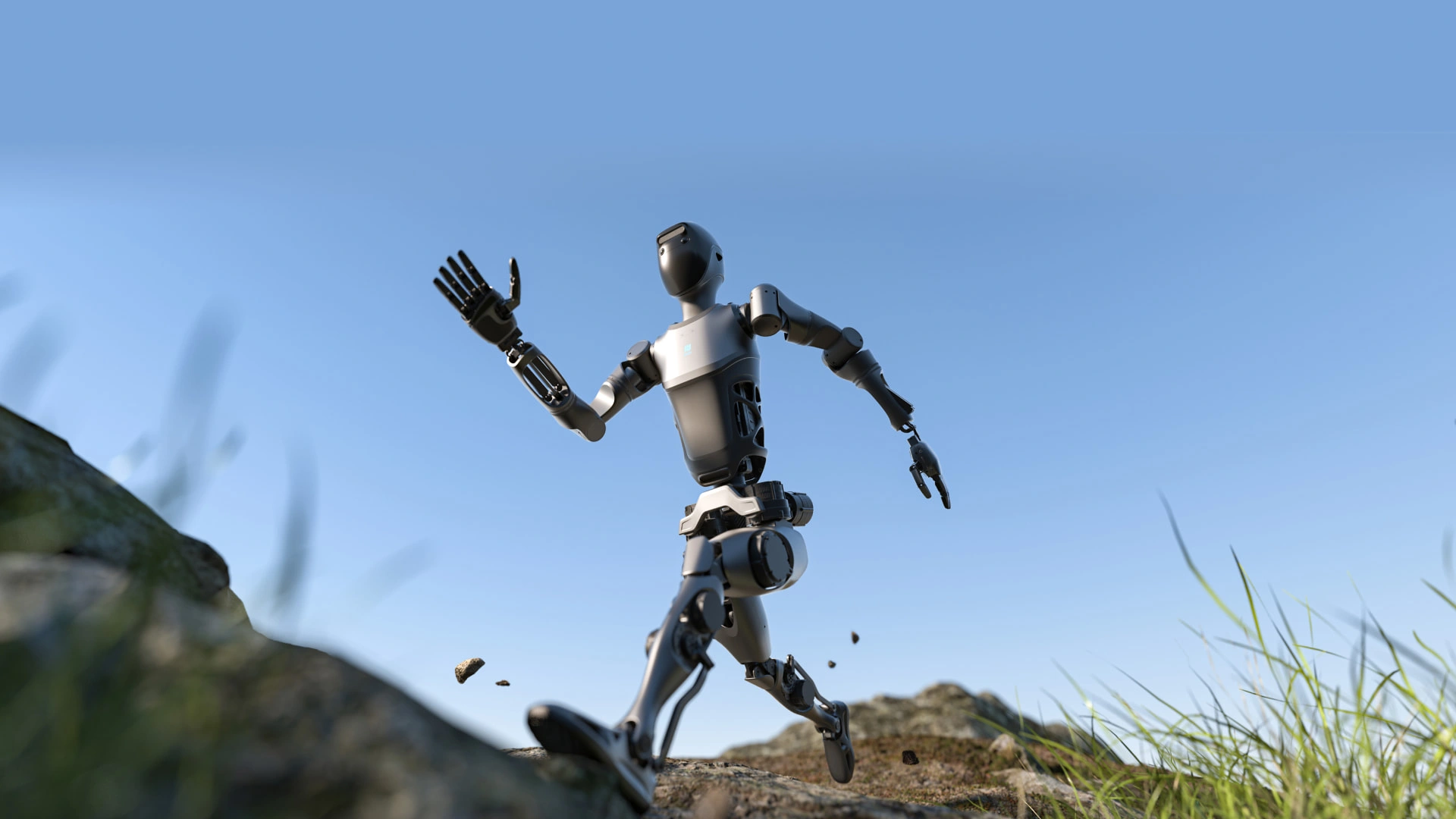
The PUDU D9 is the company’s most visible humanoid move. Public specs describe a full-size bipedal humanoid about 170 centimeters tall, weighing about 65 kilograms, with 42 degrees of freedom and dexterous hands. Those numbers put it in the serious hardware category rather than the desktop-demo category.
The company also introduced semi-humanoid and wheeled systems such as the D7, suggesting a practical staged approach. Wheels can solve many commercial problems before full bipedal locomotion is reliable or cost-effective. That matters because customers buy completed tasks, not humanoid symbolism.
Pudu’s service-robot background may help it choose jobs that real customers already understand. Restaurants, hotels, hospitals, and retail locations know delivery and cleaning robots. They may be more willing to test richer robots if the value is tied to existing workflows.
The hard question is whether Pudu can move from structured service tasks into embodied AI that handles variation. A tray-delivery route is one thing. A humanoid operating near people, furniture, tools, and changing objects is much harder.
| Company | Core Product | Commercial Test |
|---|---|---|
| Pudu Robotics | Service robots and PUDU D9 humanoid | Turn service-robot channels into embodied AI deployments |
| Unitree | G1 and H1 humanoids | Low-cost developer and commercial adoption |
| UBTECH | Walker and industrial humanoids | Factory partnerships and public-company scale |
| LimX Dynamics | Luna and TRON platforms | Convert fast hardware into useful customer pilots |
The D9 Hardware Story
The D9 is designed as a human-scale bipedal platform. Its height, weight, joint count, and hand configuration aim at general service and industrial tasks where a robot must move through human-built spaces. Human-scale geometry matters because doors, counters, shelves, elevators, and tools are built around people.
Bipedal movement gives the robot access to spaces that wheeled systems may struggle with, including steps, uneven areas, and cluttered rooms. It also adds cost, fall risk, energy demands, and control complexity. Pudu has to prove that legs create enough value to justify the extra difficulty.
The D9’s 42 degrees of freedom and DH11-style dexterous hand point toward manipulation ambitions. The robot is not only meant to walk. It is meant to interact. That brings the company into the hardest part of humanoids: reliable grasping, tool use, and task completion under changing conditions.
Pudu’s advantage may be system integration. A company that already builds thousands of service robots understands batteries, motors, sensors, fleet management, remote diagnostics, support, and customer training. Those are not glamorous, but they decide whether robots survive outside labs.
The D9 still has to earn its place. A humanoid must prove uptime, safety, intervention rate, and customer value. Product videos are not enough.
Funding and Global Channels
Pudu announced nearly $150 million in new financing in 2026, with reports placing total funding above $300 million and valuation above $1.5 billion. That capital gives the company room to expand embodied AI development, product lines, and overseas operations.
Funding matters because humanoid development consumes money quickly. Actuators, hands, batteries, sensors, compute, test labs, manufacturing, field support, and AI training all require sustained investment. A service-robot company has revenue, but humanoids can absorb far more capital than a traditional delivery robot line.
Pudu’s global footprint is an important asset. The company already sells in many countries and has customers familiar with robot deployment. That channel could help D9 or D7 pilots reach real environments faster than a startup with no field organization.
Global sales also create obligations. Customers need documentation, spare parts, repairs, software updates, cybersecurity policies, data protection, and local support. These details become more sensitive when humanoids use cameras and operate near workers or guests.
The company’s next commercial test is whether it can use existing service relationships to launch higher-value robots without overpromising autonomy.
Service Work May Be the Right First Market
Pudu’s likely early humanoid market is not a fully autonomous factory worker replacing a person across every task. The more credible path is supervised service work, inspection, reception, light delivery, guidance, and controlled manipulation in environments the company already serves.
Those tasks can create value even when autonomy is partial. A robot can guide visitors, carry items, patrol a site, scan shelves, press simple controls, or act as a mobile telepresence platform while software improves. The customer does not need science fiction. The customer needs a job done reliably.
This is where Pudu’s fleet experience matters. Service robots produce operational lessons about mapping, charging, traffic, human interaction, cleaning, maintenance, and support. Those lessons are relevant to humanoids, even though the mechanics are harder.
The danger is novelty deployments. Humanoids can attract attention in hotels and malls without producing durable value. Pudu should focus on repeatable workflows where customers expand after a pilot because the robot saves time or improves service quality.
The company’s best near-term signal would be small fleets in ordinary commercial sites doing defined jobs week after week.
The 2026 Watchlist
The first signal is pilot quality. Pudu should show D9 or D7 deployments with named tasks, customer settings, uptime, and intervention data.
The second signal is manufacturing discipline. The company has experience building service robots, but humanoid bodies are more complex and expensive. Quality control will matter more.
The third signal is software progress. Embodied AI has to move beyond voice interaction and basic navigation into task-level reliability.
The fourth signal is channel leverage. Pudu should use existing restaurant, hotel, hospital, and commercial customers as structured test beds, not only marketing venues.
The fifth signal is price. If Pudu can deliver capable humanoid or semi-humanoid platforms at a cost customers can actually justify, it will put pressure on higher-priced competitors.
Why Pudu Deserves a Profile
Pudu Robotics deserves a profile because it brings real robot deployment experience into a humanoid market crowded with demos. Its service robots have already reached customers around the world, and that gives the company practical knowledge about what businesses tolerate and what they reject.
The D9 is not proven as a commercial humanoid yet. It still has to show manipulation, safety, durability, and repeatable value. But Pudu has a better starting point than companies that have never supported fleets outside a lab.
The company’s strategic question is whether humanoids become an extension of its service-robot business or a costly distraction from it. A staged approach through D7, D9, and existing customer workflows would make the most sense.
Pudu does not need to win the humanoid race by making the most dramatic robot. It can win a valuable segment by making robots that businesses can deploy, service, and understand.
For Biped, that makes Pudu one of the most important service-robot companies moving into embodied AI. Its 2026 funding and D9 rollout put it directly in the group of companies testing whether humanoids can become commercial products rather than spectacle.
FAQ
When was Pudu Robotics founded?
Pudu Robotics was founded in Shenzhen in 2016 by Felix Zhang.
What is the PUDU D9?
The PUDU D9 is a full-size bipedal humanoid robot announced in December 2024, with public specs listing about 170 centimeters of height, 65 kilograms of weight, and 42 degrees of freedom.
Why does Pudu’s service-robot background matter?
Pudu already has global customers, fleet support experience, and manufacturing practice from commercial service robots, which may help it deploy humanoids in real workplaces.
What Service Robots Teach Humanoids
Pudu’s service-robot history matters because commercial robotics is full of operational details that do not appear in launch videos. Robots need to charge at the right time, avoid blocking customers, recover from network problems, handle spills or clutter, and keep working after hundreds of ordinary interactions.
Those lessons transfer to humanoids unevenly but usefully. A humanoid has harder mechanics, yet it still needs fleet management, mapping, remote support, maintenance schedules, user permissions, and clear customer training. Pudu has already had to build many of those functions for simpler robots.
The company also understands hospitality and service environments. Those markets care about appearance, noise, reliability, safety, and guest acceptance. A robot can be technically capable and still fail if it makes staff uncomfortable or irritates customers.
Humanoids add new concerns. A falling delivery robot may be annoying. A falling full-size humanoid can be dangerous and expensive. Pudu will need stronger safety systems, slower initial deployments, and clearer operating boundaries than it uses for wheeled robots.
The benefit is that Pudu does not have to invent the customer conversation from zero. It can approach existing buyers with a progression: delivery robot, cleaning robot, semi-humanoid assistant, then full humanoid for specific jobs.
That staged trust may be more important than raw robot specifications. Customers adopt robots when they believe the vendor will support the deployment after the novelty fades.
D7, D9, and the Practical Body Question
The most interesting part of Pudu’s roadmap may be that it does not rely only on a biped. A wheeled or semi-humanoid body can solve many commercial tasks at lower cost and lower risk than a walking machine. That gives Pudu options.
D9 is useful where human-scale mobility matters. It can potentially move through spaces designed for people, reach human-height objects, and perform tasks that look natural to customers. But legs are expensive and difficult.
D7-style platforms can bridge the gap. A robot with arms, perception, and a stable mobile base can handle reception, light delivery, inspection, and basic manipulation without the fall risk of a biped. If the customer does not need stairs, wheels may win.
This is the practical body question in humanoids: what form factor does the task actually need? Many buyers may say they want a humanoid when they really need a reliable mobile manipulator. Pudu is well positioned if it offers several bodies tied to the same software and support stack.
The risk is product sprawl. Too many bodies can split engineering, parts, documentation, and support. Pudu will need to keep the platform family coherent.
The strongest approach is common software, common fleet tools, shared sensors where possible, and clear task boundaries for each robot. That lets the company sell outcomes instead of forcing every customer into the same humanoid shape.
Competitive Pressure From China and Abroad
Pudu is entering a crowded humanoid field. Unitree is pushing cost and developer visibility. UBTECH has industrial deployments and public-market experience. Fourier, LimX, EngineAI, Agibot, Galbot, and other Chinese companies are iterating quickly. Western firms such as Figure, Apptronik, Agility, and Tesla are chasing enterprise scale from different angles.
This competition will compress hardware differentiation. If several companies can build a walking robot with dexterous hands, customers will compare price, reliability, software, support, safety, and integration. Pudu’s service network could become a real advantage if the hardware is good enough.
International trust will also matter. Robots with cameras, microphones, cloud software, and remote support raise data questions. Pudu will need enterprise-grade privacy, security, update controls, and regional compliance if it wants broad adoption outside China.
The company should avoid trying to match every rival’s headline. The best lane may be commercial service and light industrial tasks where Pudu already knows the buyer. A focused customer base can beat a broad but shallow humanoid pitch.
Fleet expansion is the metric to watch. One robot in a hotel lobby can be marketing. Ten robots across a customer’s properties after a pilot is a business signal.
Pudu’s advantage is not that it announced a humanoid. Many companies have. Its advantage is that it already knows how hard it is to keep robots useful after delivery. If it carries that discipline into D9, the company becomes a serious embodied AI contender.
Deployment Economics
Pudu’s humanoid economics will depend less on peak capability than on daily utilization. A robot that performs one flashy task for visitors is a marketing expense. A robot that works across several shifts, handles routine assignments, and reduces staff friction can become operational equipment.
That difference changes how customers evaluate price. Restaurants, hotels, hospitals, and retail operators usually work with tight labor budgets and clear service expectations. They will compare robot cost against wages, turnover, availability, customer satisfaction, and maintenance burden.
Pudu can help itself by packaging deployments around specific jobs. A hotel may need delivery and guest guidance. A hospital may need supply transport and wayfinding. A retail site may need shelf scanning or after-hours inspection. Each workflow needs different safety rules and success metrics.
The company’s service history should make those packages more realistic. It already knows that customers need training, site mapping, charging locations, maintenance plans, and staff buy-in. Humanoids will require all of that plus stronger safety review and clearer escalation paths.
A robotics-as-a-service model may fit some customers because it turns a capital purchase into an operating expense. That can speed adoption, but it puts more financial risk on Pudu. The company would have to own uptime, repair costs, and fleet utilization.
Direct sales may work better for research, education, and innovation teams that want to experiment with D9. Commercial service customers will likely prefer managed pilots first. Pudu should treat pilots as conversion funnels, not isolated demonstrations.
The best commercial signal would be expansion from one robot to many at the same customer. That would show the robot is useful after staff learn its limits. Repeat deployment is the point where a humanoid stops being a novelty and starts becoming a product.
What to Measure Next
The clearest 2026 metric is intervention rate. If a D9 or related platform needs frequent human rescue, the economics weaken. If remote operators intervene rarely and the rate improves over time, Pudu can argue that software learning is compounding.
Task completion rate is just as important. Walking through a lobby is not enough. Customers need robots to deliver items, guide people, inspect spaces, or manipulate objects with measurable reliability.
Durability will be another filter. A full-size humanoid has joints, covers, hands, sensors, batteries, and compute modules that can wear or break. Serviceability may decide whether customers trust the platform.
Pudu should also publish clearer safety and data policies for global customers. Cameras, microphones, maps, and cloud connectivity are manageable concerns only when the vendor gives enterprise buyers direct answers.
If Pudu can show improving intervention rates, repeat deployments, and real customer workflows, its service-robot base becomes a major advantage. If the company only shows polished humanoid demos, it will blend into an already crowded field.