Technology
Robot Proprioception Explained: How Humanoids Know Where Their Bodies Are
Robot proprioception is the internal sensing layer behind humanoid balance and manipulation. This explainer covers encoders, IMUs, force sensors, contact detection, state estimation, learning, and why body awareness matters for physical AI.
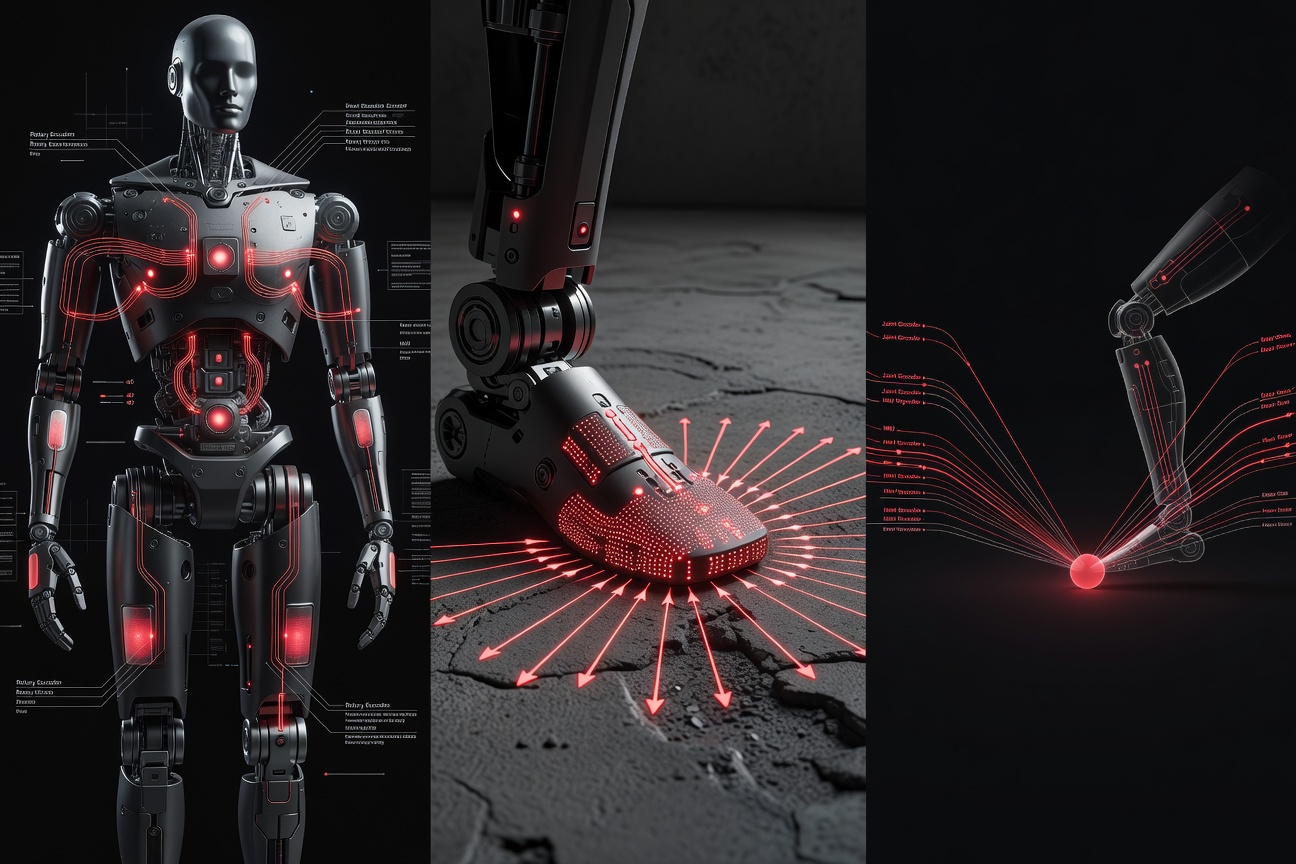
Proprioception is the hidden body sense inside a humanoid robot. It is how the machine knows where its limbs are, whether a foot is loaded, and when balance is starting to fail.
Without it, vision and AI planning are not enough. The robot has to feel its own motion before it can work safely in the physical world.
Key Signals
Encoders
joint position
IMU
body motion
F/T
contact forces
EKF
state fusion
What Proprioception Means in a Robot
Robot proprioception is the machine version of body awareness. It tells a humanoid where its joints are, how fast its body is rotating, which foot is carrying weight, whether a hand is pushing on something, and whether the robot is starting to slip. Vision tells the robot about the outside world. Proprioception tells it what the body is actually doing.
That internal sense is essential because legged robots cannot wait for cameras to solve every balance problem. A foot contact can change in milliseconds. A joint can lag a command. A floor can be softer than expected. A box can push back. The controller needs high-rate signals from inside the robot before a stumble becomes a fall.
The core sensor is the joint encoder. Encoders measure joint angle, and from angle over time the controller estimates velocity. Absolute encoders know position at startup. Incremental encoders measure movement from a reference. High-quality joint sensing lets the robot compute where each limb is relative to the body through forward kinematics.
An inertial measurement unit, or IMU, usually sits in the torso or pelvis. It combines gyroscopes and accelerometers to measure angular velocity and acceleration. The IMU gives the robot a fast estimate of orientation and motion, but it drifts if used alone. Gyros accumulate bias. Accelerometers see gravity and motion together. The IMU is powerful, but it needs correction.
The Sensor Stack
Force and torque sensors add contact truth. A foot sensor can estimate ground reaction force. An ankle or wrist sensor can measure pushes, twists, and load transfer. Motor current can also estimate torque, though friction and transmission dynamics complicate the mapping. Contact sensing helps the robot decide whether a foot is planted, slipping, unloaded, or hitting an obstacle.
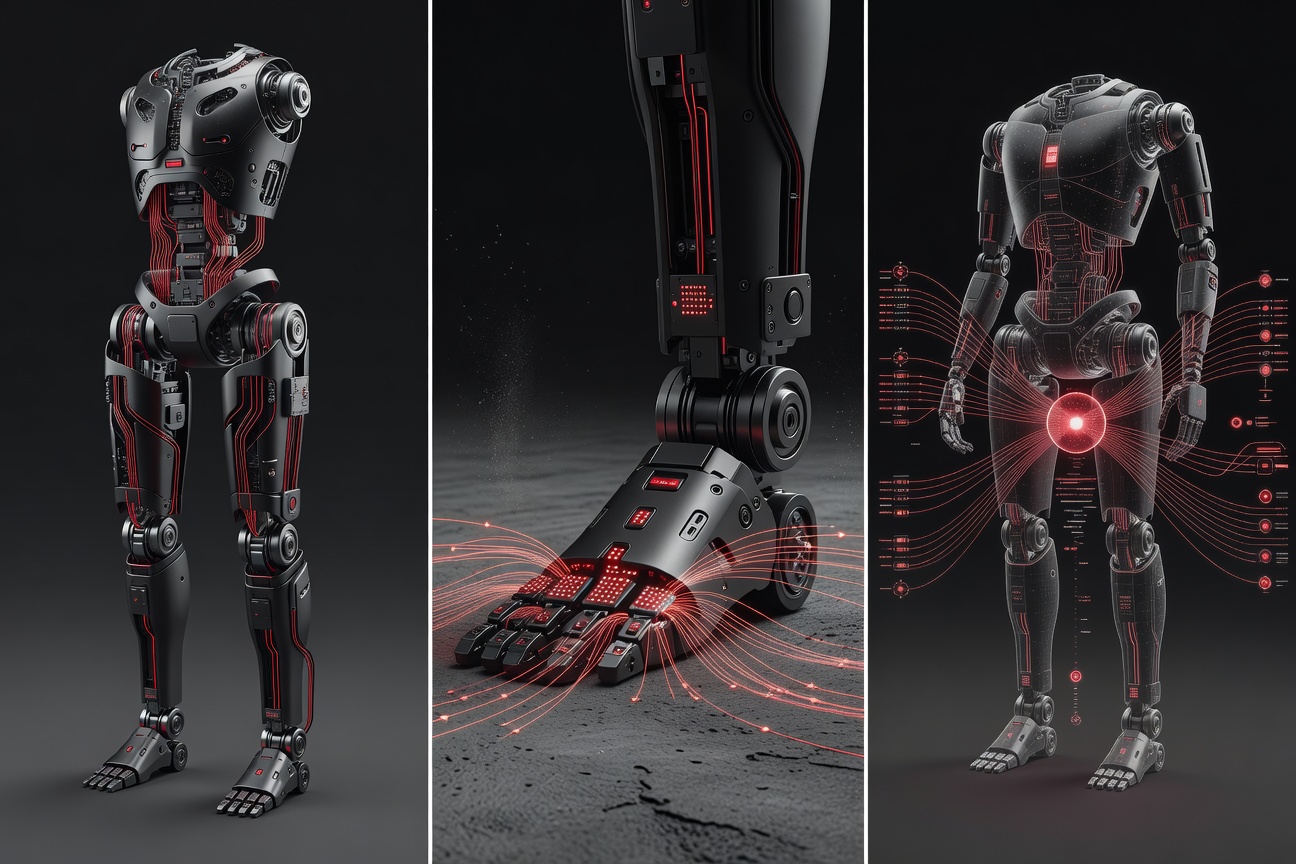
Proprioception becomes useful through sensor fusion. A state estimator combines encoders, IMU data, force sensors, motor currents, and contact assumptions into a best estimate of body pose, velocity, joint state, and foot contact. Filters such as extended Kalman filters are common because no single sensor is enough. The robot balances on estimates, not raw signals.
Leg odometry is one example. If a foot is firmly planted, the robot can treat that foot as a temporary reference point. Encoders tell where the hip is relative to that foot, and the estimator uses that information to correct body motion. When the foot lifts or slips, that assumption has to change quickly. Contact detection is therefore part of state estimation.
The difficulty is that contacts are intermittent. A wheeled robot can often assume continuous ground contact. A humanoid alternates stance, swing, double support, toe-off, heel strike, hand contact, and occasional impacts. Each contact changes which measurements are trustworthy. The estimator has to update its model of the world while the robot is moving.
State Estimation and Contact
Whole-body control depends on this internal state. A controller that computes joint torques needs to know center of mass, foot locations, body orientation, and external forces. If the state estimate is late or wrong, the controller can push the robot in the wrong direction. Many apparent AI failures are really sensing, timing, or estimation failures.
Latency is the enemy. Proprioceptive loops often run far faster than vision pipelines because balance needs immediate correction. Joint control may run at hundreds or thousands of hertz. Vision can add planning context at lower rates, but the inner balance loop needs fresh encoder, IMU, and force data. Fast boring signals keep the impressive behavior possible.
Calibration matters. An encoder zero offset, IMU bias, torque sensor drift, or foot sensor scale error can corrupt the state estimate. A humanoid with dozens of joints needs calibration procedures that survive shipping, falls, temperature changes, maintenance, and part replacement. Fleet robotics turns calibration into an operations problem, not a lab ritual.
Proprioception also supports learning. Reinforcement learning policies trained in simulation often consume proprioceptive observations: joint angles, velocities, body orientation, angular rates, commanded actions, and contact flags. If the real robot's sensors are noisy or delayed in ways the simulation did not model, sim-to-real transfer suffers. Good sensing makes learning more reliable.
 AI-generated image
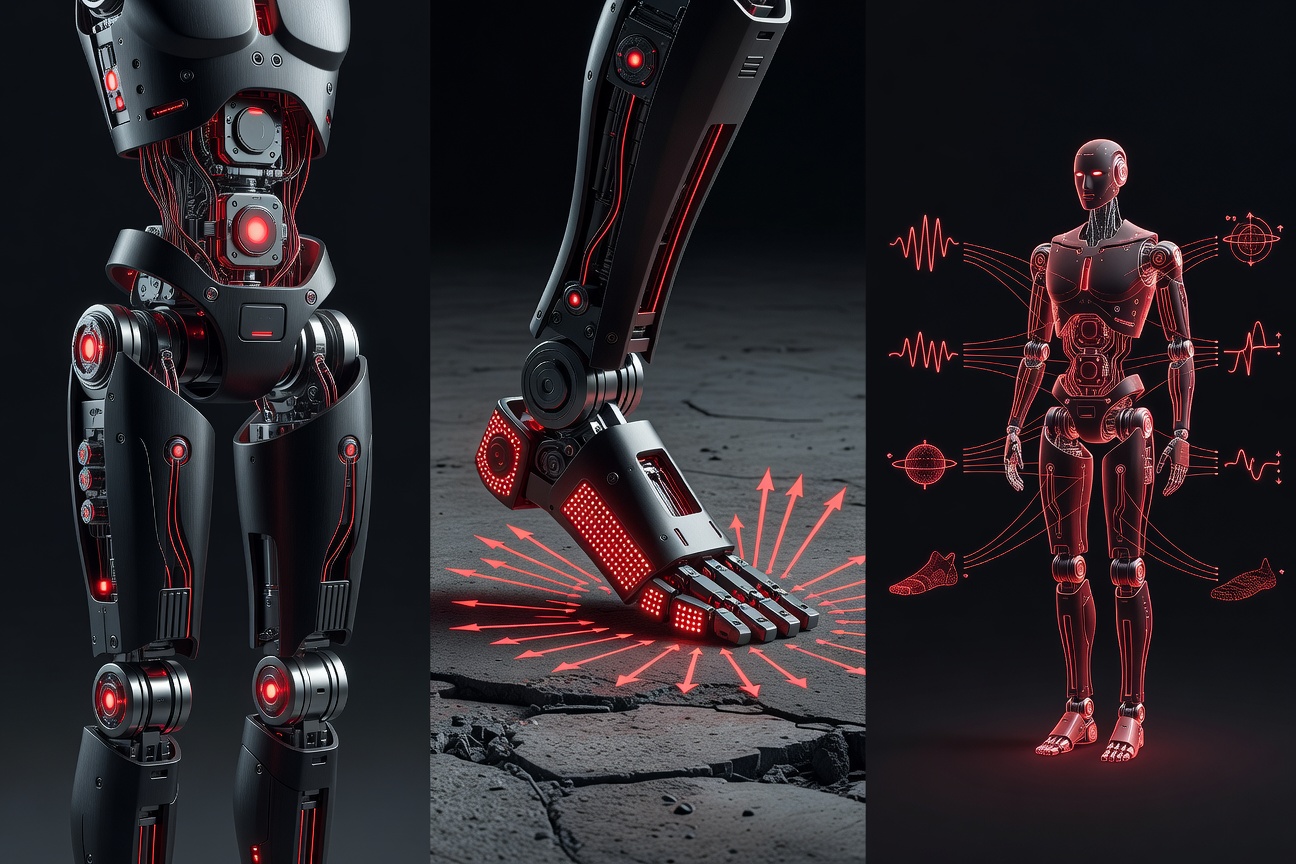
Foot contacts tell the estimator which assumptions are safe to use.
Why Balance Depends on Fast Internal Signals
Vision and proprioception solve different problems. Vision can see a stair, pallet, tool, or person before contact. Proprioception verifies what happened when the robot stepped, grasped, or collided. A robust humanoid uses both. If vision is blinded by dust, glare, darkness, or occlusion, proprioception still gives the controller a fighting chance to stand and retreat.
Foot sensing is especially important. A humanoid's support polygon can change from two feet to one foot to a toe edge. Ground reaction forces show whether weight is where the controller expects. Uneven floors, cables, gravel, soft mats, and slopes all change contact mechanics. Without foot feedback, the robot is guessing at the most important interface it has with the world.
Hands need proprioception too. A robot manipulating tools or boxes must know finger positions, tendon tension, wrist forces, and contact loads. Cameras may not see the exact contact patch once the hand closes. Tactile and force signals tell the controller whether the grasp is secure, slipping, crushing, or misaligned. Dexterity is body awareness at small scale.
Motor current is a useful but imperfect sensor. In a simple direct drive, current can map closely to torque. In geared humanoid joints, friction, backlash, compliance, temperature, and reducer efficiency complicate the relationship. That is why some robots use dedicated torque sensors or elastic elements. The more dynamic the task, the more honest force information matters.
Hands, Feet, Learning, and Maintenance
State estimation has to handle falls. After a fall, the robot may be in an unusual pose, with unexpected contacts and saturated sensors. A good estimator can recover orientation, identify which limbs are touching, and support a get-up behavior. A brittle estimator may assume the robot is still upright and make recovery worse. Fall recovery starts with knowing the body is on the ground.
Proprioceptive data is also maintenance data. Rising friction, unusual current draw, encoder noise, impact signatures, or foot-force imbalance can warn that a joint, bearing, gearbox, cable, or sole is wearing out. Fleet operators will use internal signals for predictive maintenance because downtime is expensive. The robot's body awareness becomes the service department's evidence.
There are tradeoffs. More sensors add cost, wires, compute, calibration, failure points, and data bandwidth. Fewer sensors simplify hardware but force the controller to infer more from weaker signals. A commercial robot needs enough sensing to work safely, but not so much that it becomes fragile and expensive. Proprioception is a product-design decision.
Humanoids will likely become more proprioceptive over time. Better joint modules, cheaper force sensors, tactile skins, multi-IMU layouts, and learned contact estimators can all improve internal state. The goal is not to drown the controller in data. The goal is a clean, timely estimate of what the body is doing and what the world is doing to it.
 AI-generated image
Sensor fusion turns noisy internal signals into a state estimate the controller can use.
What Comes Next
The simplest test is a bump. Push a robot gently at the shoulder. Does it feel the motion, shift weight, adjust foot forces, and recover without overreacting? That response is not just balance software. It is encoders, IMU, contact sensing, force estimation, latency control, and mechanical compliance working together.
For deployment, proprioception is what makes robots trustworthy around imperfect humans and imperfect floors. A warehouse worker will not place every box perfectly. A factory floor will not stay spotless. A home will have rugs, cords, pets, and surprises. A robot that knows its own body can absorb that mess better than one that only follows a planned motion.
Proprioception is therefore one of the quiet foundations of physical AI. Foundation models may choose tasks and interpret scenes, but internal sensing lets the robot execute those tasks without falling over. The body has to report the truth back to the brain.
The bottom line: humanoid robots do not walk, grasp, or recover because they can see. They do it because they can feel their own joints, forces, motion, and contacts quickly enough to correct themselves.
Why cameras are not enough
Cameras can identify stairs, shelves, people, and tools, but they do not directly measure joint torque or foot load. They also have latency and can be fooled by lighting, occlusion, reflective surfaces, or motion blur. A humanoid that waits for vision to confirm every balance correction will be too slow. Proprioception is the fast inner loop that lets vision operate at a safer planning layer.
The estimator as the robot nervous system
A state estimator is not glamorous, but it is the nervous system of a legged robot. It decides which measurements to trust, how to handle noisy sensors, when a foot is planted, and how the body is moving. If that estimate is wrong, the planner and controller are working from fiction. Robust autonomy begins with a truthful internal estimate.
Contact is a belief, not a fact
A foot can appear to be on the ground while sliding, rocking on an edge, or barely loaded. That makes contact estimation probabilistic. The robot combines force thresholds, joint motion, IMU changes, commanded motion, and terrain expectations. Good systems can downgrade a bad contact quickly instead of trusting it until the robot falls.
Slip detection
Slips are dangerous because the controller may believe a foot is fixed when it is moving. Proprioceptive signals can reveal slip through unexpected joint motion, force changes, and IMU acceleration. Vision can help after the fact, but the first warning often comes from the body. Fast slip detection lets the robot widen stance, reduce force, or take a recovery step.
Force control
Robots that work around people and objects need force control, not only position control. A pure position command can drive a hand through a fragile object or push too hard against a fixture. Force and torque feedback lets the controller regulate contact. That matters for opening doors, carrying bins, using tools, and leaning against surfaces during recovery.
Why feet need multiple signals
A foot is a sensor platform. Pressure distribution, ankle torque, joint angles, IMU motion, and sole deformation can all reveal ground conditions. A single binary foot switch is rarely enough for advanced humanoid work. The more varied the terrain, the more valuable richer foot sensing becomes, as long as the added hardware remains durable.
Proprioception and compliance
Mechanical compliance and sensing work together. A slightly compliant joint or sole can absorb impact, but the controller must know how that compliance changes the body state. Too much unmeasured flex creates estimation error. Good robots either keep structures stiff enough to model or measure the compliance so the controller can account for it.
Fleet data
When many robots run the same tasks, proprioceptive logs become a dataset. Engineers can find recurring impacts, high-current motions, slip-prone floors, bad grasps, and wearing joints. That feedback improves hardware, controls, and task planning. The deployed fleet teaches the company where the body is struggling, not just where the AI made a wrong decision.
Sensor failure
Sensors fail quietly before they fail completely. An encoder can become noisy, an IMU can drift, a force sensor can lose calibration, and a cable can intermittently disconnect. A safe robot needs fault detection and graceful degradation. It should notice impossible combinations of signals and stop or limp home instead of trusting corrupted data.
What buyers should ask
A buyer evaluating a humanoid should ask how the robot detects slips, impacts, overloads, bad contacts, and sensor faults. Ask how often sensors need calibration and how the system behaves after a fall. These questions cut through demo polish because they reveal whether the robot can survive normal messy operations.
The path to better body sense
Future humanoids may use distributed tactile skins, better foot pressure arrays, cheaper joint torque sensors, multi-IMU fusion, learned contact estimators, and self-calibrating joints. The goal is not more data for its own sake. The goal is cleaner body truth at lower cost and lower latency.
The deployment filter
A robot with weak proprioception can look impressive in scripted scenes and fail in ordinary work. Warehouses, factories, hospitals, and homes all contain small surprises. Body awareness is what lets a machine notice those surprises physically, not just visually. That is why proprioception is a deployment filter for humanoids.
Timing and compute
Proprioception also has a compute budget. Sensor data must be timestamped, synchronized, filtered, and delivered to controllers without unpredictable delays. A perfect sensor that arrives late is less useful than a good sensor that arrives on time. Real robots need deterministic pipelines because balance control cannot wait for overloaded software queues.
The human analogy
Humans can close their eyes and still touch their nose because the nervous system tracks limb position internally. Humanoid robots need a mechanical version of that ability. They do not have muscles and tendons in the same way, but encoders, torque sensing, IMUs, and estimators provide the same functional loop: know the body before commanding the next motion.
Why this affects trust
People trust robots that move predictably and recover calmly. Proprioception helps create that impression because the robot responds to contact instead of blindly continuing a motion. A machine that detects a bump and yields feels safer than one that keeps pushing until software notices a problem. Trust is partly a sensing outcome.
The bottom line for builders
The strongest humanoid teams treat proprioception as core architecture, not a sensor checklist. They design joints, feet, hands, wiring, calibration, estimators, and controllers together. Body awareness is not added after the robot walks. It is one of the reasons the robot can walk in the first place.
What to watch next
Watch for robots that report contact confidence, slip events, joint health, and recovery behavior as measurable product features. That will show the industry is moving beyond staged movement and toward machines that understand their own bodies well enough to work through ordinary physical mess.
In practical terms, the best humanoid will not be the one with the most sensors. It will be the one that turns the right sensors into the most reliable state estimate at the lowest cost, with the least downtime and the clearest safety margins across a real fleet, not one carefully staged lab demo shown online to investors.