Company Profiles
Tesla Optimus: The Manufacturing Giant's Humanoid Robot Strategy
Tesla Optimus Gen 2 is performing battery handling at Fremont with 1,000+ units planned for 2025. Gen 3, under new Autopilot-origin AI leadership, targets external sales in 2026. The robot isn't the most advanced on paper — but Tesla's manufacturing ecosystem might make it the most important.

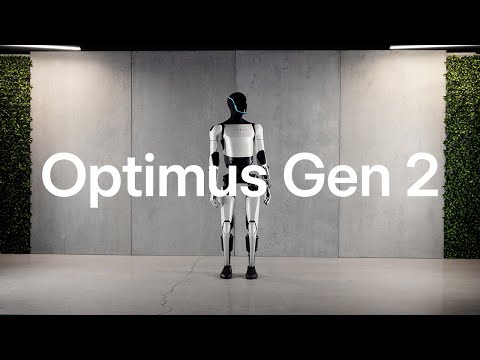 Official source video
Tesla Optimus is the most consequential humanoid robot program in the world — not because it's the most technically sophisticated, but because it sits inside a company with the manufacturing scale, vertical integration, and AI infrastructure to bring humanoid robots to mass production. At 1.73 m tall and 57 kg, Optimus Gen 2 is already performing real tasks inside Tesla's Fremont Gigafactory. Gen 3, expected to advance significantly on dexterity and autonomy, represents the program's pivot from prototype to product.
The Optimus story is complicated by Elon Musk's history of timeline inflation. But strip away the hype and what remains is genuinely significant: a robot capable of walking, manipulating objects, and performing factory tasks, built by a company that assembles 1.8 million vehicles per year using its own manufacturing infrastructure, AI chips, and training data pipelines. No other humanoid robot program has access to those resources.
 Photo: Steve Jurvetson, CC BY 2.0
Tesla Optimus Gen 2 on the factory floor at Fremont, performing battery handling tasks. Source: Tesla
Key Stats — Tesla Optimus Gen 2
57 kg
Robot Weight
1.73 m
Height
20 kg
Payload Capacity
22 DOF
Per Hand (Gen 3)
~$30K
Target Consumer Price
1,000+
Planned Units (2025)
2021
Program Announced
Internal
Funded (Tesla P&L)
Beyond the Demos: The Optimus Program in Context
Tesla announced Optimus at its first AI Day event on August 19, 2021 — and the rollout has been a study in managing expectations vs. engineering reality. The initial presentation featured a person in a robot suit. The 2022 AI Day showed semi-functional prototypes that could barely walk. The 2023 update demonstrated block-sorting and limited autonomous manipulation. By late 2024, Optimus was appearing at Tesla's "We, Robot" event interacting with guests — though critics noted the interactions relied heavily on teleoperation.
The more substantive signal came in mid-2024, when Tesla began deploying Optimus Gen 2 inside its Fremont, California Gigafactory for actual production tasks. Battery handling — moving, positioning, and inserting battery modules in a structured factory environment — became the primary use case. This isn't glamorous, but it's real commercial deployment at Tesla's own facility, generating production hours and training data simultaneously.
In June 2025, the program changed leadership: Milan Kovac, who had headed Optimus since 2022, was replaced by Ashok Elluswamy, previously the director of Tesla's Autopilot and autonomous driving program. This transition is significant — Elluswamy brings end-to-end neural network philosophy from the FSD program, where Tesla moved away from LIDAR and rule-based systems toward camera-only, neural-network-driven autonomy. Applying that framework to humanoid robot control could be the architectural shift that defines Gen 3.
🔋 Tesla's Unfair Advantages
Tesla manufactures its own AI training chips (Dojo), operates its own fleet of data-collecting vehicles, produces its own actuators and motors, and has in-house manufacturing at Gigafactories. No humanoid startup can replicate this vertical integration stack.
🧠 FSD Architecture Transfer
Tesla's Full Self-Driving program is built on camera-only perception with neural networks trained on billions of real-world miles. Applying the same "data flywheel" philosophy to Optimus — camera-only, neural-net-driven, trained on real factory hours — is the Gen 3 architectural hypothesis.
🏭 Fremont as Test Bed
Tesla's Fremont facility produces approximately 550,000 vehicles per year. Deploying Optimus internally gives Tesla a controlled but real production environment for robot training — without the risk of a third-party commercial deployment going wrong publicly.
📉 The Cost Advantage
Musk has publicly targeted a $30,000 consumer price point for Optimus — dramatically below current humanoid robot estimates of $100K–$200K+. Tesla's manufacturing cost curves from Model 3 and Model Y production give the company real experience in driving per-unit costs down through volume and vertical integration.
Under the Hood: Optimus Gen 2 Architecture
Optimus Gen 2 is a significant refinement over the prototype shown in 2022. The slimmer profile — 57 kg compared to earlier estimates of ~73 kg — reflects ongoing work on actuator efficiency and structural optimization. The robot uses planetary roller screw linear actuators throughout its limb joints rather than traditional ball screws, providing higher shock load resistance during walking motions and more precise torque control — critical for tasks that require sustained force output without gear-level feedback.
Hand Evolution: Gen 2 to Gen 3
The hands tell the story of Optimus's technical progression most clearly. Gen 2 Optimus hands, demonstrated in 2023, had 11 degrees of freedom — capable of basic grasps but limited in dexterous manipulation. Gen 3 hands, demonstrated in 2024, advanced to 22 degrees of freedom — a doubling that enables significantly more complex manipulation tasks including fine motor work like cable routing, bolt tightening, and fragile object handling. Each hand now features tactile sensing on fingertips and a more human-proportioned joint arrangement.
AI and Autonomy Stack
Optimus uses the same neural network training infrastructure Tesla built for Autopilot and FSD, running on Tesla's custom Dojo supercomputer for training and the Tesla FSD chip (or successor hardware) for inference. The robot processes camera feeds through a vision-language model for scene understanding and task planning — the same "end-to-end neural network" approach that characterizes Tesla's autonomous driving philosophy.
However, the autonomy gap vs. competitors remains contested. Critics of the 2024 "We, Robot" event noted that guest interactions appeared to rely on teleoperation, where human operators remotely controlled the robots' responses. Tesla disputed this characterization but did not fully disclose the autonomy/teleoperation split. For factory tasks at Fremont, Tesla has been more forthcoming: battery handling tasks run with human supervisors monitoring but not actively controlling robot motion.
Photo: Steve Jurvetson, CC BY 2.0
Optimus Gen 3's hands feature 22 degrees of freedom — a major upgrade from Gen 2's 11 DOF, enabling precision tasks like bolt tightening and cable routing.
Specs Comparison: Optimus vs. The Field
| Spec | Tesla Optimus Gen 2 | Figure 02 | Boston Dynamics Atlas | Agility Digit |
|---|---|---|---|---|
| Height | 1.73 m | 1.70 m | 1.90 m | 1.75 m |
| Weight | 57 kg | 60 kg | 90 kg | ~65 kg |
| Payload | 20 kg | 25 kg | 30 kg (sustained) / 50 kg (instant) | ~16 kg |
| Hand DOF | 11 (Gen 2) / 22 (Gen 3) | 16 per hand | Not disclosed | ~7 per hand |
| Target Price | ~$30,000 | Not disclosed | Enterprise RaaS pricing | RaaS model |
| Funding Model | Internal (Tesla P&L) | $1.75B+ VC | Hyundai-owned | ~$150M VC + Amazon |
| AI Training Infrastructure | Dojo + FSD chip | Nvidia RTX + Helix VLA | Boston Dynamics / Hyundai | Custom stack |
| Commercial Availability | 2026 (external sales projected) | Deployed (BMW, 2024) | Pilot (Hyundai, 2025) | Deployed (Amazon/GXO) |
Key Insight: The Manufacturing Advantage
Tesla's core advantage isn't the Optimus hardware — it's the manufacturing ecosystem around it. Tesla produces its own custom AI chips, operates the world's largest private supercomputer cluster (Dojo), and assembles products at multi-hundred-thousand-unit annual scales. These capabilities allow Tesla to drive per-unit costs down at a rate no VC-funded startup can match. The $30,000 consumer price target that Musk cited in 2024 is implausible for any other humanoid robot company in 2026 — but potentially achievable for Tesla by 2028–2030 if Optimus achieves high-volume production.
Tesla: The Full Picture on Optimus
2021
Program Announced
1,000+
Units Planned for 2025
2026
External Sales Target
$30K
Long-Term Price Target
Dojo
Training Supercomputer
FSD
AI Architecture Model
Tesla's Optimus program is funded directly from Tesla's balance sheet, unlike every other major humanoid robot company, which relies on VC or corporate parent funding. This means Optimus doesn't need to generate near-term revenue to survive — it needs to prove internal value by reducing labor costs and increasing throughput at Tesla's own factories. Musk has stated that if Optimus can perform at even a portion of its projected capability, it would be worth "more than the entire rest of Tesla."
The leadership transition in June 2025 — from Milan Kovac to Ashok Elluswamy — signals a strategic reorientation. Kovac was a robotics specialist focused on the mechanical engineering challenge of making the robot walk and manipulate. Elluswamy is an AI engineer whose signature achievement at Tesla was eliminating LIDAR from FSD and achieving robust autonomous driving purely through camera-based neural networks. His mandate for Optimus is almost certainly to apply the same data-driven, end-to-end neural approach to robot control — reducing the dependency on task-specific programming and moving toward general autonomy trained on real factory floor data.
Musk's June 2024 statement — "limited production in 2025, with over 1,000 used in Tesla facilities, and sales to external companies in 2026" — sets the commercial timeline. Whether those numbers hold is contested, but the direction is clear: internal deployment first, then external sales. This is the inverse of Figure AI's strategy (commercial BMW deployment first, internal use second), reflecting Tesla's advantage of having its own manufacturing facilities as a test and deployment environment.
What Optimus Means for the Humanoid Robot Market
Tesla's participation in the humanoid robot market changes the competitive dynamics for every other player. Not because Optimus is technically superior — it isn't, in most dimensions, compared to Boston Dynamics Atlas (which has better locomotion) or Figure 02 (which has more dexterous hands). The impact is structural: if Tesla can bring humanoid robots to market at $30,000–$50,000 per unit at scale, it forces every other player to compete on price as well as capability. That's a race that VC-funded startups are ill-equipped to win.
The more immediate industry impact is on labor market expectations. Musk's aggressive projections — millions of Optimus units by 2030, eventually acting as a "general-purpose worker" — have driven significant public discourse about automation and employment. Whether or not those timelines are realistic, they're influencing investment decisions, policy discussions, and workforce planning at major manufacturers. Companies that might otherwise wait five years to pilot humanoid robots are evaluating them now, partly to avoid being caught flat-footed if Optimus does scale.
Optimus Market Signals
• Labor substitution at Tesla: Battery handling, paint shop support, parts transport — tasks that are physically demanding and currently filled by human workers on rotating shifts.
• Cost-per-hour competition: At $30,000 purchase price, a robot working 6,000 hours before major maintenance has a per-hour cost of $5 — competitive with minimum wage labor in many markets.
• FSD data flywheel precedent: Tesla's FSD capability improved significantly as more vehicles logged more miles. The same compounding improvement is the thesis for Optimus: more robots in more factories generating more training data → better autonomy → more robots deployable in more environments.
The employment impact at scale would be significant and sector-concentrated. Manufacturing — particularly automotive, electronics, and logistics — would see the highest penetration of humanoid robots in the 2025–2030 window. Goldman Sachs estimated in 2024 that the humanoid robot market could reach $38 billion annually by 2035, implying millions of deployed units. That's not mass unemployment — it's a multi-decade transition concentrated in specific sectors with time for workforce adaptation — but it's real and measurable displacement.
What's Coming: Optimus Gen 3 and the 2026 Roadmap
Gen 3 Optimus is where Elluswamy's architectural influence will be most visible. The expected changes — based on the Gen 2 to Gen 3 hand upgrade (11 → 22 DOF) already demonstrated in 2024, and Elluswamy's FSD background — point toward a robot with significantly improved manipulation dexterity, camera-only perception (no dedicated LiDAR sensors), and AI models trained on Dojo using real factory floor data from the 2025 Fremont deployments.
The timeline for external sales — "2026" per Musk's June 2024 statement — is the most watched milestone. If Tesla begins accepting orders from non-Tesla entities in 2026, it would represent a fundamental shift from internal program to commercial product. The first external customers are likely to be other large manufacturers — potentially automotive OEMs, electronics manufacturers, or logistics companies — who can absorb the complexity and cost of early-commercial humanoid robots.
Key Milestones to Watch (2026)
• Gen 3 official reveal: Full specification disclosure, hardware demonstration, timeline announcement.
• External sales announcement: First non-Tesla commercial buyer — who, how many units, at what price point.
• Fremont deployment count: How many Optimus units are working at Tesla facilities by end of 2026?
• Autonomy disclosure: What percentage of factory tasks run fully autonomously vs. teleoperation-assisted?
• Dojo utilization: Evidence of Optimus training data being processed at scale through Tesla's AI infrastructure.
Frequently Asked Questions
Can I buy a Tesla Optimus robot in 2026?
Elon Musk stated in June 2024 that external sales to companies (not consumers) could begin in 2026. As of early 2026, Tesla has not announced a commercial sales process, pricing structure, or order intake for Optimus. Tesla's $30,000 consumer price target refers to a long-term vision at high-volume production scale — early commercial units would cost significantly more. Consumer sales (for home use) are further out, likely 2027–2030 at the earliest.
How is Optimus controlled — is it autonomous or teleoperated?
The autonomy/teleoperation split varies by task and has not been fully disclosed by Tesla. For structured factory tasks at Fremont (like battery handling), Tesla reports that robots operate with human supervisors monitoring but not actively controlling motion. The "We, Robot" event in October 2024 drew criticism because the interactive guest demonstrations appeared to use significant teleoperation — Tesla disputed this but did not provide specific autonomy metrics. Gen 3, under Ashok Elluswamy's leadership, is expected to push significantly toward full autonomy using FSD-style end-to-end neural networks.
How does Optimus compare to Figure 02 or Boston Dynamics Atlas?
By hardware specs, Boston Dynamics Atlas (90 kg, 56 DOF, 30 kg sustained payload, IP67 rating) outperforms Optimus on raw physical capability. Figure 02 (16 DOF per hand, 25 kg payload, deployed at BMW) leads on commercial deployment maturity. Optimus's competitive position is built on Tesla's manufacturing scale and AI infrastructure — if those advantages translate to lower per-unit cost and better AI training, Optimus wins on economics even if it trails on specs. Current Optimus Gen 2 specs (57 kg, 20 kg payload, 11–22 DOF hands depending on generation) are competitive but not class-leading.
What tasks does Optimus currently perform at Tesla factories?
Tesla has disclosed that Optimus performs battery handling tasks at the Fremont Gigafactory — specifically, moving, positioning, and inserting battery modules in the vehicle assembly process. This is a structured, repetitive task well-suited to a robot's strengths: consistent force application, defined workspace, clear start/end states. Tesla has also shown Optimus performing parts transport and sorting tasks in promotional videos, though the degree of autonomous vs. teleoperated control in those demonstrations has been disputed.
Will Optimus be powered by the same AI as Tesla's Full Self-Driving?
The AI architecture is similar but distinct. FSD uses camera-based neural networks to process road scenes and output driving commands. Optimus uses a similar camera-based neural network approach to process factory scenes and output robot motion commands. Both run on Tesla's custom FSD chip for inference and are trained on Tesla's Dojo supercomputer cluster. With Ashok Elluswamy — who led FSD development — now running Optimus, the convergence of these two AI stacks is likely to accelerate. The specific models and weights are separate, but the training methodology and hardware infrastructure are shared.
The 12-Month Outlook: Gen 3 and External Sales
Tesla Optimus sits at an inflection point in 2026. The Gen 2 platform has proven it can perform real tasks in a production environment; the question is whether Gen 3 can deliver the autonomy improvement — and the manufacturing cost reduction — needed to make Optimus commercially competitive as an external product, not just an internal tool. Under Elluswamy's leadership, the FSD-to-Optimus technology transfer accelerates, and the data flywheel from 1,000+ factory robots begins generating meaningful training improvements.
What makes Optimus uniquely dangerous to every other player in the humanoid robot space is not its current specs or current deployment count — it's the combination of Tesla's manufacturing infrastructure, AI training resources, and Musk's willingness to set ambitious targets that force the market to react. Even if Optimus is six months behind the current projections, it will be the most cost-competitive humanoid robot in the world at any meaningful production volume. That's the competitive moat competitors need to reckon with.
The Bottom Line: Tesla Optimus is not the most technically advanced humanoid robot in 2026 — but Tesla's manufacturing scale, AI infrastructure, and $30,000 price target make it the most disruptive force in the humanoid robot market over a 3–5 year horizon.
The next 12 months will reveal whether Gen 3 delivers on the technical promise, whether external sales materialize in 2026, and whether the Fremont deployment count scales from triple digits to four digits. Watch the autonomy metrics most closely — that's where the real story is.