Physical AI
Vision-Language-Action Models Explained: How Robots Turn Camera Pixels and Commands Into Motion
Vision-language-action models let robots map camera images and human instructions directly into actions. The hard part is making that generalization reliable outside the demo bench.
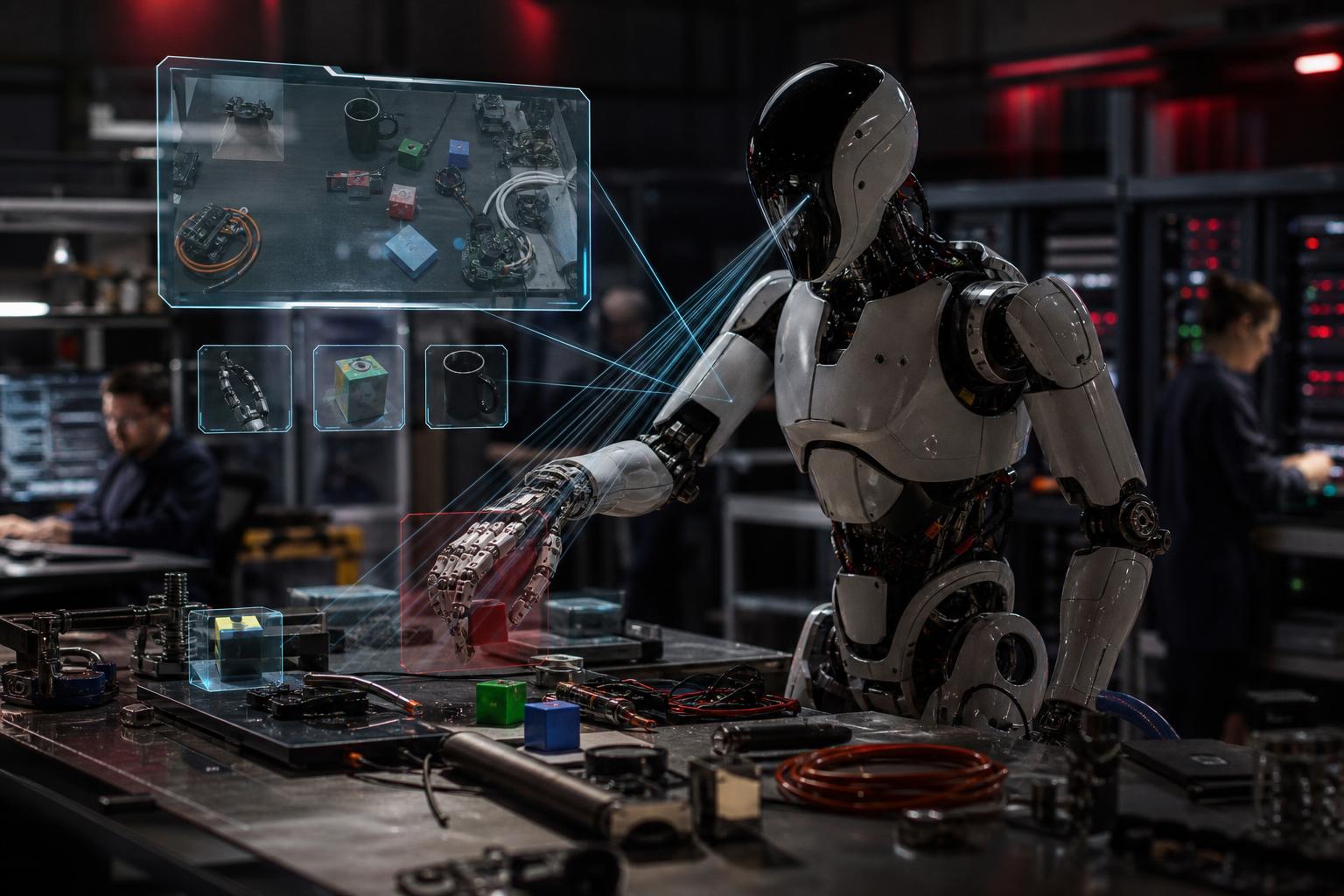
RT-2 improved unseen-scenario performance to 62 percent from RT-1's 32 percent in Google DeepMind testing, making vision-language-action models a serious robotics architecture.
The deployment question is whether those models can run fast, safely, and cheaply enough on real robots.
Definition
A VLA maps camera input and language instructions into robot actions.
Key Stats
7B
OpenVLA Parameters
970K
Training Episodes
6K+
RT-2 Trials
62%
RT-2 Unseen Tasks
How VLAs Work
A vision-language-action model, or VLA, is a robot policy that takes images, language instructions, and sometimes robot state, then predicts actions. The important shift is that the model is not just labeling an image or planning in text. It is producing the next movement command for a physical machine.
Google DeepMind’s RT-2 made the category visible in 2023 by co-fine-tuning web-scale vision-language models on robot trajectory data. In more than 6,000 trials, Google reported that RT-2 held performance on seen tasks while improving unseen-scenario performance from 32 percent for RT-1 to 62 percent. That result explained why web knowledge suddenly mattered to robot control.
OpenVLA pushed the idea into the open-source world. The Stanford, Berkeley, TRI, Google, MIT, and Physical Intelligence-linked team released a 7-billion-parameter model trained on 970,000 robot episodes from Open X-Embodiment data. The point was not that one checkpoint solves robotics. The point was that researchers could finally inspect, fine-tune, quantize, and deploy a generalist manipulation model without waiting for a closed lab.
The input side usually includes one or more camera views and a natural-language command. The output side may be tokenized robot actions, continuous action chunks, end-effector poses, gripper commands, or joint-level targets depending on the architecture. Most production systems still place safety controllers and lower-level servo loops beneath the learned policy.
The robot does not learn physics from language alone. It learns correlations between visual states, instructions, robot embodiments, and demonstrated actions. That is why data diversity matters. A model trained on tabletop arms may understand the word “mug” but still fail on a humanoid hand if the embodiment, camera geometry, force limits, and action space are different.
Why Robot Companies Care
VLAs are attractive because they can reduce the amount of task-specific engineering. A warehouse robot that understands “pick the red tote behind the box” needs perception, grounding, motion, and manipulation. A VLA tries to bind those pieces into one learned policy instead of a brittle pipeline of detectors, planners, and scripts.
The catch is reliability. A 90 percent success rate can look excellent in a demo and terrible in a customer site. Industrial buyers care about intervention rate, damage rate, recovery behavior, and mean time between human assists. For humanoids, a bad action can damage the robot, the workpiece, or a person. The policy has to be surrounded by constraints.
Latency is another deployment filter. Large models are expensive to run at high frequency. Some architectures split slow semantic reasoning from fast motor control. Others predict short action chunks, use smaller distilled models, or run quantized policies near the robot. A humanoid reaching, balancing, and grasping cannot wait for a cloud round trip for every correction.
Fine-tuning is where general turns specific. OpenVLA emphasizes parameter-efficient adaptation because a factory or home robot needs local data: camera placement, lighting, tool geometry, gripper behavior, and task variants. A foundation model can start the process, but the customer environment usually finishes it.
Simulation still matters. VLAs can learn from real demonstrations, but real robot data is expensive and slow. Simulated data can expand object variety, viewpoints, and failure cases. The sim-to-real gap remains, which is why deployment teams mix real demonstrations, teleoperation, synthetic data, and on-site correction.
| Layer | Role | Deployment Risk |
|---|---|---|
| Vision-language model | Understands scene and command | May mis-ground objects or intent |
| Action head | Predicts movements | Can fail under new embodiment dynamics |
| Safety controller | Limits force, speed, collision, workspace | Must catch bad policy outputs |
What Has to Be Proven
Safety architecture usually separates intent from authority. The VLA can propose an action, but collision avoidance, torque limits, workspace boundaries, force thresholds, and emergency stops decide what is allowed. This is especially important for humanoids because balance and manipulation are coupled. A reach can become a fall if the whole body is ignored.
The business case depends on transfer. If every new task requires weeks of data collection and tuning, VLAs become another custom automation tool. If a model can adapt from a small number of demonstrations and reuse common skills across sites, the economics start to look like software.
The competitive field includes Google DeepMind, Physical Intelligence, NVIDIA, Figure, Tesla, Apptronik, Agility Robotics, 1X, and many university labs. Some companies expose models. Others keep policies behind product demos. The market is still sorting out whether the durable advantage is data, embodiment, compute, safety certification, fleet operations, or all of the above.
Benchmarks are improving, but they lag the real world. A model that does well on manipulation tasks may struggle with dirty lighting, reflective packaging, deformable objects, or human interruptions. For buyers, the most useful benchmark is still a paid pilot with logged hours, failure taxonomy, and intervention data.
The simplest way to understand VLAs is this: they are the bridge between the internet-trained AI boom and machines that touch the world. They make robots more flexible, but they do not repeal mechanics, latency, safety, or unit economics. Physical AI still has to earn its keep one reliable action at a time.
FAQ
Are VLAs the same as robot brains? They are one policy layer, usually paired with perception systems, safety controllers, motion control, and fleet software.
Can VLAs run on humanoids? Yes, but embodiment-specific data and low-latency control are still hard requirements.
What should buyers ask for? Ask for intervention rate, task success by object class, recovery behavior, runtime hardware, and safety limits.
Why Action Is Different
A language model can be wrong and still recover in the next sentence. A robot policy can be wrong and break something. That is the reason the action part of VLA matters so much. The model has to turn pixels and words into motions that obey the robot body, the task, the object, and the safety envelope. A command such as “put the cup on the tray” contains perception, spatial grounding, grasp selection, trajectory choice, force control, and release timing.
Tokenized Actions
Early VLA systems often represented robot actions as tokens so they could use language-model training machinery. Joint movements, end-effector deltas, gripper states, or other action values can be discretized into bins and predicted like a sequence. This is elegant because it lets one model consume images and language while producing actions in a familiar transformer format. It is also limiting because physical motion is continuous, timing-sensitive, and embodiment-specific.
Continuous Control Pressure
The field is moving toward action chunking, diffusion-style policies, dual-rate controllers, and smaller deployable policies because robots need smooth and fast behavior. A humanoid hand cannot pause between every token while holding an object. A balancing robot cannot wait for slow semantic reasoning when its center of mass shifts. Many practical systems therefore separate high-level interpretation from lower-level control that runs at higher frequency.
Embodiment Is the Wall
A model trained on robot arms has learned something useful about objects and tasks, but it has not automatically learned a humanoid body. Camera placement changes the visual problem. Hands change the grasping problem. Legs change the stability problem. Torque limits change what “push” means. This is why robot companies care so much about fleet data. The model needs examples from the body that will do the work.
The Data Flywheel
A deployed fleet can collect failures, recoveries, teleoperation traces, and successful task completions. That data can improve the next policy. The flywheel is only valuable if the company has data infrastructure, labeling discipline, privacy controls, and a way to distinguish useful failures from noise. A million hours of sloppy logs may be less valuable than a smaller dataset with clean state, action, and outcome records.
Safety Layers
A VLA should not have unchecked authority over a humanoid robot. Speed limits, force limits, geofences, collision monitors, balance recovery, and emergency stops belong in the stack. Safety layers can reject or modify a proposed action before the machine executes it. That may reduce apparent autonomy, but it is how robots become deployable around people, forklifts, shelving, glass, cables, and expensive workpieces.
Latency and Compute
Running a large model on every control step is expensive. Cloud inference adds network risk and delay. Edge inference adds power and thermal constraints. Quantization, distillation, smaller models, and specialized accelerators are not side projects. They are deployment requirements. A robot that needs a data-center budget to fold towels or move totes will struggle to produce acceptable unit economics.
Benchmarks Versus Sites
Academic benchmarks are useful because they let researchers compare methods under controlled conditions. Customer sites are useful because they reveal everything the benchmark leaves out. Lighting changes. Objects are damaged. Humans interrupt. Wi-Fi drops. Packaging reflects camera light. Floors are uneven. The robot is bumped. A serious VLA product has to survive the messy distribution shift between a dataset and a workplace.
What Buyers Should Demand
A buyer should ask for task-level success rates, intervention rates, time-to-recover, object coverage, safety incidents, runtime hardware, update cadence, and evidence from a site that resembles their own. A polished demo with five objects on a clean table is not enough. The commercial proof is logged operation across shifts, with failures categorized and improvements measured.
Bottom Line
VLAs are one of the most important ideas in physical AI because they connect general AI pretraining to robot motion. They are not a free pass around mechanics. The winners will combine foundation models, robot-specific data, fast control, safety engineering, and fleet operations. The model may understand the instruction, but the business only works when the robot completes the job repeatedly without expensive human rescue.
Failure Recovery Is the Product
A robot policy will fail. The product question is what happens next. Does the robot stop safely, ask for help, retry with a different grasp, move the object to a safer pose, or continue into a worse state? VLA demos often emphasize first-attempt success. Commercial deployments care about recovery because human rescue time destroys labor economics. A system with slightly lower first-pass success but excellent recovery may beat a flashier model in the field.
Human Data Is Expensive
Robot demonstrations usually come from teleoperation, kinesthetic teaching, scripted tasks, or autonomous runs corrected by humans. Each method has costs. Teleoperation produces useful action traces but may not match autonomous timing. Scripted data scales but can be narrow. Human correction data is valuable because it captures real failures. Building a VLA business therefore means building a data operation, not just a model team.
Multimodal Grounding
A robot has to ground words in the scene. “The left bin” depends on camera viewpoint. “The fragile part” may require visual recognition and force limits. “Put it where it belongs” may require memory, site knowledge, and task history. VLAs are promising because they can combine language and vision, but grounding errors are dangerous in robotics. A wrong answer on a screen is cheap. A wrong grasp near a sharp tool is not.
Fleet Learning and Version Control
Once robots are deployed, model updates become operational events. A new policy may improve one task and degrade another. Fleet operators need version control, staged rollouts, rollback plans, and site-specific evaluation. They also need to know which data can legally and ethically be used for retraining. Homes, hospitals, factories, and warehouses all have different privacy expectations. Physical AI companies that ignore deployment discipline will discover that model improvement can become customer risk.
Why Humanoids Raise the Stakes
Humanoids make VLAs harder because manipulation is tied to posture and balance. Reaching for a box changes the center of mass. Carrying a tote changes gait. Opening a heavy door requires force, foot placement, and recovery planning. A VLA that predicts arm motion without respecting the whole body can create instability. This is why humanoid autonomy needs tight coordination between learned policies and classical control.
The Next Useful Benchmark
The next useful benchmark will look less like a single tabletop score and more like an operations log. It will report hours, interventions, task mix, object variety, near misses, damage, latency, compute load, and recovery outcomes. That kind of benchmark is harder to publish because it exposes ugly details. It is also the benchmark buyers need. VLAs will mature when the industry rewards operational reliability as much as surprising generalization.
Operational Checklist
A serious VLA deployment should be evaluated like an operations system. Buyers should ask how many hours the policy has run, how many interventions occurred per hour, which objects caused failures, how the robot recovered, what safety layer blocked unsafe actions, where inference runs, how much latency is tolerated, and how updates are tested before fleet rollout. Those answers matter more than whether the model can perform one surprising instruction on camera.
The best VLA companies will look partly like AI labs and partly like field-service businesses. They will collect data, clean it, train models, validate policies, deploy carefully, monitor failures, and send humans when hardware needs help. The model is the exciting part, but the operating system around the model is what turns physical AI from a demo into labor that customers can rely on.
Operational Checklist
A serious VLA deployment should be evaluated like an operations system. Buyers should ask how many hours the policy has run, how many interventions occurred per hour, which objects caused failures, how the robot recovered, what safety layer blocked unsafe actions, where inference runs, how much latency is tolerated, and how updates are tested before fleet rollout. Those answers matter more than whether the model can perform one surprising instruction on camera.
The best VLA companies will look partly like AI labs and partly like field-service businesses. They will collect data, clean it, train models, validate policies, deploy carefully, monitor failures, and send humans when hardware needs help. The model is the exciting part, but the operating system around the model is what turns physical AI from a demo into labor that customers can rely on.
Operational Checklist
A serious VLA deployment should be evaluated like an operations system. Buyers should ask how many hours the policy has run, how many interventions occurred per hour, which objects caused failures, how the robot recovered, what safety layer blocked unsafe actions, where inference runs, how much latency is tolerated, and how updates are tested before fleet rollout. Those answers matter more than whether the model can perform one surprising instruction on camera.
The best VLA companies will look partly like AI labs and partly like field-service businesses. They will collect data, clean it, train models, validate policies, deploy carefully, monitor failures, and send humans when hardware needs help. The model is the exciting part, but the operating system around the model is what turns physical AI from a demo into labor that customers can rely on.
Operational Checklist
A serious VLA deployment should be evaluated like an operations system. Buyers should ask how many hours the policy has run, how many interventions occurred per hour, which objects caused failures, how the robot recovered, what safety layer blocked unsafe actions, where inference runs, how much latency is tolerated, and how updates are tested before fleet rollout. Those answers matter more than whether the model can perform one surprising instruction on camera.
The best VLA companies will look partly like AI labs and partly like field-service businesses. They will collect data, clean it, train models, validate policies, deploy carefully, monitor failures, and send humans when hardware needs help. The model is the exciting part, but the operating system around the model is what turns physical AI from a demo into labor that customers can rely on.