Company Profiles
Wandercraft: The Exoskeleton Company Turning Balance Into Humanoids
Updated profile of Wandercraft, including real Calvin-40 images, Renault Douai testing, rollout targets, and SAPA deployment evidence.

Wandercraft is a Paris-founded robotics company best known for self-balancing robotic exoskeletons. Founded in 2012 by Nicolas Simon, Matthieu Masselin, and Alexandre Boulanger, the company has spent more than a decade turning dynamic balance into medical mobility products.
The company now wants that balance stack to power industrial humanoids. In 2025, Wandercraft announced a $75 million Series D and unveiled Calvin, a humanoid robot developed with Renault Group to target factory work before broader service applications.
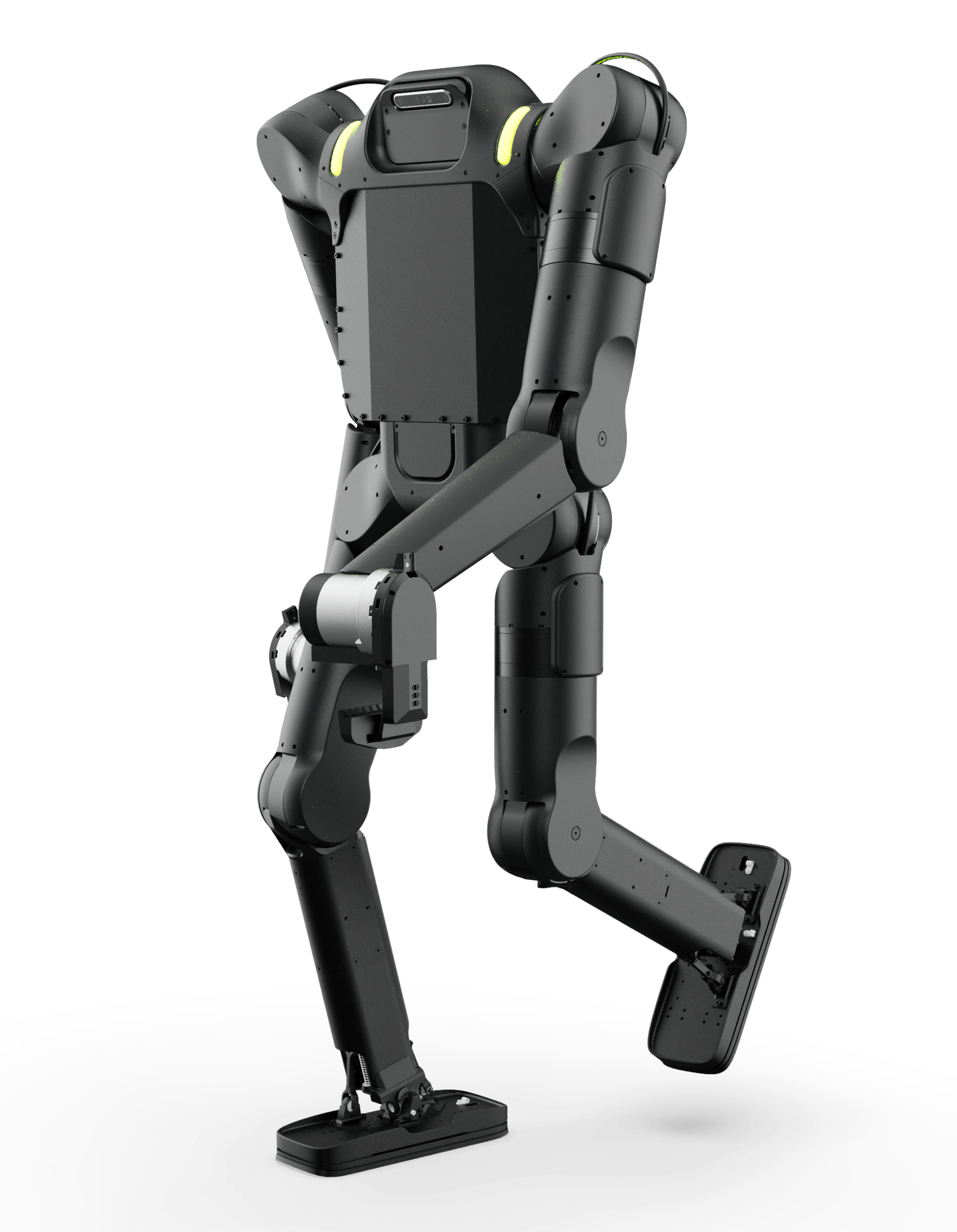
Update · July 30, 2026
Since this profile first ran, Calvin has moved from a Renault partnership headline into more specific deployment evidence. Renault Group says Calvin is being tested at its Douai plant in the wheel workshop, where it handles pairs of tires weighing roughly 30 kilograms at a time. Renault also described a roadmap of about ten robots in French and Spanish plants by the end of 2026 and 350 robots across European factories by the end of 2027.
Wandercraft has also announced a SAPA deployment partnership in industrial manufacturing. That matters because it broadens Calvin-40's evidence base from an OEM partner to a Tier 1 automotive supplier, with initial work focused on repetitive movement of large and heavy parts.
Key Stats
2012
Founded
$75M
Series D
Renault
Industrial Partner
350
Renault 2027 Target
SAPA
Tier 1 Partner
From Medical Exoskeletons to Industrial Humanoids
Wandercraft did not begin as a humanoid hype company. It began with a harder and more regulated problem: building self-balancing robotic exoskeletons that help people with severe mobility impairments stand and walk. That history gives the company a different technical base from startups that started with warehouse manipulation or consumer demos.
The company’s Atalante exoskeleton uses dynamic balance to support gait rehabilitation. In medical robotics, balance, safety, repeatability, and regulatory discipline are not optional. A system that supports a patient’s body has to behave predictably and earn trust from clinicians. That background matters as Wandercraft moves toward humanoids because legged robots fail first at balance and safety.
Calvin is the industrial expression of that knowledge. The robot was presented as a humanoid platform for factory and logistics work, developed with Renault Group as a partner. The logic is straightforward: if Wandercraft can balance a robotic system around human movement in clinical settings, it may be able to build a useful biped for industrial environments.
That does not make the transition easy. An exoskeleton supports a human user. A humanoid has to perceive, decide, manipulate, navigate, recover, and complete tasks without being worn by a person. The control stack may transfer, but the product challenge expands.
For Biped readers, Wandercraft is interesting because it represents Europe’s attempt to turn deep locomotion experience into a general robotics platform. It is not starting from a blank demo. It is starting from years of balance data and a medical product, then moving into industrial automation.
Funding and the Renault Signal
Wandercraft’s 2025 Series D brought $75 million in equity and debt financing, with participation tied to Renault Group, Bpifrance-managed programs, Teampact Ventures, Quadrant Management, and other investors. The round was meant to accelerate the company’s robotics portfolio, including medical systems and Calvin.
Renault’s role is important because humanoid robots need real industrial feedback. A factory partner can tell a robotics team which tasks are valuable, which layouts are common, what safety rules apply, and where a humanoid creates more complexity than value. Without that feedback, a robot can look polished and still miss the workflow.
The partnership also fits a European industrial policy moment. Europe wants more sovereign robotics capability, more automation for aging workforces, and more high-value manufacturing technology. A French robotics company working with a major automotive group is easier for policymakers to support than a generic lab project.
The funding is meaningful but not unlimited. Humanoid robotics can consume hundreds of millions before durable revenue appears. Wandercraft has to use the capital carefully by leveraging its existing balance stack, medical products, and partner sites instead of trying to match every feature promised by larger U.S. and Chinese competitors.
The strongest reading of the round is that investors see Wandercraft as more than a medical device company. They are betting that self-balancing robotics can become a platform. Calvin is the proof point that will test that claim.
What Calvin Has to Prove
Calvin has to prove that a humanoid form factor is useful in industrial settings where existing automation already works well in some places and fails in others. Automotive factories have robots, conveyors, fixtures, cobots, and human workers. A humanoid must fit into gaps that are too variable or too costly for fixed automation.
The first useful tasks are likely to be material handling, line-side movement, inspection support, tool delivery, and work in areas designed around human reach. These jobs still require perception, manipulation, safety, and uptime. They may be less glamorous than a humanoid building a car, but they are closer to economic value.
Balance is Calvin’s natural differentiator. A robot that can walk, stop, turn, and recover well has a better chance in real factories than one that needs perfect floors and scripted motion. Wandercraft’s medical history gives it credibility here, but industrial environments bring payloads, timing pressure, and collision risks that medical systems do not face in the same way.
Manipulation will be the harder question. A humanoid without reliable hands and task policies becomes a walking sensor mast. Wandercraft needs Calvin to handle objects, tools, totes, buttons, doors, or fixtures in repeatable ways. That requires hardware, AI models, training data, and workflow design.
The company should be judged by customer metrics rather than videos. Intervention rate, uptime, task completion, maintenance time, worker acceptance, and deployment cost will matter more than whether Calvin looks smooth in a short clip.
The Medical Robotics Advantage
Wandercraft’s exoskeleton background gives it one clear advantage: it has worked on robots that balance around people. Medical rehabilitation requires controlled movement, fall prevention, clinician workflows, and careful human-machine interfaces. Those requirements build habits that are useful for humanoids, especially around safety.
The company also has experience with regulated markets. That can slow product development, but it teaches documentation, quality systems, risk analysis, and service discipline. Industrial customers may not ask for medical-device paperwork, but they do ask what happens when a robot fails near workers.
Atalante and related products also produce real-world locomotion data. Data from assisted walking is not the same as data from factory work, but it can inform balance, gait, and recovery. A decade of hardware iteration can reduce the number of basic mistakes a humanoid team makes.
The advantage has limits. Medical exoskeletons are high-value, lower-volume systems used in supervised settings. Industrial humanoids need lower cost, longer uptime, easier maintenance, and broader task capability. Wandercraft has to prove it can shift from specialist robotics to deployable automation.
That transition is exactly why the company is worth watching. If medical balance technology can scale into factory humanoids, it would give Europe a route into the market that does not simply copy the U.S. warehouse path or the Chinese low-cost hardware path.
Competition and Europe’s Humanoid Opening
Wandercraft enters a crowded humanoid market. Figure AI, Apptronik, Agility Robotics, Tesla, Unitree, UBTECH, Fourier, 1X, Sanctuary AI, Persona AI, and many others are all pushing versions of mobile embodied labor. Some have more capital. Some have faster hardware cycles. Some have closer ties to major manufacturing ecosystems.
Wandercraft’s opening is specificity. It has a European base, a Renault relationship, a medical robotics record, and a balance-first story. That combination may appeal to European manufacturers that want local partners and cautious deployment rather than an imported black-box system.
The company also benefits from the fact that the humanoid market is not settled. No provider has proven a universal robot worker at large scale. Early deployments are narrow, supervised, and measured. That leaves room for companies with a strong subsystem advantage to win specific roles.
The risk is speed. Humanoid hardware is moving quickly, and customers may compare Calvin against platforms with larger software teams, cheaper components, or more aggressive pricing. Wandercraft has to show that balance and safety translate into productivity, not only technical elegance.
Europe’s robotics opportunity may be to build trusted industrial systems rather than chase the loudest consumer narrative. Wandercraft fits that route. Its success would give the region a serious humanoid reference customer base and a homegrown platform for factories, logistics, and service environments.
The 2026 Watchlist
The first signal is Calvin’s deployment evidence. That signal is stronger now than it was when this profile first published: Renault has named Douai wheel-workshop testing and published targets for roughly ten robots in French and Spanish plants by the end of 2026, followed by 350 across European factories by the end of 2027. The remaining question is whether those units complete useful work and survive daily operations.
The second signal is customer breadth. Renault remains the anchor, but SAPA gives Wandercraft a Tier 1 supplier partner and a separate manufacturing environment. If Calvin can move from Renault-specific tire and load-handling tasks into supplier workflows, the product story becomes less dependent on a single strategic partner.
The third signal is product split. Wandercraft has medical exoskeletons, Eve mobility work, and Calvin. Those products may share technology, but they address different customers. Management has to allocate capital without starving the product that can generate near-term revenue.
The fourth signal is manufacturing. Humanoid companies often underestimate the difficulty of building repeatable hardware. Wandercraft needs suppliers, assembly processes, service tools, and quality control that can support more than prototypes.
The fifth signal is safety certification and customer acceptance. Industrial humanoids will operate near workers, vehicles, tools, and production schedules. Wandercraft’s medical DNA should help, but customers will need proof through procedures, sensors, remote stop systems, training, and support.
Why Wandercraft Deserves a Place on the Humanoid Shortlist
Wandercraft is not the loudest humanoid company, but it has earned attention for a specific reason. Dynamic balance is one of the hardest parts of bipedal robotics, and the company has spent years making balance useful in medical settings. That gives Calvin a credible technical inheritance.
The company’s challenge is to turn that inheritance into industrial output. A factory robot must be useful, affordable, maintainable, and easy to supervise. It cannot rely on novelty. Workers and managers will judge it by whether the shift runs better when the robot is present.
Wandercraft’s best path is narrow deployment first. Prove Calvin on a small set of Renault-linked tasks, measure results, then expand into similar factories and logistics sites. That route is less flashy than promising a universal worker, but it is more likely to create durable customers.
For the humanoid sector, Wandercraft is a test of whether deep locomotion companies can compete with AI-first or manufacturing-first entrants. If Calvin works, it will show that medical robotics experience can move into industrial automation. If it struggles, it will show how much manipulation, cost, and deployment still matter after balance is solved.
That makes Wandercraft one of the more useful companies to track in 2026. It is a bridge between assistive robotics and industrial humanoids, between European policy and factory demand, and between elegant movement and measurable productivity.
The Manipulation Gap
The most important unanswered question for Calvin is not whether it can stand. It is whether it can do useful work with its hands often enough to justify deployment. Industrial customers need robots that move parts, handle tools, press controls, scan items, open fixtures, or support workers without constant rescue.
Wandercraft’s balance expertise can get the robot to the work area, but manipulation turns mobility into value. Hands, wrists, arms, cameras, force sensing, and task software must work together. A robot that walks beautifully but cannot handle ordinary factory objects becomes a research platform, not a worker.
This is where the Renault partnership can help. A car factory has countless tasks that expose the difference between a generic demo and a useful robot. Some tasks may be too precise or too fast for early Calvin units. Others may be good fits because they involve movement, inspection, or repetitive handling in spaces already designed for people.
The company should resist the temptation to describe Calvin as general purpose too early. Narrow tasks with strong metrics will teach more than broad claims. A small set of reliable jobs can become a product. A large set of almost-working demos can drain capital.
Service, Support, and the Real Cost of a Humanoid
Humanoid economics include much more than the robot’s bill of materials. Customers pay attention to installation, supervision, safety training, maintenance, spare parts, software updates, insurance, downtime, and the number of human technicians needed to keep a fleet working. A robot that needs frequent specialist support can become expensive even if the hardware price falls.
Wandercraft’s medical-device history may help here because clinical systems require service procedures and user training. The company already knows that robotics products live or die after delivery. Industrial customers will expect the same discipline, with faster response times and less tolerance for interruptions.
The fleet question will matter if Wandercraft pursues hundreds of deployments. Ten robots can be supported by heroic engineering. Hundreds require documentation, diagnostics, remote monitoring, modular repairs, and predictable parts supply. That transition is where many robotics companies discover that product maturity is different from technical capability.
Calvin’s business model has not been proven publicly, but the cost structure will shape adoption. Leasing, robotics-as-a-service, direct sales, or partner-managed deployments all put risk in different places. Wandercraft needs a model that lets factories try the robot without hiding the real cost of uptime.
Why Europe Needs This Kind of Robotics Company
Europe has strong industrial companies, advanced research labs, and demanding labor markets, but it has not dominated the humanoid conversation. Much of the attention has gone to U.S. AI labs, Tesla’s manufacturing narrative, and fast-moving Chinese hardware firms. Wandercraft gives Europe a different entry point.
A European humanoid company tied to medical robotics and automotive manufacturing fits regional strengths. It can emphasize safety, worker assistance, regulatory trust, and industrial partnership. Those may sound slower than consumer robotics promises, but they align with the customers most likely to pay for useful machines first.
The policy angle should not be ignored. Governments want automation that supports domestic manufacturing and reduces dependence on imported platforms. If Wandercraft can show credible factory results, it may attract more support from public funds, strategic investors, and industrial buyers that want European options.
That support will not replace product-market fit. Calvin still has to work. Yet a region that wants robotics sovereignty needs companies with real hardware experience, not only AI software. Wandercraft has that foundation, which is why its next deployments will be watched beyond France.
The Product Road From Calvin to a Fleet
The next step for Wandercraft is turning Calvin from a prototype into a fleet product. That means freezing enough of the design to manufacture repeatable units while leaving room for software improvement. It also means deciding which jobs define the first product version. A humanoid can be too flexible in theory and too vague in practice.
A strong fleet plan would start with mapped workcells, limited objects, clear safety zones, and repeatable tasks that expose the robot to real operations without asking it to solve every factory problem at once. That approach lets engineers measure progress and gives customers a reason to expand deployment when the numbers improve.
Data will be central. Every stumble, grasp failure, blocked route, and operator intervention becomes training material if the system is designed to learn from it. Wandercraft’s advantage is that it already understands balance data. The industrial phase will require the same discipline around manipulation and task context.
The company will also need a practical upgrade path. Early robots should not become obsolete after a few pilots. Modular hands, replaceable sensors, software updates, and serviceable joints can protect customer investment and help Wandercraft improve the platform without rebuilding the whole fleet.
This is where the humanoid market becomes less cinematic and more operational. The winners will be companies that can support ordinary deployments, document problems, ship fixes, and keep customers engaged after the first excitement fades. Wandercraft has the technical story. Calvin now has to become a product customers can live with.
Sources and Image Notes
- Wandercraft Calvin-40 product page for official Calvin imagery and product claims.
- Renault Group's June 10, 2026 update for Douai testing, tire-handling detail, and rollout targets.
- Wandercraft's SAPA deployment announcement for the Tier 1 manufacturing partnership.
FAQ
When was Wandercraft founded?
Wandercraft was founded in Paris in 2012 by Nicolas Simon, Matthieu Masselin, and Alexandre Boulanger.
What is Calvin?
Calvin is Wandercraft’s industrial humanoid robot, developed with Renault Group for factory and service work.
How much did Wandercraft raise in its Series D?
Wandercraft announced $75 million in equity and debt financing as part of its Series D round in 2025.