Developer Platforms
Berkeley Humanoid Lite Makes the $5,000 Robot a Serious Research Tool
Berkeley Humanoid Lite uses 3D-printed modular cycloidal gearboxes and open-source software to put a mid-scale humanoid research platform under the $5,000 mark.

Berkeley Humanoid Lite puts a hard number on one of humanoid robotics' biggest bottlenecks: less than $5,000 for a complete mid-scale biped research platform, built around 3D-printed modular cycloidal gearboxes and widely available parts.
The project is not new as a research paper, but it became newly newsworthy on August 31 as open-source hardware coverage resurfaced the design at the exact moment the industry is arguing over whether physical AI will be controlled by a few expensive robot vendors or tested by a much wider developer base.
Key Stats
<$5K
Target Hardware Cost
0.8 m
Approx. Height
16 kg
Approx. Weight
Open
CAD, Code, Training Stack
Why This Matters Now
The humanoid market has spent much of 2026 talking about factory pilots, national robotics policy, billion-dollar valuations, and sprint records. That makes Berkeley Humanoid Lite look small at first glance. It is a research platform, not a warehouse worker. It is roughly child-sized, not adult-sized. Its public claim is not that it can replace a job, unload a truck, or stock a shelf for eight hours.
That is exactly why it matters. The industry's public demos are getting louder, but the underlying development stack still has a capacity problem. There are not enough affordable, modifiable humanoid robots in the hands of students, controls researchers, hardware hackers, and small labs. If physical AI needs real-world contact data, failed walking trials, actuator repairs, calibration mistakes, and shared policy experiments, closed industrial platforms are a narrow pipe.
The Berkeley team frames the project as a response to high-cost, closed, non-transparent humanoid hardware. The design uses 3D-printed modular gearboxes as both actuator components and structural elements. Other components are meant to be sourced from common commerce channels or fabricated with desktop 3D printers. The practical claim is simple: a capable biped research machine can be copied, modified, repaired, and studied without a procurement cycle that looks like an enterprise software contract.
The editorial signal
Berkeley Humanoid Lite is not a commercial deployment story. It is a tooling story. If it works as advertised, it lowers the cost of embodied AI experimentation and makes humanoid research less dependent on vendor-controlled black boxes.
The Hardware Story
The project's core engineering choice is the modular 3D-printed cycloidal gearbox. In legged robots, actuators are not just motors. They have to deliver torque, tolerate shock, fit into compact joints, and survive repeated falls. Commercial humanoid companies often use expensive custom modules or tightly integrated supplier stacks. Berkeley Humanoid Lite takes a different path by building much of the actuator and body around printable parts.
Cycloidal gearboxes are not a magic shortcut. They can offer compact reduction and good shock behavior, but 3D-printed versions raise obvious durability questions. The Berkeley paper directly addresses that concern by testing the printed actuators and presenting the design as strong enough for research validation, not as a replacement for hardened industrial joints. That distinction matters. A lab robot does not need the same duty cycle as a paid logistics unit. It needs to be understandable, repairable, and cheap enough to risk.
The design also emphasizes standard fabrication. A robot that requires a five-axis CNC shop is not really open to most labs. A robot that can use desktop printers, common electronics, public documentation, and shared training code gives the community more room to reproduce the work. Reproducibility is still hard. Print settings, material choices, assembly precision, wiring discipline, and calibration all matter. But the barrier moves from "buy an unavailable robot" to "build and validate one carefully."
| Platform Type | Typical Access Model | Strength | Tradeoff |
|---|---|---|---|
| Berkeley Humanoid Lite | Open-source build, under $5,000 target hardware cost | Transparent hardware and software for research replication | Requires assembly skill and is not industrial-grade |
| Commercial humanoid pilot robot | Vendor partnership, lease, pilot, or direct sale | Higher integration, support, and deployment readiness | Expensive, less modifiable, limited public internals |
| Small educational biped | Kit, consumer sale, or hobbyist build | Low cost and easy experimentation | Often too small or simplified for serious humanoid controls work |
What Open Source Changes
Open-source humanoid hardware changes who can ask serious questions. A large company can buy robots, hire operators, and run controlled trials. A university lab can sometimes do the same through grants. Everyone else tends to watch videos. Berkeley Humanoid Lite gives a different route: download the files, source the parts, print the structure, build the robot, run the code, and modify what does not fit the experiment.
That model is valuable because humanoid robotics is still full of unresolved basics. How should a low-cost biped recover from foot slip? How many sensors are needed before a learned controller transfers reliably? Which failures come from policy design, which come from actuator backlash, and which come from poor assembly? Closed systems can hide those answers. Open platforms expose them.
The project also includes the software side of the loop. The Berkeley researchers describe open-sourcing the hardware design, embedded code, training framework, and deployment framework. That is important because physical AI is not a single model problem. It is a chain of CAD, motors, firmware, state estimation, simulation, reinforcement learning, deployment scripts, logging, and repair. If one link is proprietary, replication becomes weaker.
Access
A sub-$5,000 bill of materials can put biped hardware within reach of small labs and advanced builders.
Repair
Printable components make breakage part of the learning loop instead of a vendor support ticket.
Replication
Shared CAD, code, and policies let researchers compare results against a visible baseline.
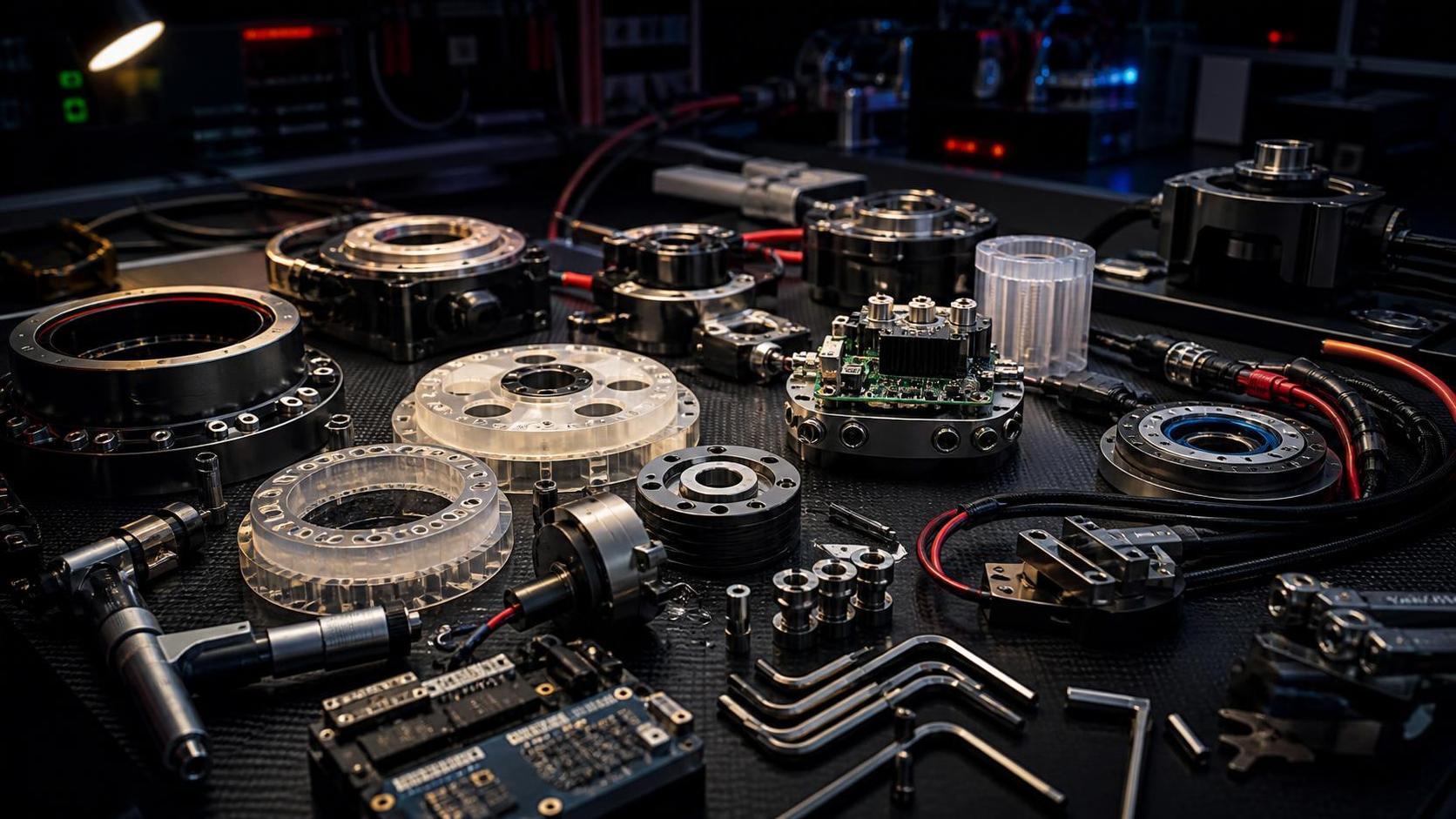 AI-generated image
The real value of cheaper research robots is repeated testing under imperfect conditions, where policies, sensors, and hardware all fail in visible ways.
The Limits Are the Point
The honest read is that Berkeley Humanoid Lite will not settle the humanoid race. It does not prove that low-cost printed joints can survive industrial shifts. It does not create a ready-made labor product. It does not remove the hard problems of manipulation, balance, perception, safety, battery life, or field support. Anyone treating it as a cheap substitute for an industrial robot is reading the wrong story.
The stronger interpretation is that low-cost hardware can create more failure data. Physical AI researchers need machines that can be pushed until they fall, repaired, logged, and pushed again. A robot that costs less than a high-end workstation changes the risk calculus. Builders can try more aggressive policies, redesign a joint, replace a gearbox, or test a new sensor stack without waiting for a vendor roadmap.
There is also a talent pipeline argument. The next generation of humanoid engineers will not learn enough from promo videos. They need access to torque curves, cracked parts, calibration drift, simulation mismatch, and controller instability. A transparent platform gives those lessons earlier. That does not guarantee commercial success, but it makes the research community less passive.
What to Watch Next
The next test is not whether Berkeley Humanoid Lite gets attention. The web already rewards cheap humanoid claims. The test is whether independent builders can reproduce the platform, document failures, contribute fixes, and run comparable policies. Open-source hardware only compounds when the community closes the loop between build instructions, real-world testing, and maintainable changes.
Watch for three signals. First, build replication outside Berkeley. Second, published durability data from users who are not the original authors. Third, controller benchmarks that show whether the platform can support useful sim-to-real research across labs. If those signals appear, the project becomes more than a clever low-cost build. It becomes shared infrastructure.
The timing is useful for the broader market. China is scaling humanoid factories and training centers. U.S. and European startups are chasing industrial pilots. Big AI companies are building robot foundation models. In that environment, an open robot that a small team can actually build is not a side story. It is a reminder that physical AI needs bottoms-up infrastructure, not just capital-intensive flagships.
FAQ
Is Berkeley Humanoid Lite a commercial robot?
No. It is an open-source research platform aimed at accessibility, customization, and replication. It should be judged as research hardware, not as a warehouse or home robot product.
How much does it cost?
The project describes a target hardware cost under $5,000 based on U.S. market prices, using commonly sourced components and desktop 3D-printed parts.
Why use 3D-printed cycloidal gearboxes?
They reduce cost and make the actuator design more accessible, while still aiming for enough robustness for research validation. The tradeoff is that printed parts require careful fabrication and will not match hardened industrial components.
Why is this news in 2026?
Humanoid robotics is moving toward expensive pilots and national-scale competition. Berkeley Humanoid Lite points in the opposite direction: more open, lower-cost, reproducible hardware for testing the physical AI stack.
The Bottom Line
Berkeley Humanoid Lite is compelling because it refuses the usual humanoid framing. It is not trying to look like a finished worker. It is trying to make the unfinished work cheaper, clearer, and easier to share.
That may prove more useful than another polished demo. Physical AI still needs open baselines, reproducible failures, and enough real hardware in the world for researchers to learn what breaks. A sub-$5,000 humanoid platform will not replace industrial robots. It can help train the people and tools that make the next generation of robots less opaque.