Technology
Robot Reducers Explained: Harmonic, Cycloidal, and Planetary Gears Inside Humanoid Joints
Precision reducers are the hidden torque machines inside humanoid robot joints. This explainer compares harmonic drives, cycloidal reducers, and planetary gears for backlash, stiffness, shock load, cost, and scale.

A humanoid robot joint is not just a motor. It is a compact torque machine built from a motor, reducer, bearings, sensors, brakes, thermal path, and control software. The reducer is the part that turns high-speed motor rotation into the slow, high-torque motion needed at knees, hips, shoulders, elbows, wrists, and ankles.
That makes precision reducers one of the hidden supply-chain bottlenecks in humanoid robotics. Harmonic drives, cycloidal reducers, and planetary gears decide how much payload a joint can move, how precisely it can stop, how quietly it behaves under contact, and how long it survives factory work.
Key Stats
30:1+
Common precision ratio
<1 arcmin
Low-backlash target
5x
Nabtesco E-stop capacity claim
20-30
Arc-sec repeatability claim
Why reducers matter
Electric motors are efficient at speed. Humanoid joints need controlled torque at human-scale speeds. A knee may need to support body weight, recover from impact, and reverse direction quickly. A wrist may need fine positioning and low reflected inertia. A shoulder needs range, stiffness, and enough torque to lift objects away from the body. The reducer bridges those needs.
Reduction multiplies torque while reducing speed. A 50:1 reducer can let a compact motor produce useful joint torque, but the choice comes with costs. Gear friction wastes energy. Backlash creates dead zones. Compliance affects force control. Reflected inertia can make a joint feel heavy and hard to backdrive. Wear changes calibration over time. In a humanoid, these penalties appear as shorter battery life, worse balance, noisy motion, or less reliable manipulation.
The best reducer is not universal. Humanoid designers mix architectures by joint. A hip or knee may prioritize torque density and shock resistance. An elbow may prioritize compactness and accuracy. A hand may need tiny reducers or tendon drives. The robot's commercial job matters too. A warehouse robot that lifts totes has different needs from a home robot that handles dishes.
Harmonic drives: compact precision
A harmonic drive, also called a strain wave gear, uses three main parts: a wave generator, a flexible spline, and a rigid circular spline. The wave generator deforms the flexspline into an elliptical shape, causing teeth to engage in a controlled wave around the ring. Because the flexspline has slightly fewer teeth than the circular spline, each rotation advances the output by a small amount. The result is a high reduction ratio in a compact package.
The appeal is clear. Harmonic drives can deliver high ratios, zero or near-zero backlash, and excellent packaging for elbows, wrists, shoulders, and leg joints. Harmonic Drive, the original category leader, built the technology into aerospace and industrial robotics. Chinese suppliers such as Leaderdrive have pushed cost and capacity competition as robot production grows. For humanoids, strain wave gears are attractive because joint volume is limited and precision matters.
The limitation is the flexspline. It is literally flexing under load. That can create fatigue concerns, shock-load sensitivity, heat, and efficiency tradeoffs. A harmonic drive can be perfect for a compact precision joint and still be the wrong choice for a high-impact knee if the duty cycle is harsh. Designers care about rated torque, peak torque, lost motion, torsional stiffness, efficiency, lifetime, lubrication, and thermal behavior under repeated starts and stops.
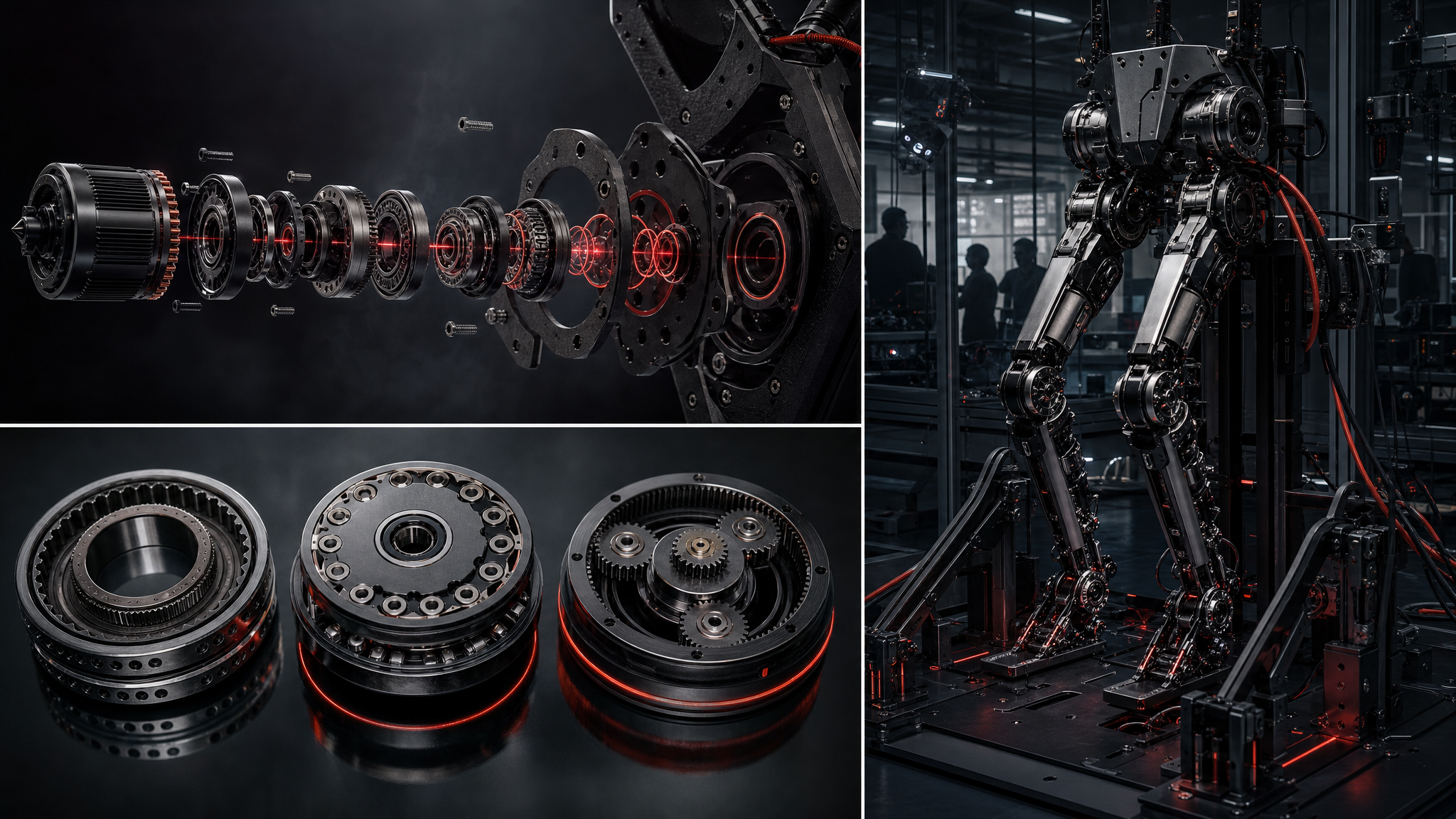 AI-generated image
Harmonic, cycloidal, and planetary reducers solve the same torque problem with different geometry and failure modes.
Cycloidal reducers: stiffness and shock resistance
Cycloidal reducers use eccentric motion and rolling contact to reduce speed. Nabtesco's RV-style reducers are the benchmark in many industrial robot arms. Nabtesco describes its two-stage design as offering large torque, high ratios, significant shock-load capability, and near-zero backlash. Its published engineering material cites less than one arc-minute of backlash, typical repeatability of 20 to 30 arc-seconds, and emergency-stop capacity of five times rated torque for some products.
That combination matters in humanoid robots because real work is messy. A robot foot hits the ground. A hip sees sudden load transfer. A shoulder may bump a fixture. A warehouse robot can misjudge a tote and load a joint unevenly. Cycloidal reducers tend to handle shock and rigidity well, which makes them attractive for high-load axes.
The trade is packaging. Cycloidal reducers can be bulkier or heavier than harmonic drives for the same joint envelope. They can also add complexity and cost. For a humanoid, every gram in the distal limbs hurts efficiency. A heavier ankle or wrist increases the control burden and battery draw. The ideal location for cycloidal gearing may be larger proximal joints where stiffness and impact tolerance are worth the mass.
Planetary gears: efficient, familiar, and not always precise enough
Planetary gearboxes use sun gears, planet gears, ring gears, and carriers. They are efficient, robust, scalable, and widely manufactured. In robotics, low-backlash planetary reducers can be useful where cost and durability matter more than absolute precision. They also pair well with belts, brakes, and compound reductions.
The issue is backlash and ratio density. Standard planetary gearboxes often have more backlash than strain wave or precision cycloidal reducers. High-ratio designs can require multiple stages, which adds length, friction, and compliance. For a humanoid that needs smooth contact-rich motion, backlash is not a small nuisance. It can make force control noisy and produce impact when direction reverses.
Planetaries still have a place. They can be a cost-effective answer for less sensitive joints, mobile bases, grippers, or accessory axes. They can also become part of a custom actuator where software compensates for known behavior. The key is not to treat them as drop-in substitutes for zero-backlash reducers in every joint.
| Reducer | Best use | Risk |
|---|---|---|
| Harmonic | Compact, high-ratio precision joints | Flexspline fatigue and shock sensitivity |
| Cycloidal | High-load, stiff, shock-tolerant axes | Mass, size, and cost |
| Planetary | Efficient cost-sensitive reductions | Backlash and multi-stage packaging |
The supply-chain angle
Humanoid scaling turns reducers from engineering components into strategic parts. A prototype can buy expensive precision gearboxes. A fleet of 10,000 robots cannot treat every joint as a boutique purchase. If each humanoid has dozens of actuated joints, annual production quickly translates into hundreds of thousands of reducers. Lead time, yield, consistency, and repair cost become business issues.
That is why Chinese reducer suppliers, Japanese incumbents, and robot startups are all watching the same bottleneck. Harmonic Drive and Nabtesco have decades of trust. Leaderdrive and other Chinese suppliers offer capacity and cost pressure. Some humanoid companies are designing integrated actuators in-house to control packaging and margin. Others will depend on tier-one suppliers the way automakers depend on transmission and braking suppliers.
The winner will not simply be the reducer with the best datasheet. It will be the reducer that can be manufactured at volume, survive the target duty cycle, stay quiet enough for humans, hold calibration, and fit inside a serviceable actuator. Maintenance matters. If a robot needs reducer replacement after a few months of warehouse work, autonomy gains will be swallowed by service labor.
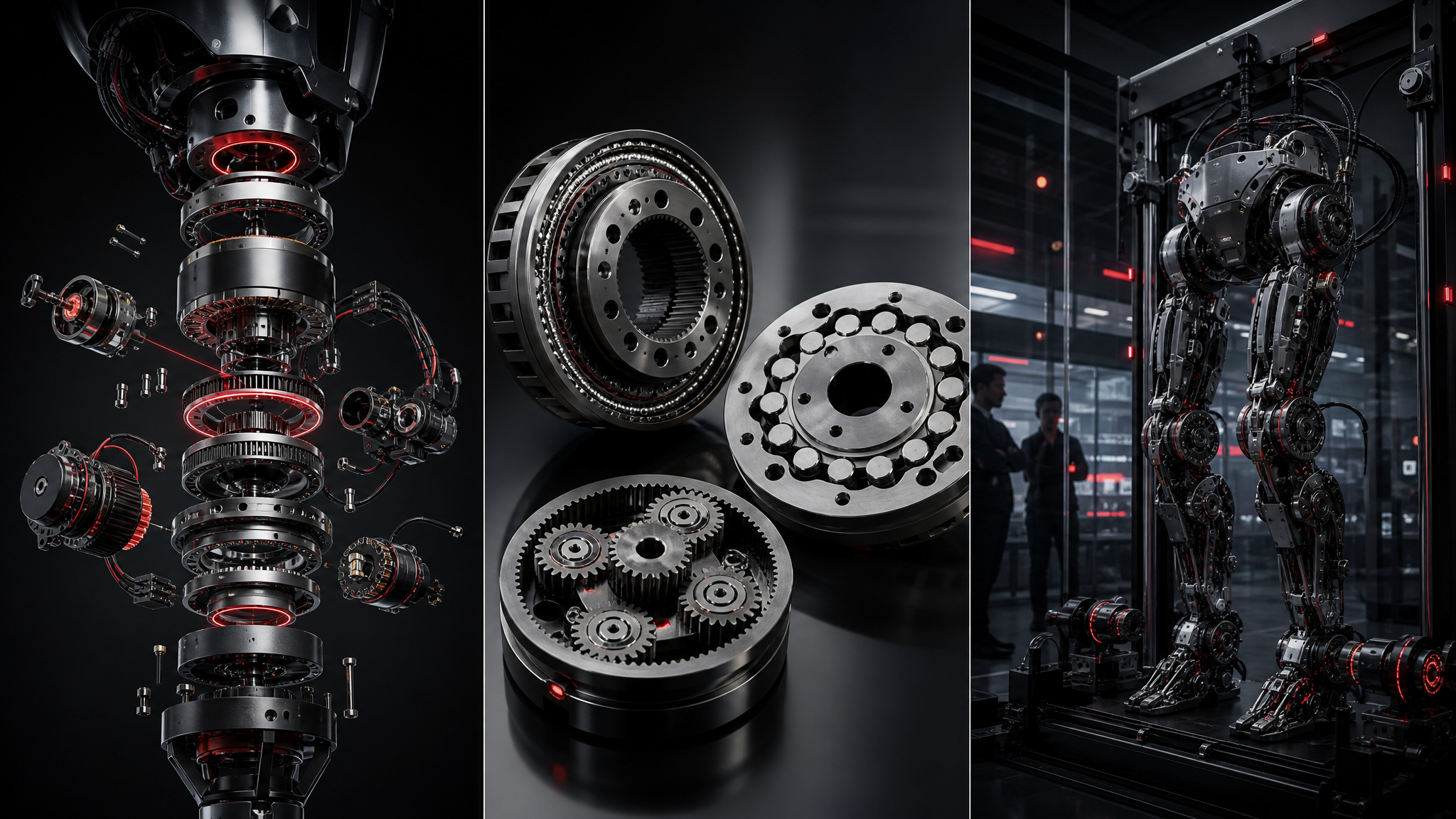 AI-generated image
Joint test stands reveal heat, backlash growth, lost motion, and shock damage long before a robot reaches customers.
FAQ
Are harmonic drives always best for humanoids?
No. They are excellent for compact precision, but shock load, heat, lifetime, and cost can favor cycloidal or planetary designs in some joints.
Why does backlash matter?
Backlash creates a mechanical dead zone. It hurts positioning, makes force control harder, and can cause impact when the joint reverses direction.
Can software fix poor reducers?
Software can compensate for predictable behavior, but it cannot erase heat, wear, lost stiffness, or sudden mechanical play under load.
The bottom line
Humanoid robot performance is often framed as an AI problem. In the joints, it is a precision manufacturing problem. Reducers decide whether model outputs become smooth motion, whether a robot can carry useful payload, and whether a fleet survives long enough to earn back its cost.
The companies that solve reducers at scale will have a real advantage. They will build robots that are lighter, quieter, stronger, cheaper to service, and easier to control. The robot brain matters. The gearbox decides whether that brain has a body worth trusting.
What buyers should ask about joint reducers
A humanoid demo can hide weak reducers for a few minutes. A deployment cannot. Buyers should ask for joint-level duty-cycle data, not only whole-robot videos. The useful questions are practical: how many hours has the hip actuator run under rated load, how much backlash growth appears after shock events, what is the reducer temperature after a full shift, and how quickly can a field technician replace a failed unit?
Backlash should be measured under load and after wear, not just when new. Stiffness should be reported across the operating range. Peak torque should be separated from continuous torque because a robot that can briefly lift a box may not be able to do it every minute for eight hours. Thermal derating should be explicit. If the reducer overheats, the robot may slow down long before the battery is empty.
Noise is another under-discussed metric. A robot working near people cannot sound like a worn industrial gearbox. Gear whine, impact noise from backlash, and bearing noise all affect acceptance in homes, retail sites, hospitals, and warehouses. Quiet motion requires mechanical precision, lubrication control, motor control, and enclosure design. Reducers sit at the center of that stack.
Reducer due diligence checklist
- Continuous torque rating at realistic actuator temperature.
- Backlash or lost motion after endurance testing.
- Shock-load rating for falls, bumps, and emergency stops.
- Lubrication interval and contamination tolerance.
- Replacement time, cost, and calibration procedure.
- Supplier capacity for the target robot production volume.
Reducer choice changes the control problem
Software teams feel reducer decisions every day. A stiff, low-backlash joint is easier to position, but it may be less backdrivable. A compliant joint can absorb impacts and improve force interaction, but it complicates precise motion. A high-ratio reducer gives torque, but it can increase reflected inertia and make the limb less responsive. The controller has to work with the mechanics it is given.
Whole-body control depends on accurate torque estimates, predictable friction, and consistent joint response. If friction changes with temperature, the controller needs compensation. If backlash changes after wear, the motion planner may see errors that look like perception or balance problems. If efficiency is poor, the battery model becomes wrong. Mechanical uncertainty becomes software complexity.
This is why many advanced humanoid teams design actuators as integrated modules instead of buying a motor and gearbox separately. Integration lets them place encoders on the motor and output side, tune the thermal path, control lubrication, package bearings correctly, and choose the exact ratio. The downside is manufacturing burden. Owning the actuator means owning quality failures too.
Series elastic actuators add another option. By placing an elastic element between the motor and output, designers can measure force and absorb shocks. That can help walking and safe contact. It also adds compliance that may reduce positional stiffness. Some robots will use high-ratio geared joints. Others will use quasi-direct-drive actuators with lower ratios and higher torque motors. The reducer is one piece of a larger actuation philosophy.
The factory economics of precision gears
A 30-joint humanoid produced at 10,000 units per year represents hundreds of thousands of actuator modules. If many of those modules use precision reducers, the supply chain has to deliver repeatable gear geometry, heat treatment, bearings, lubrication, seals, and inspection at automotive-like volumes. That is a different world from prototype robotics.
Cost pressure will be intense. Harmonic and cycloidal reducers are not cheap parts. If a robot company claims consumer-level pricing, it either needs radical supplier cost reduction, simplified joint requirements, lower reducer counts, or in-house manufacturing breakthroughs. The bill of materials will expose unrealistic product plans quickly. A humanoid with premium reducers in every joint may perform well but miss the price point. A humanoid with cheap sloppy reducers may hit the price point and fail the job.
This creates room for specialization. Heavy industrial humanoids may pay for cycloidal stiffness in load-bearing joints. Lightweight service robots may use harmonic drives selectively and cheaper reductions elsewhere. Hands may use tendons, cables, miniature gears, or underactuated mechanisms to avoid stuffing expensive reducers into every finger. The best commercial designs will allocate precision where it creates revenue.
Reducer suppliers that can prove endurance, scale production, and support field service will become strategic partners. The same happened in industrial robotics, where gearbox reliability helped define trusted robot brands. Humanoids are more mobile, more exposed, and closer to people, so the penalty for mechanical weakness is even higher.
What to watch next
The next signal is not another backflip video. It is endurance data. Watch for companies publishing actuator lifetime tests, field replacement rates, reducer temperature curves, and supplier agreements. Watch for acquisitions of precision gearbox companies. Watch for robot makers changing joint architectures between prototype and production. Those changes often reveal what the early hardware could not survive.
The second signal is localization. China wants domestic reducers for its humanoid push. U.S. companies will want secure suppliers if robots enter critical infrastructure, defense-adjacent logistics, or healthcare. Japan's incumbent precision gear makers will remain important because trust and quality history matter. The reducer race is therefore both a hardware race and a supply-chain race.
Humanoid robots will be judged by useful work per dollar per hour. Reducers influence all three terms. They affect payload, speed, downtime, power draw, noise, maintenance, and safety. A better model can make a robot smarter. A better reducer can make the smart motion physically possible, day after day.
Reducer strategy by joint
A practical humanoid will not use the same reducer everywhere. Hips and knees carry body mass, handle walking impacts, and need high continuous torque. Shoulders need torque and range, but they also affect arm mass. Elbows and wrists need compact precision. Ankles need fast response, shock tolerance, and careful packaging. Fingers need small, cheap, serviceable transmission choices because there are many of them and they break often.
That joint-by-joint allocation is where good robot engineering shows up. A team may spend money on low-backlash precision in a wrist because manipulation quality creates customer value. It may accept a different architecture in the torso because stiffness matters more than size. It may use quasi-direct-drive legs for agility, then gear the arms for payload. The published robot spec rarely explains these decisions, but they shape real performance.
Field data will force changes. If a reducer survives lab walking but fails after forklifts bump the robot in a warehouse, the next revision will need more shock margin. If a wrist reducer develops play after thousands of picks, manipulation accuracy will fall even if the vision model is unchanged. If knees run hot, software may reduce speed and make the robot miss productivity targets. Mechanical reliability becomes business performance.
For investors and customers, the reducer question is a useful hype filter. Ask what is inside the joint, how many hours it has run, how it is tested, and who can build it at volume. A company that answers clearly is closer to deployment. A company that only shows motion clips may still be learning what its body costs.