Developer Platforms
Microduck Turns Biped Robot Learning Into a $399 Developer Platform
Hugging Face and Pollen Robotics opened preorders for Microduck, a $399 open-source biped built for reinforcement learning experiments rather than household chores.

Hugging Face and Pollen Robotics have opened preorders for Microduck, a $399, 25 cm open-source biped meant to put reinforcement learning hardware on desks instead of behind lab procurement cycles.
The timing matters because humanoid robotics has spent August showing two very different faces: record-setting biped speed in Beijing, and practical unease about whether physical AI can leave staged demos. Microduck is not a factory worker. It is a small developer robot with 15 motors, a camera, lidar, two IMUs, and a 50 Hz onboard policy loop, built around the idea that low-cost robots can make robot learning less exclusive.
Key Stats
$399
Preorder Price
25 cm
Robot Height
15
Motors
50 Hz
Policy Loop
A Small Robot With a Large Market Signal
Microduck is easy to dismiss if the benchmark is payload, factory uptime, or commercial labor replacement. It is 25 cm tall, aimed at developers and hobbyists, and ships as a playful biped rather than an industrial humanoid. That is exactly why it deserves attention. The robot is not trying to win a warehouse picking contract. It is trying to lower the price of physical AI experimentation to the level where students, independent developers, small labs, and open-source contributors can train motion policies on real hardware.
Axios reported that Hugging Face announced the robot on August 27, with preorders opening the same day and the first deliveries targeted before Christmas. The official Pollen Robotics page describes Microduck as a 25 cm open-source biped that users can train themselves with reinforcement learning. That combination, low price, biped locomotion, and an open training stack, turns a cute product launch into a serious infrastructure question: what happens when robot learning starts to look more like the early Raspberry Pi ecosystem than the current humanoid pilot market?
For Biped.News readers, the relevant point is not whether Microduck can do chores. It cannot in any useful household sense. The point is whether cheap biped hardware can create a wider base of people who understand gait policies, sim-to-real tuning, fall recovery, embedded sensing, repair cycles, and human interaction. Those are not abstract skills. They are the same practical bottlenecks larger humanoid companies face when they move from lab videos to repeatable deployments.
Why This Is Newsworthy
The launch turns bipedal robot learning into a consumer-priced developer platform. It also arrives from Hugging Face, a company already central to open AI tooling, through Pollen Robotics, the French robot maker it acquired in 2025.
What Microduck Actually Includes
According to Pollen Robotics, Microduck ships with the robot, a battery, a USB-C cable, and a game controller. The company is also selling a charger pack, a developer pack with spare motors and batteries, and an accessory pack with rollers, a ball, a laser pointer, and NFC tags. That accessory list is telling. Microduck is not packaged like a sealed consumer appliance. It is packaged like a robot people will push, break, repair, retrain, and instrument.
The core spec sheet is modest but useful: 15 motors, 25 cm height, an 800 g pickup claim, camera, lidar, two IMUs, seven trained moves out of the box, and a 50 Hz onboard policy loop. Pollen says behaviors are trained in physics simulation, then deployed on the robot, refined, retrained, and shared. It names MuJoCo as the physics simulator and says the SDK, simulation, and reinforcement learning training stack are published on GitHub under Apache 2.0.
That architecture puts Microduck closer to a physical AI development board than a toy. The value is not only in the motion it performs on day one. The value is in the loop: train in simulation, deploy on hardware, observe the failure, adjust the model or environment, then deploy again. Every robot learning team knows that loop. The difference is price and access.
| Platform | Primary Role | Price / Access | Robot Learning Signal |
|---|---|---|---|
| Microduck | Open-source biped developer robot | $399 preorder | Simulation-trained policies, fall recovery, gait experiments |
| Reachy Mini | Expressive AI companion and coding robot | $399 Lite, $499 wireless | Human interaction, apps, camera and speech experiments |
| Industrial Humanoids | Factory and logistics automation | Enterprise pilots or undisclosed pricing | Uptime, task completion, safety, fleet operations |
The Open-Source Bet
Hugging Face has spent years becoming the default public square for open AI models. Bringing that culture to robotics is harder than hosting model weights. Robots add motors, batteries, sensors, calibration, friction, backlash, broken parts, shipping costs, and the messy physics of floors. Microduck is a bet that the open-source pattern can still work if the hardware is cheap enough and the training path is understandable enough.
The open-source claim matters most around reproducibility. If the policy stack, simulator, SDK, and shipped behaviors are readable and forkable, outside developers can audit how the robot walks, recovers, grabs, and reacts. That does not guarantee quality. It does create a shared reference platform for comparing approaches. In robotics, shared platforms have historically mattered because hardware differences make software results hard to compare. A cheap biped gives researchers and builders a common floor.
There is also a business angle. Axios quoted Hugging Face CEO Clem Delangue saying the best-selling robots today have sold around 20,000 units and that 50,000 Microduck units would be a strong outcome. At roughly $400 each, that would imply about $20 million in revenue before accessories, services, cloud jobs, replacement parts, or marketplace effects. For a company often discussed through the lens of models and enterprise AI, that is not a giant hardware business. It is a meaningful proof that physical AI can have an open developer channel.
Access
A $399 biped lowers the cost of real-world robot learning experiments.
Data
More units in more hands can expose edge cases that lab fleets miss.
Repair
The dev pack hints at a platform expected to fall, wear, and be fixed.
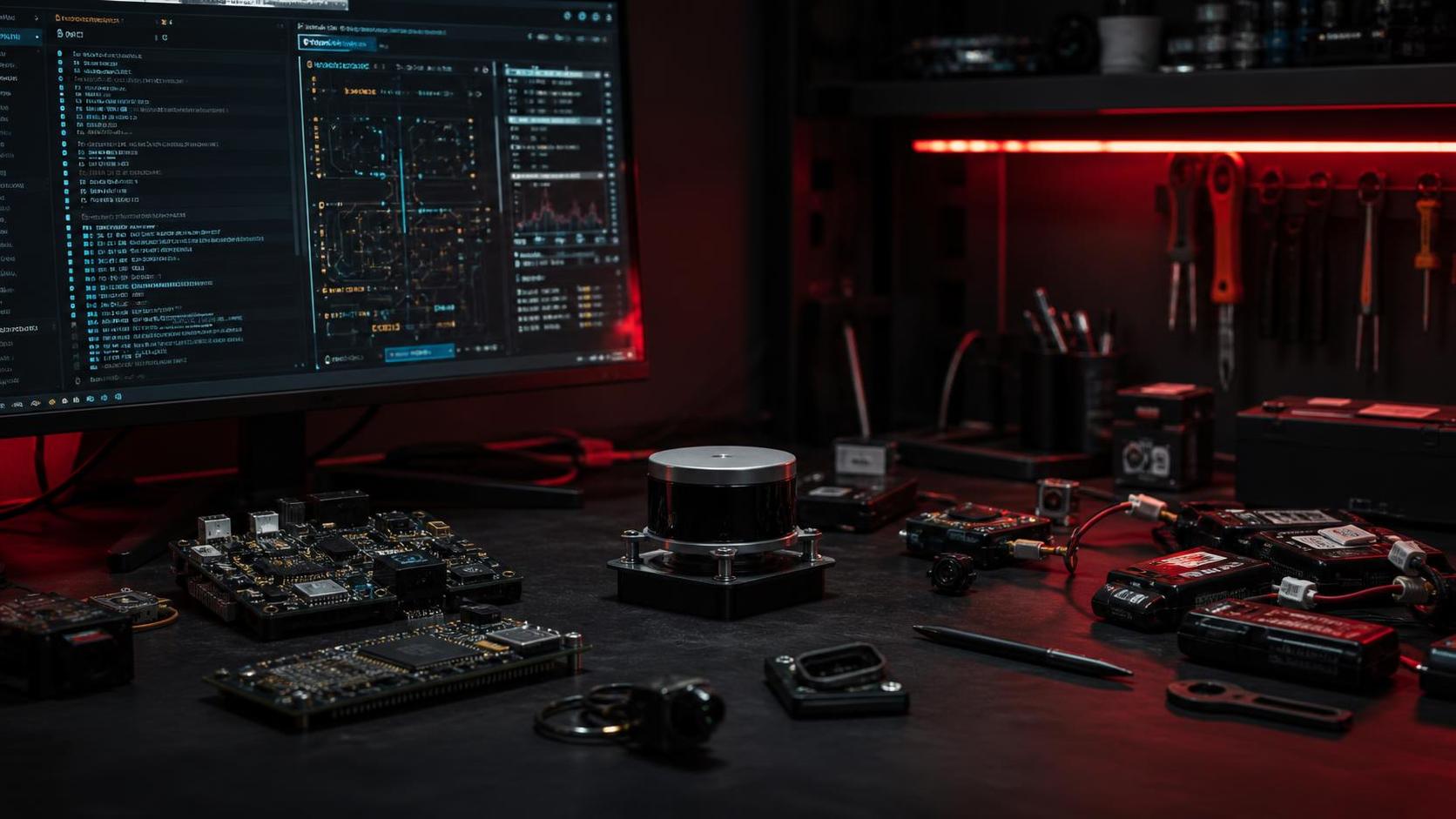 AI-generated image
Cheap robot learning hardware shifts attention from polished demos to repeatable training loops and failure recovery. Source: Biped.News editorial illustration.
The Reality Check
Microduck should not be confused with a household robot. Axios notes it is about 10 inches tall, 5.5 inches wide, and less than 2 pounds. Pollen lists the robot as 25 cm tall and built around play, training, and retraining. The company’s own framing is not that it will clean houses or staff warehouses. It is meant to move, fall, learn, and be taught new tricks.
That limitation is a strength if the expectations stay honest. The humanoid market is full of companies using impressive clips to imply near-term labor replacement. Microduck comes from the other direction. It makes failure part of the product. Fall recovery is a feature. Spare motors are an accessory. Simulation mismatch is not hidden, it is the workflow.
The hard question is whether playful biped data transfers upward. A 25 cm robot has different mass, inertia, contact dynamics, actuator loads, and safety constraints than a full-size humanoid. A policy that works on a desk robot will not simply scale to a 60 kg factory platform. But developers trained on Microduck will still learn how policies fail, how sensors lie, how floors vary, and how small mechanical changes change behavior. That human learning may matter as much as the robot data.
What To Watch
- Whether the GitHub stack is complete enough for independent policy training.
- Whether deliveries before Christmas meet the preorder target.
- Whether community policies become a real library or only a launch novelty.
- Whether failures produce useful public data about repair rates, motors, batteries, and gait robustness.
Why It Fits the Physical AI Moment
The robotics market is splitting into two tracks. One track is enterprise deployment: named customers, pilot sites, uptime dashboards, safety approvals, and capital-heavy manufacturing. The other is developer enablement: cheaper hardware, simulation, open models, shared datasets, and community experimentation. Both are needed. Enterprise deployments prove economic value. Developer platforms create the broad talent base and messy experimentation that large companies rarely publish.
Microduck sits squarely on the second track. It will not answer whether humanoids can replace repetitive labor in logistics. It can help more people understand the core problems underneath that question. Biped locomotion is hard even when the robot is tiny. Grabbing small objects with a beak-shaped gripper is still contact-rich manipulation. Recovering from a fall is still whole-body control. Training in simulation and deploying on hardware is still sim-to-real.
That makes the launch more consequential than the product’s size suggests. If Hugging Face and Pollen can ship real units, keep the stack open, and sustain a developer community, Microduck could become one of the first widely owned bipedal robot learning platforms. It would be less a consumer gadget than a training ground for the next wave of robot builders.
FAQ
Is Microduck a humanoid robot?
No. It is a small duck-like biped. It matters to humanoid robotics because it uses legs, balance, sensors, reinforcement learning, and sim-to-real training, which overlap with larger biped platforms.
How much does Microduck cost?
Pollen Robotics lists Microduck at $399 before taxes and shipping. Accessories and spare parts are sold separately.
Can it do household chores?
Not in a serious way. It is small, playful, and built for developer experimentation. Its value is teaching, retraining, and testing robot learning workflows.
Why does open source matter here?
Open code, simulation, and policy training let developers inspect and modify the robot’s behavior. That can make experiments easier to reproduce and compare.
The Bottom Line
Microduck is not the robot that proves the commercial humanoid market. It is the robot that asks whether bipedal physical AI can become cheap enough, open enough, and repairable enough for many more people to touch the problem directly. That is a different kind of milestone.
For a category chasing billion-dollar factories and national industrial policy, a $399 waddling developer robot might look small. But the robotics field needs more than flagship machines. It needs shared platforms, visible failures, practical training loops, and builders who learn by breaking real hardware. Microduck is small hardware with a serious premise: the next robotics wave may need an open-source bench before it gets a scalable factory floor.